<?xml version="1.0" encoding="UTF-8"?>
<feed xmlns="http://www.w3.org/2005/Atom">
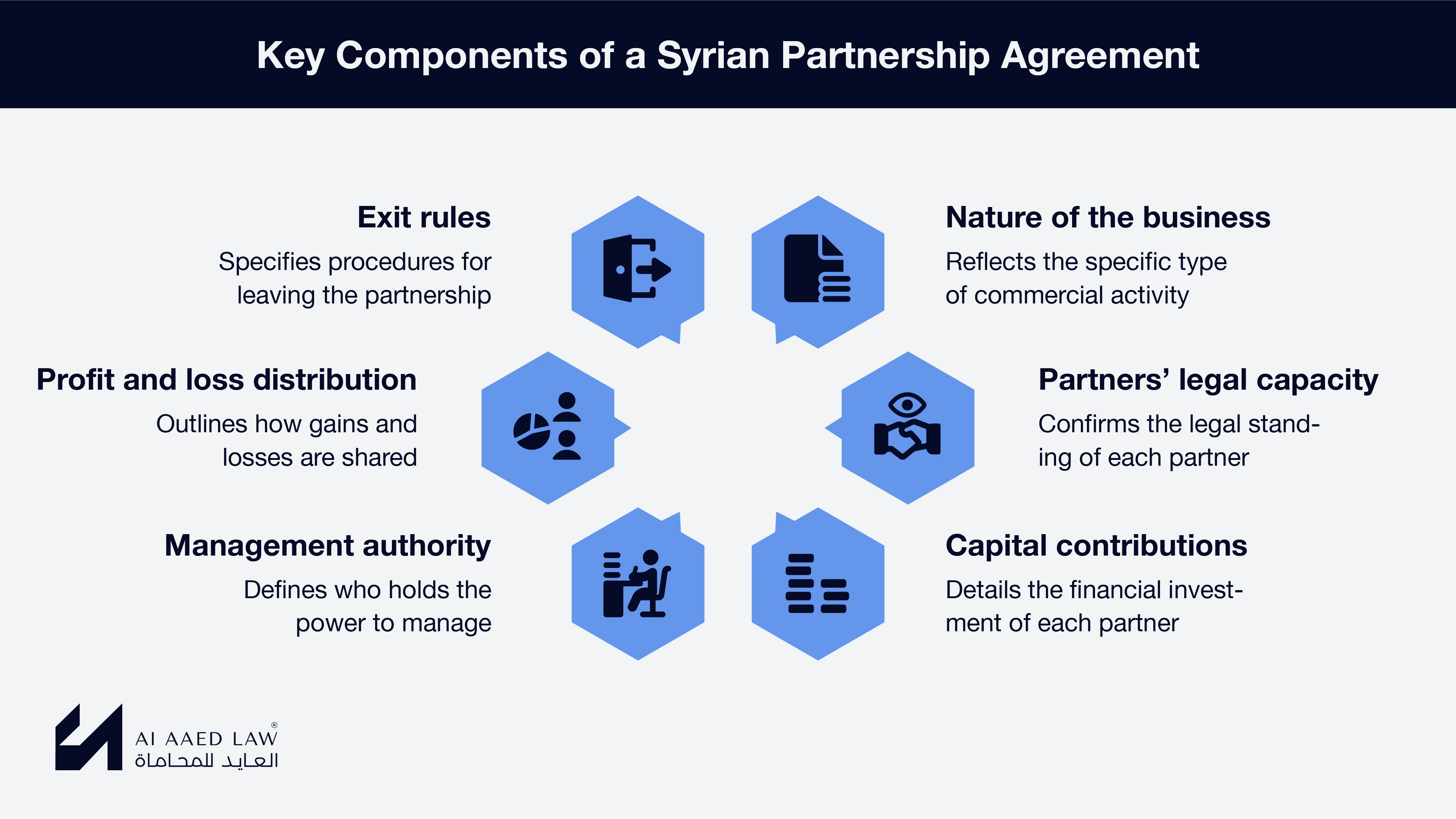
  <title>Al Aaed Law — Insights &amp; Legal Articles</title>
  <subtitle>Latest legal insights, analysis, and scholarly articles from Al Aaed Law.</subtitle>
  <link href="https://www.alaaedlaw.com/en/insights" />
  <link href="https://www.alaaedlaw.com/atom.xml" rel="self" type="application/atom+xml" />
  <id>urn:uuid:alaaedlaw:atom:combined</id>
  <updated>2026-08-13T08:44:34.709Z</updated>
  <logo>https://www.alaaedlaw.com/email-assets/al-aaed-logo.png</logo>
  <entry>
    <title>Partnership Agreement in Syria: A Legal Guide to Protecting Partners and Organizing Business Relationships</title>
    <link href="https://www.alaaedlaw.com/en/insights/partnership-agreement-in-syria" />
    <id>https://www.alaaedlaw.com/en/insights/partnership-agreement-in-syria</id>
    <published>2026-08-10T11:39:47.730966+00:00</published>
    <updated>2026-08-13T08:12:54.149575+00:00</updated>
    <category term="business" />
    <summary>A partnership agreement is a document confirming that two or more people agreed to pursue a business venture together. It explains how the partnership operates rather than list the partners and their ownership interests.</summary>
    <content type="html"><![CDATA[
      <img src="https://qqzmfnzeoktzgqeugipq.supabase.co/storage/v1/object/public/assets/insights/1786362891639-b83wev.webp" alt="Partnership Agreement in Syria: A Legal Guide to Protecting Partners and Organizing Business Relationships" />
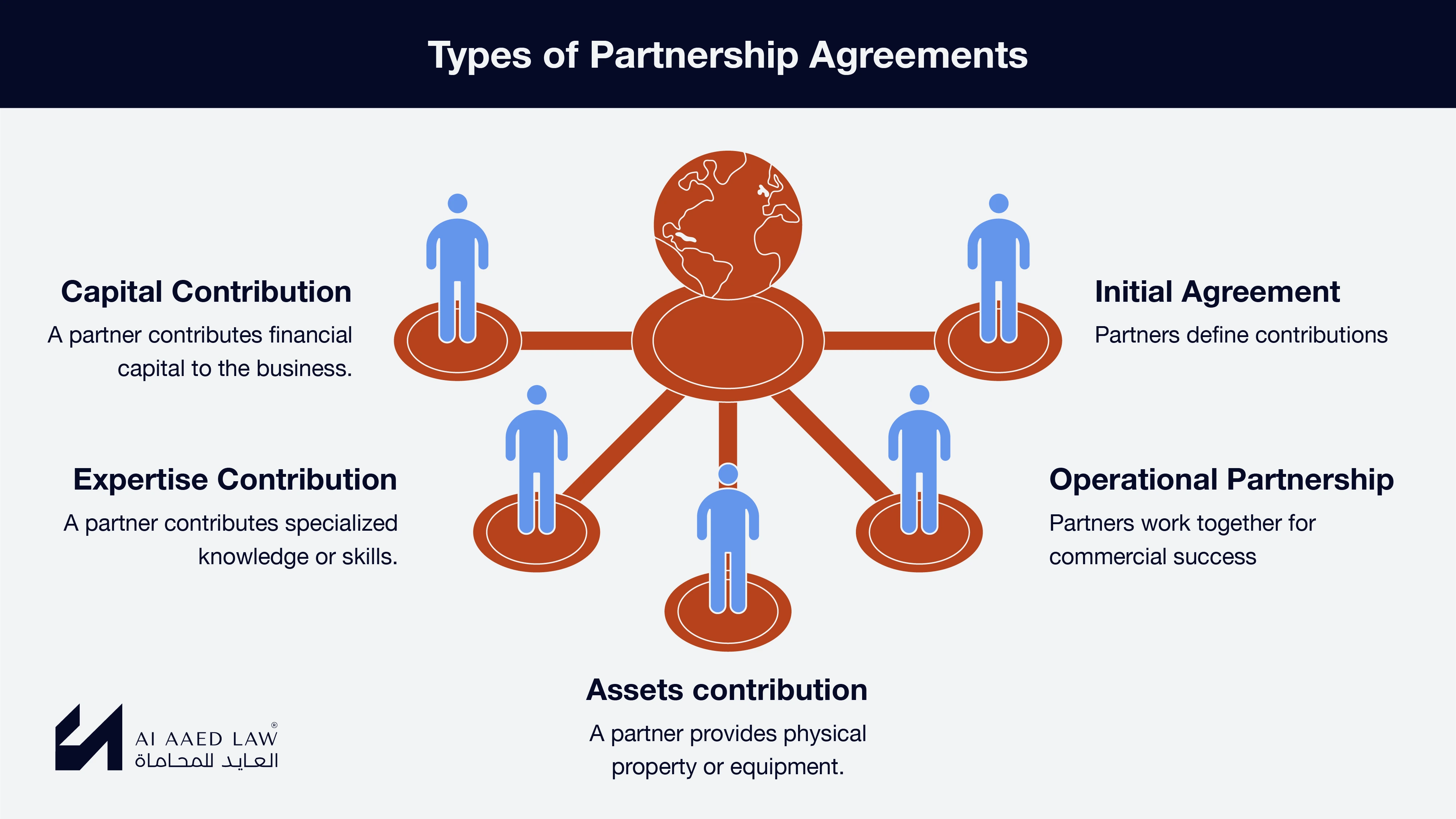
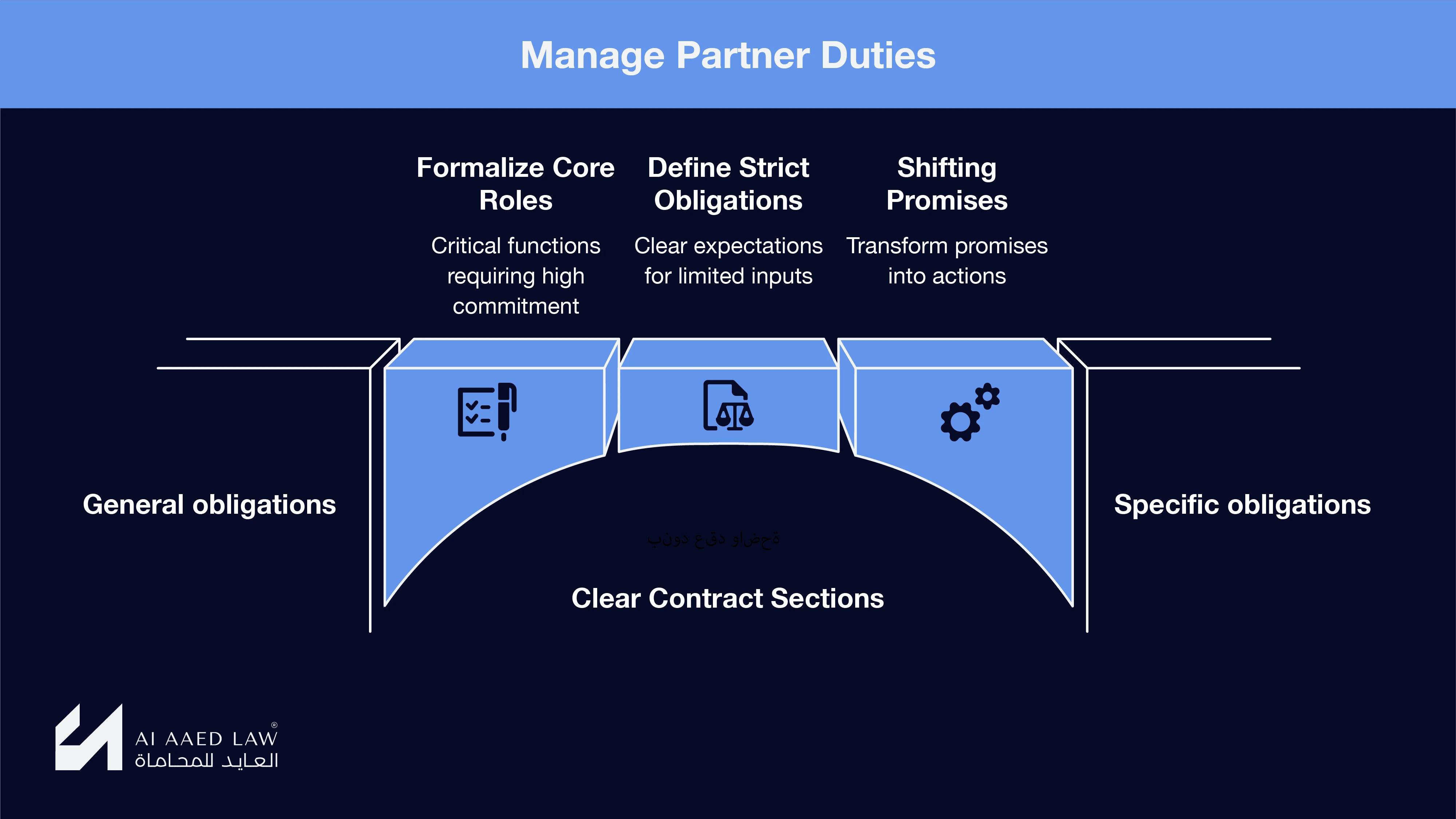
      <div>A partnership agreement is more than a document confirming that two or more people have agreed to pursue a business venture together. Its real value becomes clear when money starts coming in, expenses arise, partners’ circumstances change, or disagreements emerge over management or profits. A well-drafted agreement should therefore explain how the partnership will operate rather than simply list the partners and their respective ownership interests.</div><div>In Syria, a partnership agreement requires careful drafting that reflects the nature of the business. It also drafts the legal capacity of the partners, capital contributions, management responsibilities, profit and loss distribution, and mechanisms for exiting the venture. This guide explains the practical provisions that can help prevent disputes before they arise. However, it does not replace legal advice tailored to the circumstances of a particular business.</div><div><br></div><h2>Partnership Agreements and Their Role in Business Relationships</h2><div>A partnership agreement defines the legal and financial relationship between partners involved in a project or business activity. Its purpose goes beyond proving that a partnership exists. It establishes who has decision-making authority, who provides funding, who performs specific responsibilities, how profits are calculated, and what happens if a partner fails to meet their obligations or decides to leave. The clearer the agreement, the less the partners need to rely on verbal expectations and informal promises.</div><h3>Partnership Between Two Individuals vs. a Commercial Partnership</h3><div>A partnership between two individuals may begin with a relatively simple agreement to finance a project or manage a specific activity. A commercial partnership, however, is generally connected to an ongoing business with customers, suppliers, liabilities, and potentially <a href="/en/practice-areas/company-establishment" target="_blank" rel="noopener noreferrer">commercial registration</a> or a separate corporate structure.</div><div>The practical differences can affect liability toward third parties, evidence of the parties’ rights, taxation, decision-making powers, and the process for settling each partner’s rights when the relationship ends.</div><h3>Types of Partnership Agreements for Commercial Businesses</h3><div><p><img src="https://qqzmfnzeoktzgqeugipq.supabase.co/storage/v1/object/public/assets/insights/1786362749590-uwstxk.webp" alt="Types of Partnership Agreements for Commercial Businesses"></p><p><span style="font-family: &quot;Tenor Sans&quot;, sans-serif; color: rgb(255, 255, 255); font-size: 0.875rem;">Partnership agreements vary according to the nature of each party’s contribution. A partnership may involve capital only, expertise and management, an individual partnering with a company, two companies working together, or an arrangement intended to precede the formal incorporation of a company.</span></p></div><div>Each structure can have different implications for management and risk. For example, a partnership in which one party manages day-to-day operations may require stronger reporting and oversight provisions than a passive investment partnership.</div><div><br></div><h2>Key Terms and Conditions of a Partnership Agreement</h2><div><p><img src="https://qqzmfnzeoktzgqeugipq.supabase.co/storage/v1/object/public/assets/insights/1786362779113-r1500n.webp" alt="Key Terms and Conditions of a Partnership Agreement"></p></div><div>The strength of a partnership agreement depends on the clarity of the provisions governing the relationship between the parties, not simply on having a written document. The agreement should address the essential issues concerning the business, contributions, rights, and obligations while ensuring that the necessary legal and practical requirements are considered before signing.</div><h3>Essential Clauses in a Partnership Agreement</h3><div>Essential provisions typically include the partners’ details, description of the business activity, value of contributions, ownership interests, management arrangements, bank accounts, distribution of profits and losses, each party’s obligations, confidentiality, non-compete provisions, withdrawal, liquidation, and <a href="/en/practice-areas/dispute" target="_blank" rel="noopener noreferrer">dispute resolution</a>.</div><div>These clauses should be capable of practical application rather than relying on broad statements such as agreeing to cooperate in good faith or distributing profits by mutual agreement.</div><h3>Legal and Practical Conditions to Review Before Signing</h3><div>Among the key conditions of a partnership agreement are that its subject matter is lawful and clearly defined, each partner’s contribution is specified, the allocation of profits and losses can be determined, and every party has the necessary legal capacity to enter into the agreement.</div><div>It is also important to confirm that a person signing on behalf of a company or other business entity has the necessary legal authority. A lack of proper authority can create significant disputes later.</div><div><br></div><h2>Capital, Ownership Interests, Profits, and Losses</h2><div>Financial arrangements are among the most common sources of disagreement between partners, making it important to define them carefully from the outset. The partnership agreement should specify the value of each partner’s contribution and ownership interest, as well as the method used to calculate and distribute profits and determine how losses will be borne.</div><h3>Defining Capital and Partners’ Ownership Interests</h3><div>Simply stating the amount of capital is not enough. The agreement should explain how and when the capital will be contributed, its source where relevant, and whether the contribution consists of cash, assets, equipment, or professional services.</div><div>Where non-cash assets are contributed, they should be valued using a clear method. Overvaluing an asset can distort ownership interests and affect both profit distributions and liquidation. A signed schedule setting out each partner’s contributions can provide greater clarity.</div><h3>Distribution of Profits and Losses Between Partners</h3><div>Profit distribution should be linked to a defined accounting mechanism. The agreement should establish when accounts are closed, which expenses are recognized, whether reserves will be maintained, and whether profits will be distributed in cash or retained for business expansion.</div><div>The agreement should also specify how losses are allocated between the partners according to the nature and legal structure of the partnership. Ambiguity on this issue can quickly lead to disputes.</div><div><br></div><h2>Management, Decision-Making, and Partner Responsibilities</h2><div>Ownership percentages alone do not determine who manages the business or has authority to make decisions. A partnership agreement should clearly establish management powers alongside each partner’s responsibilities and obligations, reducing the risk of overlapping authority or disputes over accountability.</div><h3>Management Powers and Decision-Making</h3><div>A well-drafted agreement distinguishes between day-to-day management and major business decisions. A manager may have authority to make purchases and enter into contracts within specified financial limits, while decisions such as borrowing money, selling a major asset, changing the nature of the business, admitting a new partner, or entering into long-term commitments may require special approval.</div><div>Defining voting procedures and the required approval thresholds can help prevent both operational deadlock and unilateral decision-making.</div><h3>Responsibilities and Legal Obligations of Each Partner</h3><div><p><img src="https://qqzmfnzeoktzgqeugipq.supabase.co/storage/v1/object/public/assets/insights/1786362809577-an2l0m.webp" alt="Responsibilities and Legal Obligations of Each Partner"></p><p><span style="font-family: &quot;Tenor Sans&quot;, sans-serif; color: rgb(255, 255, 255); font-size: 0.875rem;">The agreement should clarify whether a partner is required to commit a specific amount of working time, provide funding, manage client relationships, oversee operations, or contribute specialist expertise.</span></p></div><div>It should also establish the consequences of failing to meet those obligations. Depending on the arrangement, these may include compensation, reduced authority, removal from management, or the purchase of the partner’s interest. Vague commitments are difficult to enforce, so promises should be converted into clear and measurable contractual obligations.</div><div><br></div><h2>Partner Withdrawal, Exit, and Dispute Resolution</h2><div>A partnership agreement should address potential disagreements and the departure of a partner before either situation occurs. Clear procedures for withdrawal, valuation of ownership interests, and dispute resolution can help preserve business continuity and reduce the impact of personal or commercial disagreements on operations.</div><h3>Withdrawal and Exit Clauses</h3><div>A partner’s departure should not leave the business in uncertainty. The agreement should specify the required notice period, how the departing partner’s interest will be valued, whether the remaining partners have a right of first refusal, how payment will be made, and how existing debts will be handled.</div><div>It may also need to address the departing partner’s use of customer relationships, confidential information, or business data after leaving. These provisions are particularly important when one partner maintains the primary relationship with major customers or suppliers.</div><h3>Dispute Resolution Between Partners</h3><div><a href="https://www.arab-reform.net/project/supporting-civil-society-and-conflict-resolution-in-syria/" target="_blank" rel="noopener noreferrer" data-linked-url="https://www.arab-reform.net/project/supporting-civil-society-and-conflict-resolution-in-syria/" style="font-family: &quot;Tenor Sans&quot;, sans-serif; font-size: 0.875rem;">Dispute resolution</a><span style="font-family: &quot;Tenor Sans&quot;, sans-serif; font-size: 0.875rem;">&nbsp;</span>&nbsp;may begin with written negotiation, followed by&nbsp;<a href="https://www.thecairoreview.com/essays/lessons-from-mediating-the-syria-conflict/" target="_blank" rel="noopener noreferrer" data-linked-url="https://www.thecairoreview.com/essays/lessons-from-mediating-the-syria-conflict/">mediation</a>&nbsp;&nbsp;or a formal notice, and ultimately litigation or arbitration where appropriate for the relationship.</div><div>The agreement should identify relevant matters such as the applicable law, competent court or agreed dispute resolution forum, language, and method or address for formal notices. A clear dispute resolution process can save time and money while preventing an operational disagreement from bringing the entire business to a standstill.</div><div><br></div><h2>Drafting and Authentication of a Partnership Agreement in Syria</h2><div>Clear legal drafting and appropriate authentication can strengthen the partners’ ability to establish their rights and rely on the agreement if a dispute arises. Partners should therefore consider both how the partnership agreement is prepared. They should agree whether authentication is appropriate, while avoiding drafting mistakes that could make important provisions ambiguous or difficult to enforce.</div><h3>Authentication of Partnership Agreements</h3><div>Authentication becomes particularly important. This is especially where the partnership involves substantial amounts of money, valuable assets, real estate, licenses, major suppliers, or dealings with government authorities and banks.</div><div>Authentication doesn't correct weak drafting, but it can strengthen the evidentiary value of the agreement. It can also reduce the possibility of disputes over signatures or the date of the agreement. The document should therefore be reviewed from both legal and financial perspectives before authentication.</div><h3>Common Partnership Agreement Drafting Mistakes</h3><div>Common mistakes include relying on a generic template found online, failing to establish a method for valuing ownership interests. This leave signing authority undefined, confusing revenue with profit, failing to address losses, and neglecting to establish an exit mechanism.</div><div>Another mistake is treating trust as a substitute for a written agreement. Trust is important in any business relationship, but it does not determine who bears a debt or who has decision-making authority when a disagreement occurs.</div><h3>The Role of a Lawyer in Drafting a Partnership Agreement</h3><div>A lawyer’s role begins with understanding the business model, source of funding, relationship between the partners, relevant risks, and the commercial objective of the partnership.</div><div>The lawyer can then translate these arrangements into enforceable contractual provisions and review their compatibility with Syrian law and applicable commercial obligations. Legal advice can also help determine whether a partnership agreement is sufficient for the proposed arrangement or whether the business should establish a separate company.</div><div><br></div><h2>Reviewing a Partnership Agreement Before Signing</h2><div>Before signing, each partner should review the agreement from both a practical and legal perspective rather than focusing only on ownership percentages and expected profits. The review should cover several parts. This includes actual contributions, decision-making powers, financial obligations, exit mechanisms, and dispute resolution. That way, every party understands the consequences of the agreement from the outset.</div><h3>Practical Considerations Before Signing</h3><div>Before signing a partnership agreement between two parties, request a clear record of contributions and obligations, review applicable taxes and licensing requirements, establish accounting procedures, avoid granting unrestricted authority, and make sure the agreement contains fair exit provisions.</div><div>If the partnership will conduct business with third parties under an established commercial name, the partners should also consider whether establishing a company would provide a more appropriate legal structure for organizing the relationship and conducting the business.</div>
    ]]></content>
  </entry>
  <entry>
    <title>Company Formation in Syria: Legal Steps and Core Requirements to Start Your Business</title>
    <link href="https://www.alaaedlaw.com/en/insights/company-formation-in-syria" />
    <id>https://www.alaaedlaw.com/en/insights/company-formation-in-syria</id>
    <published>2026-08-06T10:52:27.78106+00:00</published>
    <updated>2026-08-13T08:12:46.07383+00:00</updated>
    <category term="business" />
    <summary>Company formation in Syria starts before any application is filed. The most important decision is the legal structure that fits the activity, risk level, funding model, and number of partners. A wrong choice may create unexpected liability, make it harder to add investors, delay licensing, or complicate dealings with banks and public authorities.</summary>
    <content type="html"><![CDATA[
      <img src="https://qqzmfnzeoktzgqeugipq.supabase.co/storage/v1/object/public/assets/insights/1786014423084-7bx8rb.webp" alt="Company Formation in Syria: Legal Steps and Core Requirements to Start Your Business" />
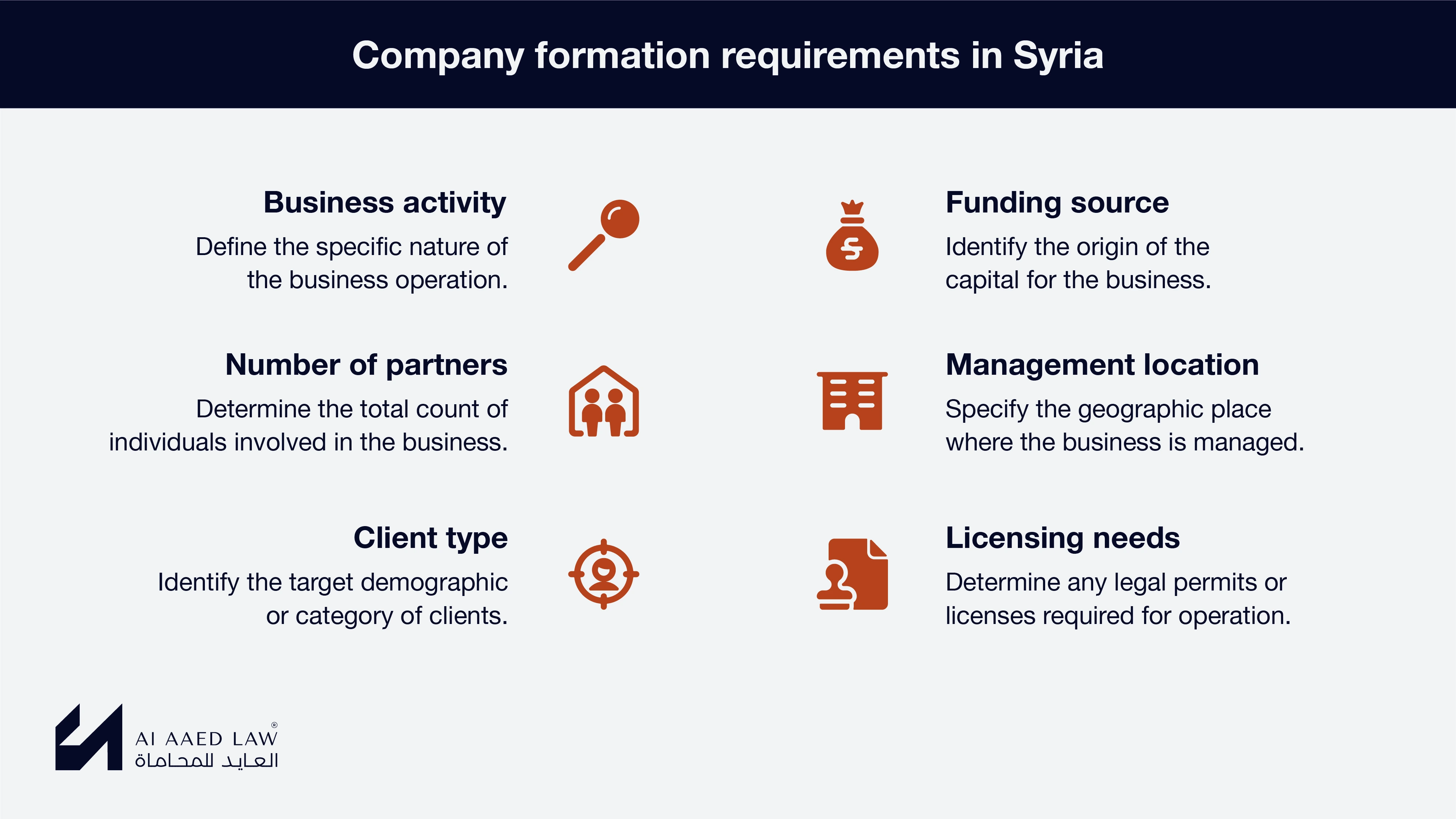
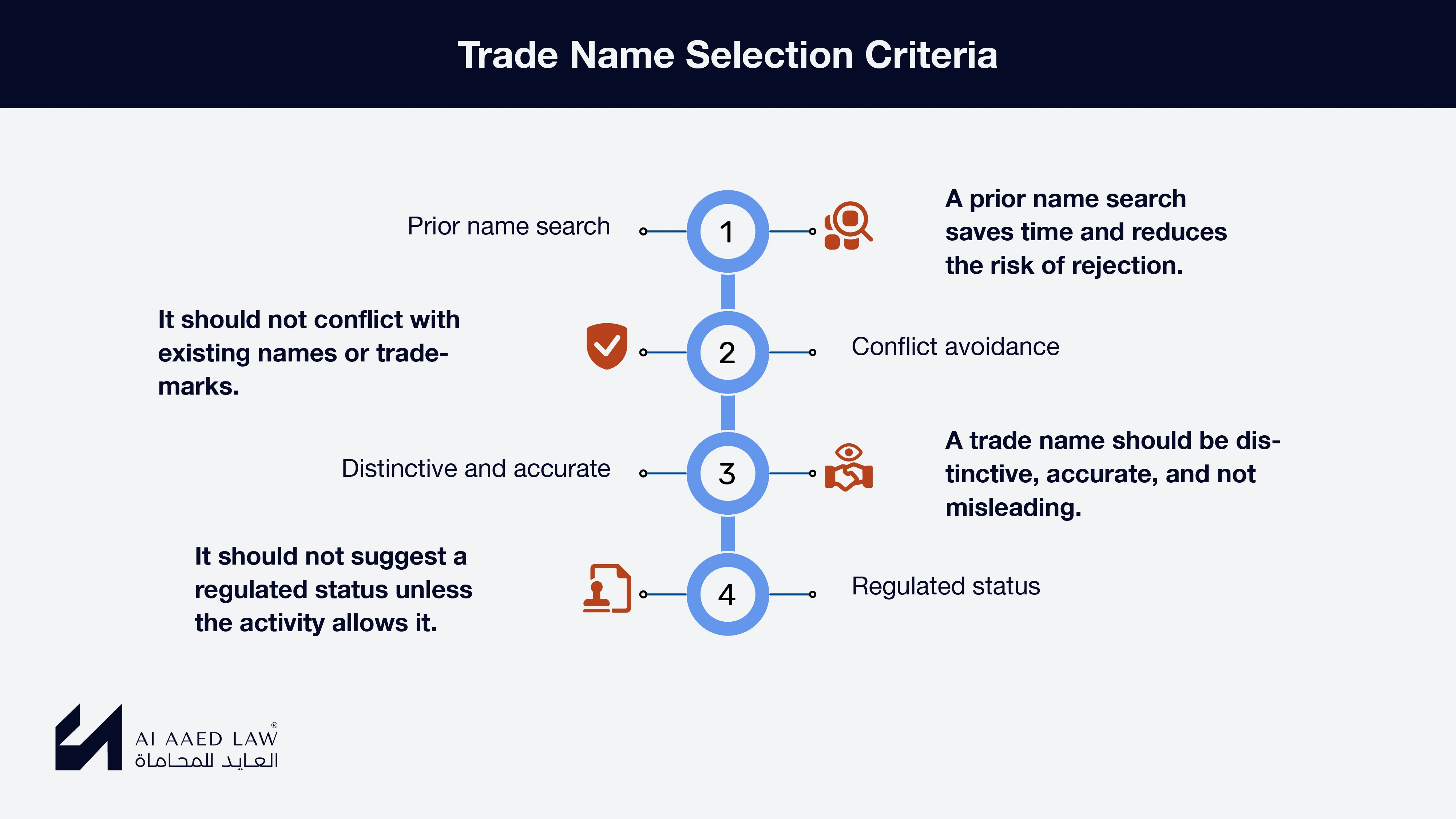
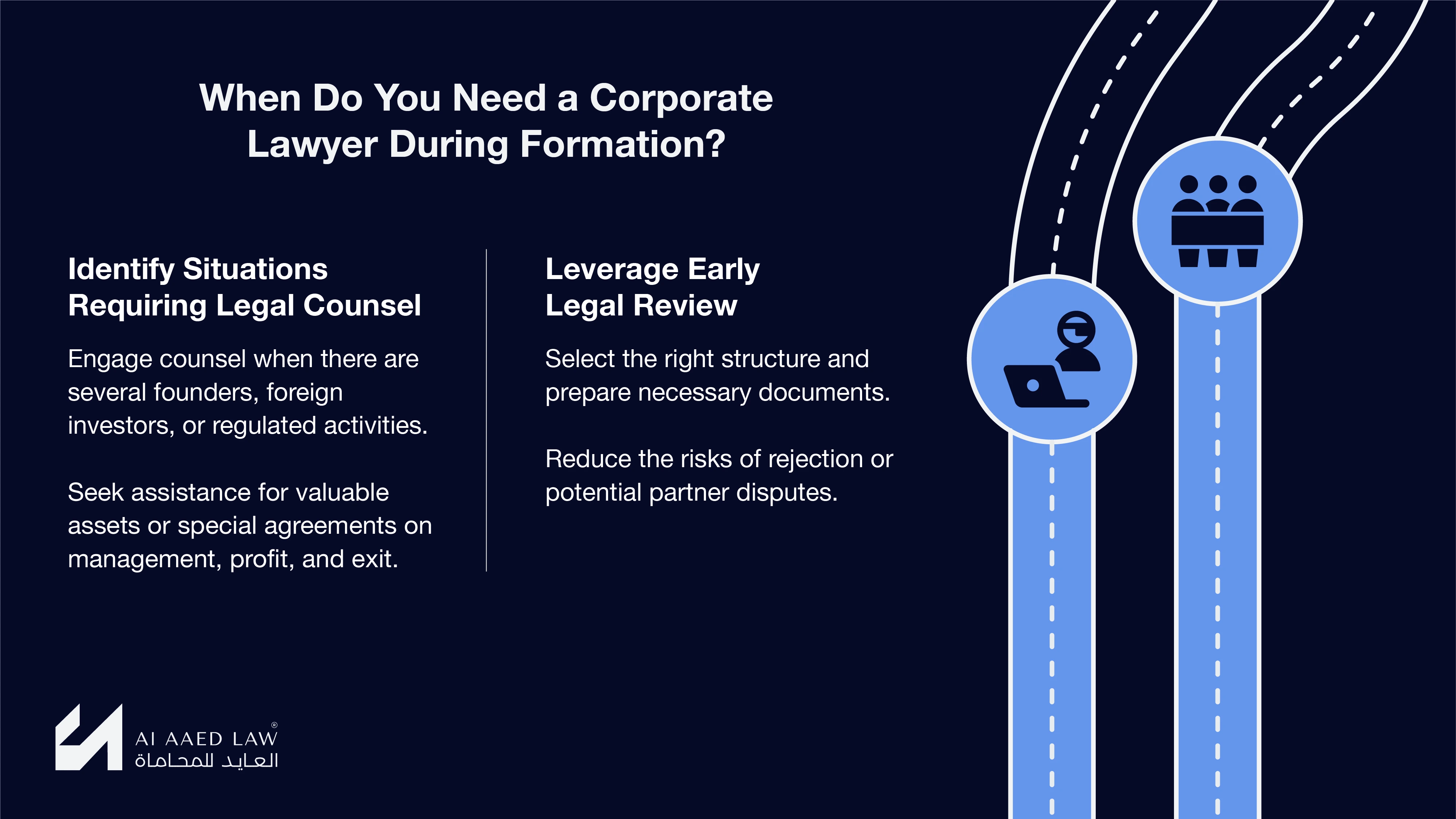
      <div>Company formation in Syria starts before any application is filed. The most important decision is the legal structure that fits the activity, risk level, funding model, and number of partners. A wrong choice may create unexpected liability, make it harder to add investors, delay licensing, or complicate dealings with banks and public authorities.<br><br></div><div>This guide explains the legal thinking behind incorporation, then moves to documents, procedures, and post formation duties. The aim is to help business owners build a company that can be registered and operated properly. Requirements may differ depending on the activity and current administrative practice.</div><div><br></div><h2>What Should You Know Before Company Formation in Syria?</h2><div>Before company formation in Syria, the founder should define&nbsp;<a href="https://www.alaaedlaw.com/en/insights/types-of-companies-in-syrian-law" target="_blank" rel="noopener noreferrer" data-linked-url="https://www.alaaedlaw.com/en/insights/types-of-companies-in-syrian-law">the type of company</a>&nbsp;&nbsp;they would like to start. They should define the business activity, funding source, number of partners, management location, client type, and any licensing needs. Some activities may fit a sole establishment, while others require a company because of partners, assets, financing, or the need to separate business risk from personal assets.</div><div><span style="font-family: &quot;Tenor Sans&quot;, sans-serif; font-size: 1.2rem; font-weight: 600;">Choosing the Right Legal Structure</span></div><div>The legal structure is not just a label. It affects liability, management, share transfer, tax treatment, and required disclosures. Common options include partnerships,&nbsp;<a href="https://sig-sy.com/en/establishing-a-limited-liability-company-in-syria/" target="_blank" rel="noopener noreferrer" data-linked-url="https://sig-sy.com/en/establishing-a-limited-liability-company-in-syria/">limited liability companies</a>&nbsp;, joint stock companies, and sole establishments. The right choice depends on risk, capital, partners, and future expansion.</div><h3>Company Formation Conditions in Syria for Business Owners</h3><div>General conditions include legally capable founders, a lawful activity, a registrable trade name, proper articles or bylaws, a company address, and clear details on capital and management. Certain activities may also require sector approvals before or after commercial registration.</div><h3>The Difference Between Forming a Company and a Sole Establishment in Syria</h3><div>A sole establishment in Syria may suit a small activity operated by one person, often with direct responsibility for obligations. A company offers a better structure when there are partners, assets, funding, or larger contracts. Depending on the structure, it may create a separate legal personality.</div><div><br></div><h2>Preparing for Company Formation</h2><div>Once you have selected the appropriate business structure, the next step is preparing the legal and administrative requirements needed for registration. Proper preparation helps avoid delays and reduces the likelihood of rejected applications.</div><h3>Documents Required for Company Formation</h3><div><p><img src="https://qqzmfnzeoktzgqeugipq.supabase.co/storage/v1/object/public/assets/insights/1786014153083-fa8bqr.webp" alt="company formation requirements in Syria"></p></div><div>Required documents differ by company type and activity. They often include founder details, identity or representation documents, articles of association, bylaws where needed, address evidence, manager details, capital or share information, and any sector approvals. Foreign documents may require translation and legalization.</div><h3>Defining Capital and Company Activity</h3><div>Capital should reflect initial operational needs and obligations, not only a formal number. The activity clause should be wide enough to support planned work but not so broad that it triggers unnecessary approvals. A narrow activity can restrict growth, while an unclear one can delay registration.</div><h3>Preparing the Articles of Association and Bylaws</h3><div>The articles identify founders, shares, management, purpose, capital, and registered office. Bylaws define governance, meetings, signing powers, controls, and share amendments. These documents matter later when adding a partner,&nbsp;<a href="https://www.alaaedlaw.com/en/practice-areas/dispute" target="_blank" rel="noopener noreferrer" data-linked-url="https://www.alaaedlaw.com/en/practice-areas/dispute">resolving a dispute</a>&nbsp;, obtaining financing, or selling a share.</div><h3>Choosing a Suitable and Registrable Trade Name</h3><div><p><img src="https://qqzmfnzeoktzgqeugipq.supabase.co/storage/v1/object/public/assets/insights/1786014193823-0v1f2h.webp" alt="Trade name selection criteria"></p></div><div>A trade name should be distinctive, accurate, and not misleading. It should not conflict with existing names or trademarks, and it should not suggest a regulated status unless the activity allows it. A prior name search saves time and reduces the risk of rejection.</div><div><br></div><h2>Company Registration Procedures in Syria</h2><div>After preparing the required documents, founders can begin the formal&nbsp;<a href="https://www.alaaedlaw.com/en/practice-areas/company-establishment" target="_blank" rel="noopener noreferrer" data-linked-url="https://www.alaaedlaw.com/en/practice-areas/company-establishment">company registration</a>&nbsp;&nbsp;process with the competent authorities. The exact procedure varies depending on the legal structure and business activity, but the overall process generally follows the same sequence.</div><h3>Registration Procedures Before the Competent Authorities</h3><div>Registration usually involves name review, document review, filing the articles, completing any approvals, entering the company or establishment in the competent register, and then handling tax and licensing steps. A consistent file reduces correction requests.</div><h3>Obtaining the Commercial Register and Required Licenses</h3><div>Commercial registration proves that the activity is recorded, but it does not always mean all operating licenses are complete. Some sectors require professional, industrial, health, municipal, or other approvals. The founder should separate entity formation from the legal right to operate the business.</div><h3>Tax and Accounting Duties After Formation</h3><div>After registration, the company must manage books, invoices, declarations, document retention, and any employee related registrations. Ignoring post formation duties can create fines, block expansion, or complicate investment, sale, or liquidation.</div><div><br></div><h2>Managing the Company After Formation</h2><div>Successfully registering a company is only the beginning. Clear governance arrangements and ongoing legal compliance are essential for stable business operations and future growth.</div><h3>Forming a Company Between Partners: What Should Be Organized?</h3><div>Partners should organize shares, management, voting, share transfers, non competition, additional funding, exit valuation, and profit distribution. They should also define who signs for the company and within what limits. These details matter more than simply agreeing on percentages.</div><h3>Legal Tips Before Starting Commercial Activity</h3><div>Before trading, review the trade name, register the trademark if needed, obtain licenses, organize supplier and customer contracts, and separate company accounts from personal accounts. Company documents should also be updated when partners, managers, or activities change.</div><div><br></div><h2>Common Challenges During Company Formation</h2><div>Many registration delays can be avoided through careful planning and proper legal guidance. Understanding the most common issues allows founders to complete the incorporation process more efficiently.</div><h3>Common Mistakes That Delay Company Formation</h3><div>Common mistakes include choosing an inaccurate activity, filing a name that can be challenged, inconsistent partner details, missing powers of attorney, unlegalized foreign documents, and failing to check sector licenses. Copying articles from another case can also create avoidable objections.</div><h3>When Do You Need a Corporate Lawyer During Formation?</h3><div><p><img src="https://qqzmfnzeoktzgqeugipq.supabase.co/storage/v1/object/public/assets/insights/1786014217589-eiuq6d.webp" alt="corporate lawyer"></p></div><div>A corporate lawyer is useful when there are several founders, foreign investors, regulated activities, valuable assets, or special agreements on management, profit, and exit. Early legal review helps select the right structure, prepare documents, and reduce rejection or partner dispute risks.</div>
    ]]></content>
  </entry>
  <entry>
    <title>Types of Companies in Syrian Law: A Guide to Choosing the Right Legal Structure</title>
    <link href="https://www.alaaedlaw.com/en/insights/types-of-companies-in-syrian-law" />
    <id>https://www.alaaedlaw.com/en/insights/types-of-companies-in-syrian-law</id>
    <published>2026-07-29T18:34:41.148191+00:00</published>
    <updated>2026-08-13T08:13:04.03515+00:00</updated>
    <category term="business" />
    <summary>Choosing a project&apos;s legal form determines liability, management authority, and how ownership transfers. This guide explains the five company forms under Syrian law and how to pick the right one.</summary>
    <content type="html"><![CDATA[
      <img src="https://qqzmfnzeoktzgqeugipq.supabase.co/storage/v1/object/public/assets/insights/company-types-syria-hero.webp" alt="Types of Companies in Syrian Law: A Guide to Choosing the Right Legal Structure" />
      <p>Choosing a project's legal form is not a formality. It determines the owners' liability for debts, who has management authority, how interests or shares may be transferred, and whether the business can attract investors or offer shares to the public. Business owners should therefore understand the <strong>types of companies in Syrian law</strong> before signing a partnership agreement or starting registration.</p>
<p>This guide explains the main legal forms, their practical differences, and the position of a sole establishment and a single-member company. Capital, fee, and sector-approval requirements should always be checked against the decisions in force when the company is formed.</p>
<h2>What Types of Companies Are Legally Recognized in Syria?</h2>
<p>Article 5 of Legislative Decree No. 29 of 2011, the Companies Law, limits the legal forms of Syrian companies to five:</p>
<ol><li>General partnership.</li><li>Limited partnership.</li><li>Joint venture company.</li><li>Limited liability company.</li><li>Joint-stock company.</li></ol>
<p>A sole establishment or individual commercial registration is a way for one natural person to conduct business, but it is not one of the five company forms listed in Article 5. It must also be distinguished from the <strong>single-member limited liability company</strong> permitted by Article 55 of the Companies Law.</p>
<h2>What Law Governs Companies in Syria?</h2>
<p>The main framework is <a href="https://homschamber.com/wp-content/uploads/2016/09/Law-29.pdf" target="_blank" rel="noopener noreferrer">Legislative Decree No. 29 of 2011, the Companies Law</a>, which replaced Companies Law No. 3 of 2008. It applies to companies formed in Syria unless they are established under a special law, with the Civil Code or Commercial Code applying to matters it does not regulate.</p>
<p>The Companies Directorate and company-register offices within the competent bodies of the <a href="https://mitcp.gov.sy/" target="_blank" rel="noopener noreferrer">Ministry of Economy and Industry</a> handle formation, publication, and amendments. As of this guide's review in July 2026, the Ministry had announced an electronic formation service for different company types. Documents, approvals, and fees may nevertheless vary by activity, governorate, and legal form, so the published instructions and forms should be checked when filing.</p>
<p>The availability of a legal form does not mean it can be used for every activity. Investment, banking, insurance, or regulated-profession laws may impose additional requirements or reserve an activity for a particular form.</p>
<h2>Partnerships and Capital Companies: What Is the Difference?</h2>
<p>This doctrinal and practical classification helps explain the importance of partner identity and capital:</p>
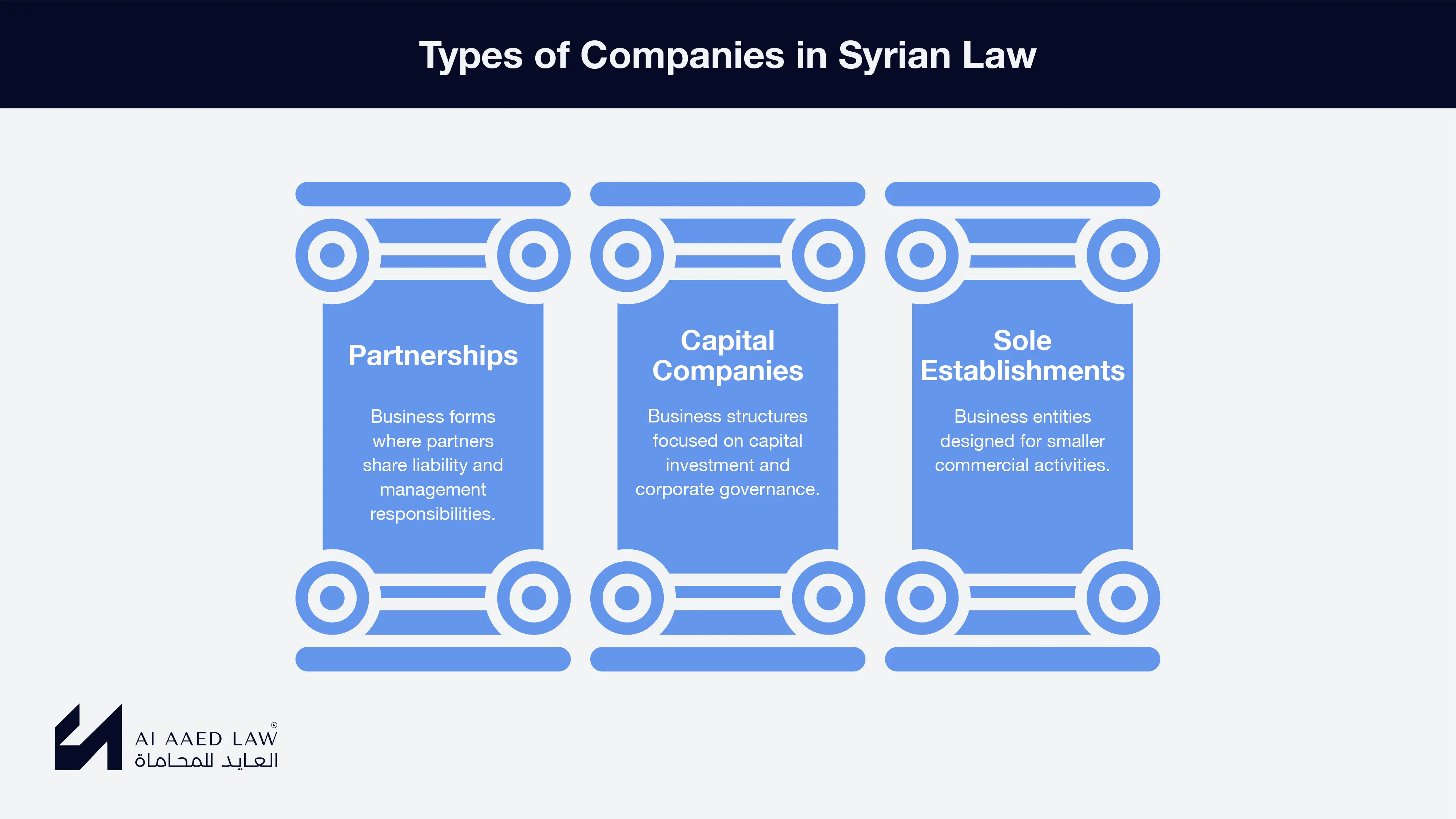
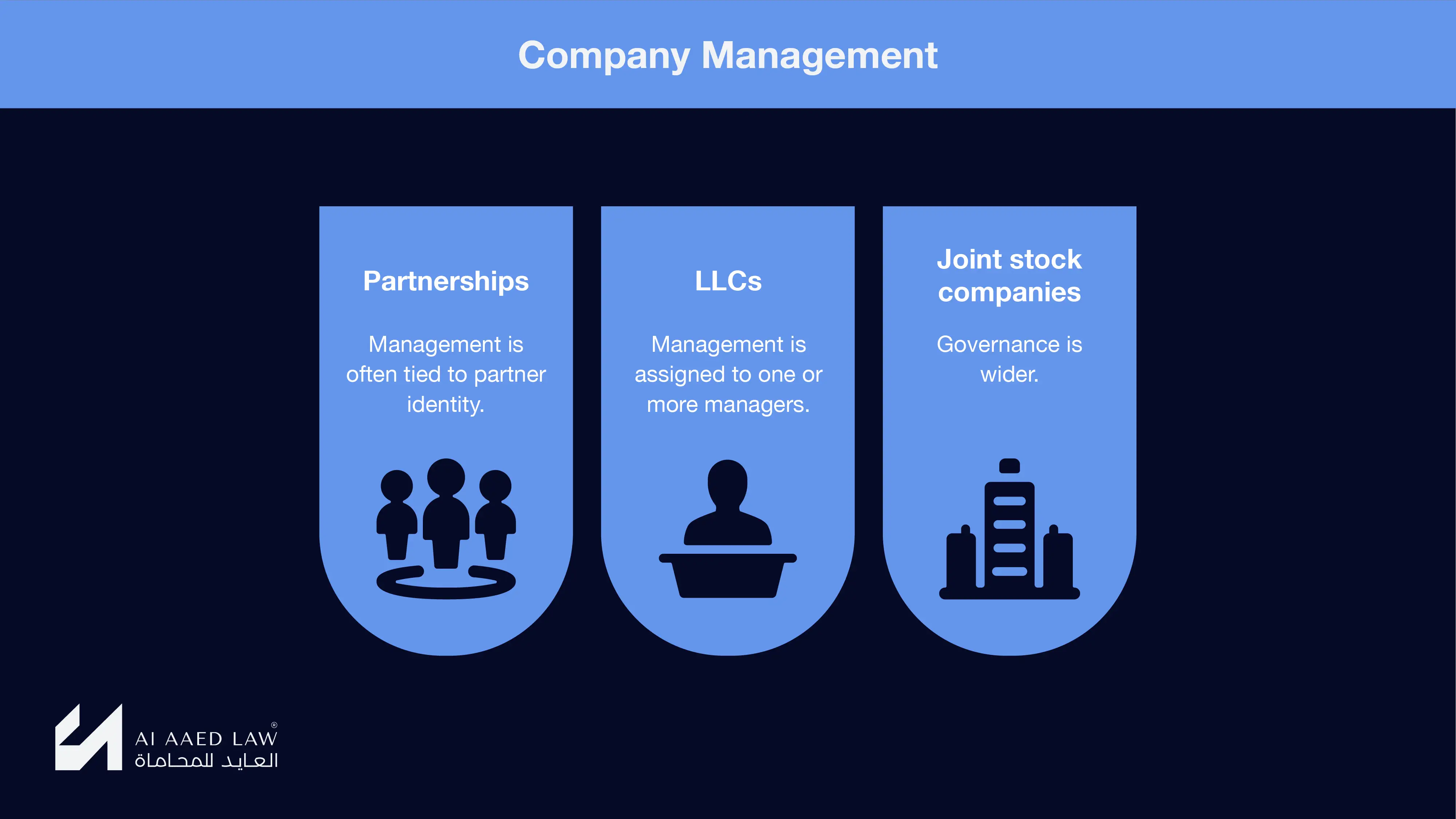
<ul><li><strong>Partnerships</strong> depend substantially on trust and the personal identity of the partners, as in a general or limited partnership. The admission, withdrawal, or transfer of a partner's interest is therefore more sensitive.</li><li><strong>Capital companies</strong> focus on capital, interests, or shares and on the entity's continuity. The joint-stock company is the clearest example.</li><li><strong>The limited liability company</strong> combines some practical features of both groups. Its capital is divided into interests and partner liability is limited in principle, but the transfer of interests and relations among partners remain more restricted than trading joint-stock shares.</li><li><strong>The joint venture company</strong> is an internal contractual relationship without legal personality or publication, so it has a special status.</li></ul>
<p>This classification is not a substitute for the rules governing each form, because liability, management, and transfer rights are not determined by the general category alone.</p>
<figure><img src="https://qqzmfnzeoktzgqeugipq.supabase.co/storage/v1/object/public/assets/insights/company-types-en-01.webp" alt="Types of companies in Syrian law: partnerships, capital companies, and sole establishments" style="max-width:100%;height:auto;" loading="lazy"></figure>
<h2>The Five Company Forms Under Syrian Law</h2>
<h3>1. General Partnership</h3>
<p>A general partnership consists of two or more partners, operates under a particular name, and makes its partners personally and jointly liable with all their assets for the company's obligations and debts. A partner in a commercial general partnership also acquires merchant status.</p>
<p>This form usually suits a directly managed project between partners who have a high degree of trust. Its central risk is that creditors may reach a partner's personal assets, and a contrary internal agreement does not protect that partner against third parties.</p>
<p>The partnership agreement should regulate, at a minimum, management powers, transactions requiring prior approval, profit and loss allocation, admission or withdrawal of partners, death or incapacity, and dispute resolution.</p>
<h3>2. Limited Partnership</h3>
<p>A limited partnership has two classes of partners:</p>
<ul><li>At least one general partner who may manage and is personally and jointly liable for company debts.</li><li>One or more limited partners who contribute capital, do not manage the company in dealings with third parties, and whose liability is limited in principle to their contributions.</li></ul>
<p>This form may suit a business that needs funding from an investor who does not wish to manage. The distinction between the two roles must be respected: including a limited partner's name in the company name or allowing that partner to intervene in external management may expand liability in the cases specified by law.</p>
<h3>3. Joint Venture Company</h3>
<p>A joint venture company is an agreement between two or more persons whose effect remains between them, while an apparent partner conducts business with third parties in that partner's own name. It has no legal personality and is not subject to the publication requirements imposed on other companies.</p>
<p>The internal agreement determines the partners' rights and obligations, its duration, how the activity is funded, and how profits and losses are shared. A third party's legal relationship is, in principle, with the partner who contracted with it.</p>
<p>This form is not a simple substitute for registration. If the company appears to third parties as a company, the law allows it to be treated as a de facto company and may impose joint liability on the partners. It should therefore not be used without a precise agreement and an analysis of dealings with customers and suppliers.</p>
<h3>4. Limited Liability Company</h3>
<p>An LLC consists of at least two persons, but it may be formed by one person as a <strong>single-member limited liability company</strong>. Each partner's liability is limited in principle to the interests held in the capital.</p>
<p>Capital is divided into interests of equal value. Those interests may not be publicly subscribed for, offered to the public, or listed on a securities market. One or more managers, whether partners or third parties, manage the company within the limits set by law and the articles.</p>
<p>An LLC is often suitable for small and medium-sized businesses and startups seeking a separate entity and clear ownership and management rules without joint-stock governance. Limited liability does not, however, prevent personal claims against a partner or manager arising from a personal guarantee, fraud, management fault, legal violation, or commingling of company and personal funds.</p>
<h3>5. Joint-Stock Company</h3>
<p>A joint-stock company's capital is divided into equal-value shares, and shareholder liability is limited to the nominal value of the shares held. The law divides this form into:</p>
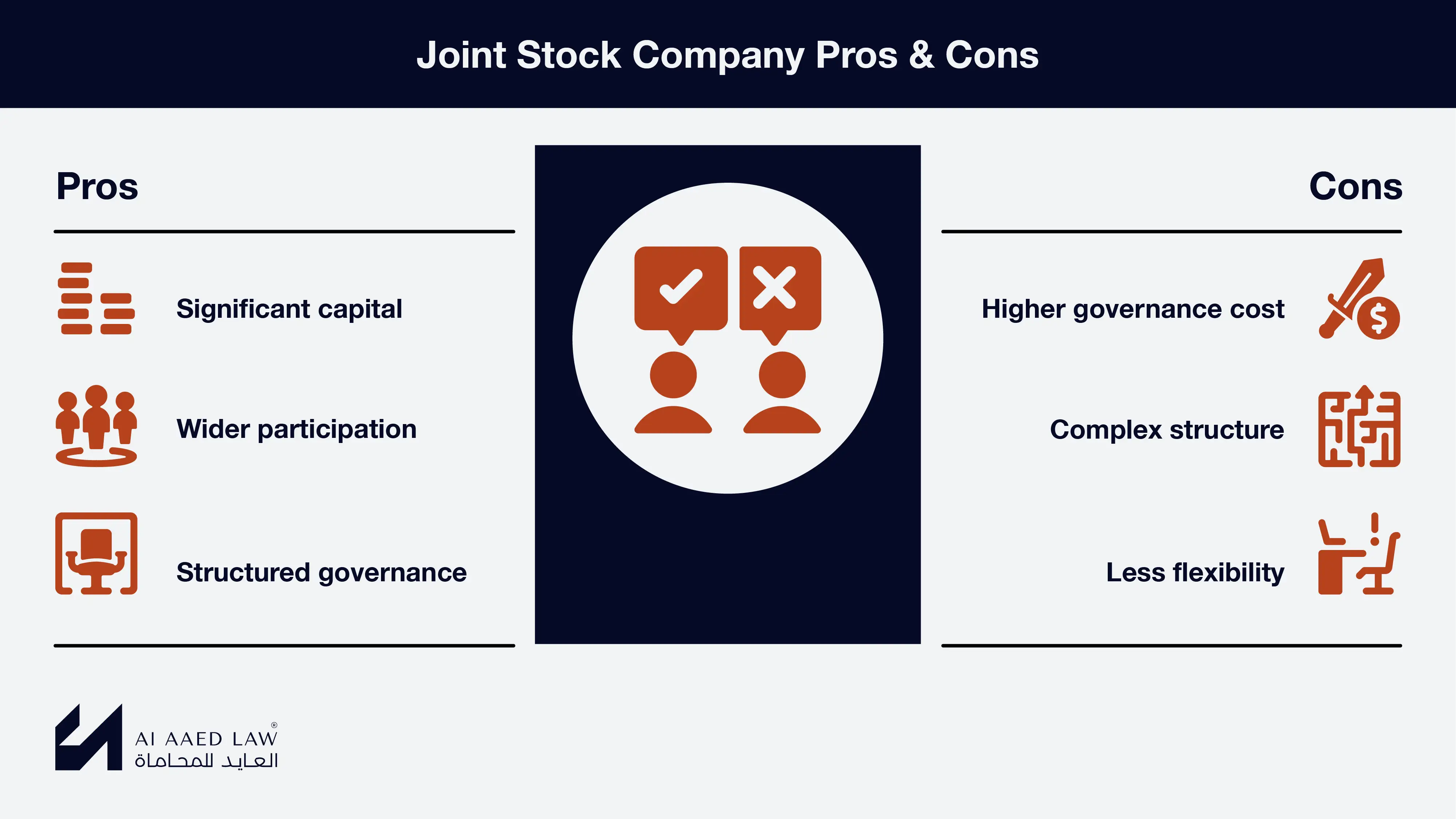
<ul><li><strong>Public joint-stock company:</strong> It has at least ten shareholders, and its shares may be traded and listed subject to the applicable laws and regulations.</li><li><strong>Private joint-stock company:</strong> It has at least three shareholders, and its founders subscribe to its capital under the formation rules without a public offering.</li></ul>
<p>A board of directors manages the company, which is subject to more structured general meetings, registers, resolutions, audits, and disclosures than an LLC. It therefore usually suits larger projects, a broader shareholder base, investment rounds, or a public offering when the company is public and satisfies securities requirements.</p>
<figure><img src="https://qqzmfnzeoktzgqeugipq.supabase.co/storage/v1/object/public/assets/insights/company-types-en-02.webp" alt="Joint stock company pros and cons in Syrian law" style="max-width:100%;height:auto;" loading="lazy"></figure>
<h2>Sole Establishment or Single-Member LLC?</h2>
<p>The difference is fundamental even though each has one owner:</p>
<ul><li><strong>Sole establishment:</strong> The owner registers as a merchant or business operator in the capacity of a natural person. An individual registration does not itself create a separate corporate barrier between that person and the business, so the business's obligations fall on the owner personally.</li><li><strong>Single-member LLC:</strong> This is a company under the Companies Law. After completing formation and publication, it has legal personality, and its owner's liability is limited in principle to the interest held, subject to exceptions concerning personal guarantees, violations, and mismanagement.</li></ul>
<p>A sole establishment may suit a low-risk small activity that does not need investors or partners. If contracts, debts, or operating liabilities are greater, a single-member LLC may be more suitable, provided the owner accepts the costs of formation, governance, and compliance.</p>
<h2>Comparison Table of Company Types in Syria</h2>
<div class="table-wrapper"><table><thead><tr><th>Form</th><th>Owners or partners</th><th>Liability in principle</th><th>Management</th><th>Publication and legal personality</th><th>Common use</th></tr></thead><tbody><tr><td>General partnership</td><td>Two or more</td><td>Personal and joint with all assets</td><td>Partners or a manager under the agreement</td><td>Published and acquires personality against third parties through publication</td><td>Project among partners with a high degree of trust</td></tr><tr><td>Limited partnership</td><td>At least one general and one or more limited partners</td><td>Unlimited for general partner; contribution limit for limited partner</td><td>General partners; limited partner does not manage externally</td><td>Subject to publication</td><td>Combining active management with non-managing partner finance</td></tr><tr><td>Joint venture company</td><td>Two or more</td><td>Third parties deal primarily with the apparent partner; joint liability may arise if the company appears</td><td>Internal agreement and apparent partner</td><td>No legal personality or publication</td><td>Internal contractual cooperation on a particular project after advice</td></tr><tr><td>Limited liability company</td><td>One, or two or more</td><td>Limited to interests in principle</td><td>One or more managers</td><td>Subject to formation and publication</td><td>Small, medium-sized, and startup businesses</td></tr><tr><td>Private joint-stock company</td><td>At least three shareholders</td><td>Nominal value of shares</td><td>Board of directors</td><td>Subject to formation, publication, and wider governance</td><td>Large or multi-investor projects</td></tr><tr><td>Public joint-stock company</td><td>At least ten shareholders</td><td>Nominal value of shares</td><td>Board of directors</td><td>Subject to governance, disclosure, and securities rules</td><td>Large projects that may need a public offering</td></tr><tr><td>Sole establishment</td><td>One natural-person owner</td><td>Personal and unlimited</td><td>Owner</td><td>Individual commercial registration; not an Article 5 company</td><td>Low-risk small activity</td></tr></tbody></table></div>
<h2>How Does Partner Liability Differ by Company Type?</h2>
<p>Liability is often the most important selection factor:</p>
<ul><li>In a general partnership, liability extends personally and jointly to the partners' assets.</li><li>In a limited partnership, liability differs between general and limited partners.</li><li>In a joint venture company, third parties deal primarily with the apparent partner, but the company's appearance may result in de facto-company treatment and joint partner liability.</li><li>In an LLC, partner liability is limited in principle to the interests held.</li><li>In a joint-stock company, shareholder liability is limited in principle to the nominal value of the shares.</li><li>In a sole establishment, the owner is personally responsible for the activity's obligations.</li></ul>
<p>“Limited liability” is not absolute immunity. Personal liability may arise from a personal guarantee or security, signing before publication is complete, exceeding authority, fraud, management errors, or a breach of a manager's or director's duties.</p>
<h2>Capital and Funding Requirements</h2>
<p>An outdated minimum-capital figure should not be copied from an old article or form, because requirements may change through implementing decisions or vary by sector. The Companies Directorate and relevant sector regulator should be consulted when filing.</p>
<p>When comparing forms, note that:</p>
<ul><li>LLC interests may not be publicly subscribed for or listed on a securities market.</li><li>LLC capital may include in-kind contributions appraised under the legal procedures, but services or work may not constitute a capital contribution.</li><li>A joint-stock company is the natural form when growth requires shares and a wider investor base. A public offering is associated with a public joint-stock company and securities rules.</li><li>Registered capital does not replace a realistic operating budget or a clear agreement on later finance, loans, and guarantees.</li></ul>
<h2>Company Management and Decision-Making</h2>
<p>The legal form should reflect how management will actually operate:</p>
<ul><li>In a general partnership, personal identity is important, and the manager's powers and transactions requiring partner approval should be defined.</li><li>In a limited partnership, general partners or authorized managers manage, while a limited partner does not represent the company externally.</li><li>In an LLC, one or more managers act within the articles' limits on signing, borrowing, asset sales, security, and guarantees.</li><li>In a joint-stock company, a board of directors manages under general-meeting oversight and wider governance rules.</li></ul>
<p>The issue is not merely who is named manager. The documents should define the limits of authority, removal or replacement, quorum and majorities, conflicts of interest, bank-signing powers, and decisions reserved to the owners.</p>
<figure><img src="https://qqzmfnzeoktzgqeugipq.supabase.co/storage/v1/object/public/assets/insights/company-types-en-03.webp" alt="Company management structures under Syrian law" style="max-width:100%;height:auto;" loading="lazy"></figure>
<h2>Transferring Interests, Admitting Investors, and Partner Exit</h2>
<p>The ease of ownership transfer differs:</p>
<ul><li>Partnership interests are generally linked to partner consent and the rules in the agreement and the law.</li><li>In an LLC, an interest transfer is subject to registration in the partners' register and legal rights and conditions, including partner pre-emption rights on a sale to a third party under the articles.</li><li>Joint-stock shares are more transferable, subject to law, the articles, and market rules if listed.</li><li>A sole establishment cannot admit a partner without reorganizing the activity as a company or using another legal arrangement.</li></ul>
<p>The articles or shareholders' agreement should cover exit valuation, death or incapacity, priority rights, deadlock, minority protection, confidentiality, and non-compete obligations within legally permitted limits.</p>
<h2>Registration, Publication, and Acquisition of Legal Personality</h2>
<p>Article 3 of the Companies Law provides that a company does not acquire legal personality against third parties until publication. Publication is completed by registering the required agreements, articles, and data in the companies register, and amendments must also be published within the statutory periods. A joint venture company is exempt because it has no legal personality.</p>
<p>Depending on the form and activity, practical formation steps include name reservation, preparing the agreement or articles, defining the purpose, capital, and management, authenticating signatures, obtaining sector approvals, proving capital payment when required, registration, publication, and related tax and social-insurance registrations.</p>
<p>In July 2026, <a href="https://sana.sy/economy/syrian-economy/2526135/" target="_blank" rel="noopener noreferrer">SANA reported the launch of an electronic company-formation service</a> and the unification of procedures across company and commercial-register offices. The <a href="https://mitcp.gov.sy/index.php?act=383&amp;dir=news&amp;ex=2&amp;lang=1&amp;nid=3538&amp;nt=1&amp;page=show" target="_blank" rel="noopener noreferrer">Companies Directorate's laws and regulations page</a> should still be checked before filing because forms and document requirements may be updated.</p>
<h2>Tax, Accounting, and Sector-Licensing Duties</h2>
<p>The legal form does not by itself determine the tax burden. The result is affected by the activity, turnover, tax laws in force, exemptions or incentives, ownership, and any special investment regime.</p>
<p>Requirements for books, financial statements, appointment of an accountant or auditor, meetings, and recording resolutions also vary. An activity may require an additional license from a regulator even after the company is formed.</p>
<p>The decision should therefore integrate company, tax, labor, social-insurance, licensing, and contract law rather than focusing on liability alone.</p>
<h2>How Do You Choose the Right Company Type?</h2>
<p>Start with these questions:</p>
<ol><li>Is there one owner or are there several partners?</li><li>What is the scale of debt, contract, product, and employee risk?</li><li>Are the owners willing to accept unlimited personal liability?</li><li>Is funding needed from investors who will not manage?</li><li>Will the project eventually need a public offering or tradable shares?</li><li>Who will manage, and which decisions need special approval?</li><li>How will a new partner enter or an existing partner leave?</li><li>Is the activity regulated or subject to prior approval?</li><li>What is the cost of accounting and governance compliance?</li><li>Is a later conversion, merger, or sale expected?</li></ol>
<p>There is no single answer for every business. A sole establishment may be enough for a limited low-risk activity; a single-member LLC may be safer for a one-owner business; a general partnership may fit partners who accept personal liability; and a joint-stock company may better serve broad investment growth.</p>
<h2>Common Mistakes When Choosing a Legal Structure</h2>
<p>Common mistakes include:</p>
<ul><li>Listing only four types and omitting the joint venture company recognized by law.</li><li>Treating a sole establishment as a company or confusing it with a single-member LLC.</li><li>Forming a general partnership for a high-risk activity without understanding exposure of personal assets.</li><li>Allowing a limited partner to manage third-party dealings in a way that may expand liability.</li><li>Assuming LLC interests may be offered to the public.</li><li>Using old capital or fee figures without checking current decisions.</li><li>Relying on limited liability while signing broad personal guarantees.</li><li>Failing to regulate exit, death, deadlock, and minority rights.</li><li>Registering the company without completing sector, tax, or social-insurance requirements.</li></ul>
<h2>Can the Legal Form Be Changed After Formation?</h2>
<p>Yes. The Companies Law permits certain forms to convert into others under conditions and procedures that depend on the company. The law may require a minimum period, a partner or general-meeting resolution, valuation of assets and liabilities, creditor notice, approval of the new articles, and completion of publication.</p>
<p>Article 217 provides that conversion does not change the company's legal personality. Its rights remain, and it continues to be responsible for earlier obligations under the liability rules that applied when each obligation arose. Conversion cannot therefore be used to erase debts or liabilities.</p>
<h2>The Lawyer's Role in Selecting the Right Company Type</h2>
<p>A <a href="/en/practice-areas/corporate" target="_blank" rel="noopener noreferrer">corporate lawyer</a> helps turn the business model into an enforceable legal structure by:</p>
<ul><li>Comparing liability, governance, and funding under each form.</li><li>Reviewing activity restrictions, investor nationality, and required approvals.</li><li>Preparing the formation agreement, articles, and shareholders' agreement.</li><li>Regulating management, signing authority, reserved decisions, and conflicts of interest.</li><li>Drafting rules on interest transfers, exit, death, and dispute resolution.</li><li>Coordinating publication, licensing, tax, labor, and social-insurance steps.</li><li>Reviewing guarantees, loans, investment, conversion, and merger consequences.</li></ul>
<p>Early legal review generally costs less than a partner dispute or restructuring after the business has begun operating.</p>
<h2>Why Work With AL AAED Law Firm in Syria?</h2>
<p><a href="/en/practice-areas/company-establishment" target="_blank" rel="noopener noreferrer"><strong>AL AAED Law Firm</strong></a> can help select a structure aligned with your activity, risks, and funding plan; prepare formation documents and shareholder agreements; and follow registration, publication, licensing, and amendment procedures.</p>
<p>Before registration, a focused legal review can identify personal-liability exposure, ownership-transfer restrictions, management powers, and investor and regulatory requirements.</p>
<p><strong><a href="/en/contact" target="_blank" rel="noopener noreferrer">Contact AL AAED Law Firm</a> for advice tailored to forming or restructuring your company in Syria.</strong></p>
<h2>Legal Notice</h2>
<p>This article provides general information and is not legal or tax advice for a particular case. Procedures, fees, capital requirements, and licensing rules may change, and some activities are governed by special laws. The current legislation, decisions, and forms should be verified and professional advice obtained before action is taken.</p>
<p><strong>Content last legally reviewed: July 2026.</strong></p>
    ]]></content>
  </entry>
  <entry>
    <title>Trademark Registration in Syria: Requirements, Process, and Protection Period</title>
    <link href="https://www.alaaedlaw.com/en/insights/trademark-registration-syria" />
    <id>https://www.alaaedlaw.com/en/insights/trademark-registration-syria</id>
    <published>2026-07-18T19:07:55.766251+00:00</published>
    <updated>2026-08-13T08:13:13.1196+00:00</updated>
    <category term="business" />
    <summary>Guide to trademark registration in Syria: eligibility, Nice classes, examination, publication, opposition periods, protection, renewal, and infringement.</summary>
    <content type="html"><![CDATA[
      <img src="https://qqzmfnzeoktzgqeugipq.supabase.co/storage/v1/object/public/assets/insights/trademark-syria/hero.webp" alt="Trademark Registration in Syria: Requirements, Process, and Protection Period" />
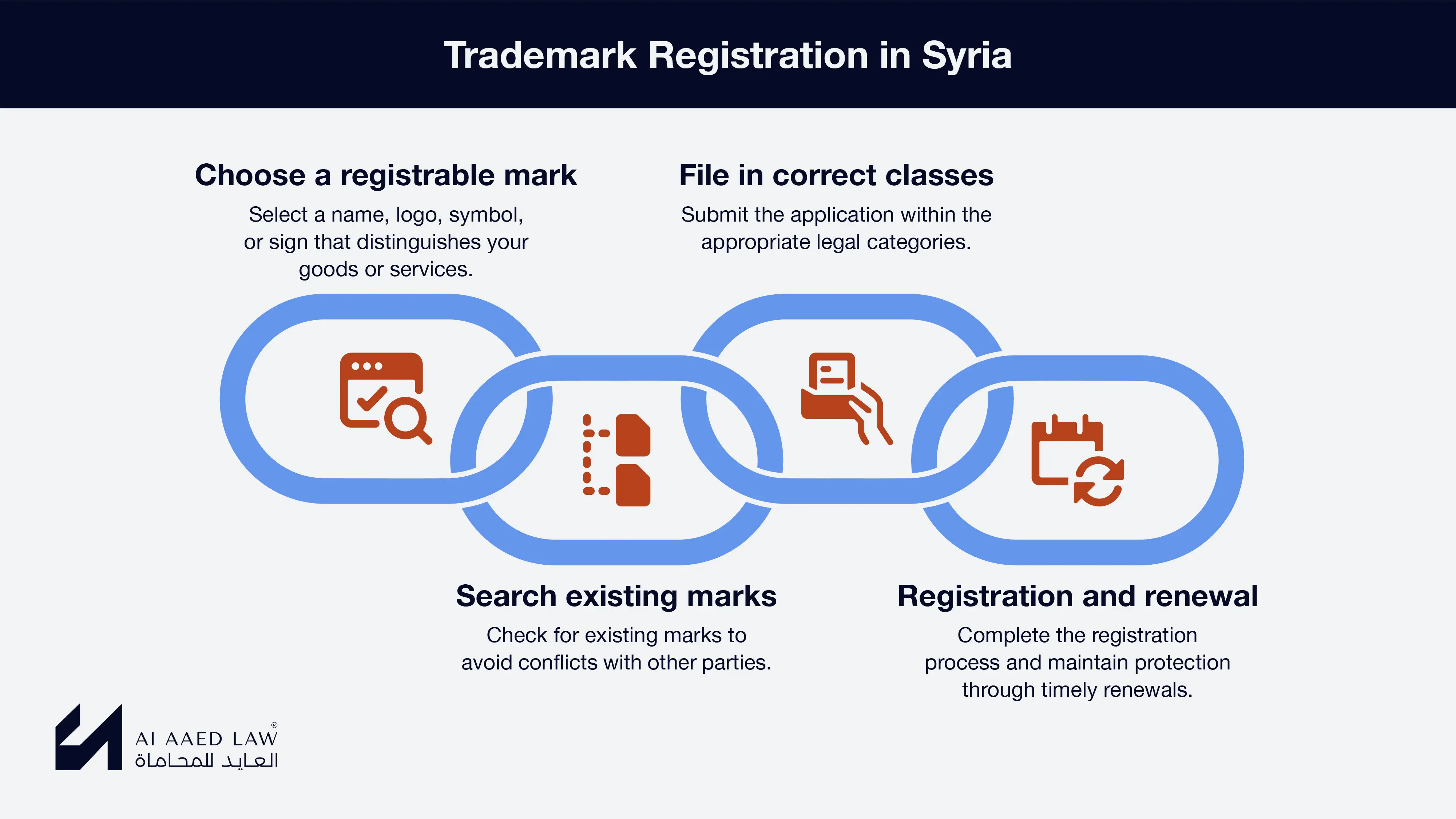
      <p>Trademark registration in Syria is an essential step for protecting the name, logo, or symbol that distinguishes a business's goods or services in the market. The risk does not begin only when a mark is copied. It may also arise when someone else registers an identical or similar mark first, or when a company invests in its website, marketing campaigns, and product packaging before confirming that the mark does not conflict with earlier rights.</p>

<p>Effective protection begins with selecting a registrable mark, conducting a prior search, identifying the appropriate classes, and then filing the application and following the examination, publication, and any opposition proceedings until the registration certificate is issued. This guide explains the process of trademark registration in Syria, the duration of protection, how registration is renewed, and how infringement can be addressed. Our <a href="/en/practice-areas/ip">Intellectual Property &amp; Technology practice</a> handles each of these stages end-to-end.</p>

<h2>What Law Governs Trademark Registration in Syria?</h2>
<p>Trademark registration in Syria is governed by Law No. 8 of 2007 concerning trademarks, geographical indications, industrial designs and models, and unfair competition, as amended by Legislative Decree No. 47 of 2009.</p>
<p>The Directorate of Commercial and Industrial Property Protection, currently affiliated with the Ministry of Economy and Industry, is responsible for receiving, examining, registering, and publishing trademark applications. It also handles oppositions, infringement complaints, and international registration under the applicable agreements.</p>
<p>The forms, fees, and procedural requirements in force at the time of filing should always be verified because they may be changed by subsequent decisions or administrative instructions.</p>

<h2>What Is Trademark Registration?</h2>
<p>Trademark registration is the official recording of a sign capable of distinguishing the goods or services of a natural or legal person from those of others. A mark may consist of a name, word, letters, drawing, logo, symbol, image, signature, seal, combination of colours, distinctive product or packaging shape, or a combination of these elements.</p>
<p>Syrian law requires a trademark to be capable of visual perception. Registration does not protect the underlying business or product idea itself. It protects the mark in relation to the goods, services, and classes specified in the application.</p>

<h2>Why Do Companies Need to Protect Their Trademarks?</h2>
<p>A trademark brings together the business's reputation, customer trust, and marketing value in a single asset. Registration helps a business to:</p>
<ul>
<li>Establish ownership of the mark in relation to the goods or services covered by the registration.</li>
<li>Prevent others from using an identical or similar mark where the use may confuse the public.</li>
<li>Take legal action against counterfeiting or misleading use.</li>
<li>License the mark to others or transfer its ownership in accordance with the applicable procedures.</li>
<li>Support business expansion and provide a clearer legal basis when negotiating with investors, partners, or distributors.</li>
</ul>
<p>Although trademark registration is not mandatory for every activity unless a specific legal provision states otherwise, it gives the owner a stronger legal position than relying only on use of the mark or company registration.</p>

<h2>What Can Be Registered as a Trademark?</h2>
<p>Any visible sign that has distinctive character and is capable of indicating the commercial source of goods or services may be registered. A trademark may include:</p>
<ul>
<li>Words, names, and designations.</li>
<li>Letters, drawings, logos, and symbols.</li>
<li>Images, signatures, and seals.</li>
<li>Combinations or distinctive arrangements of colours.</li>
<li>The distinctive shape of a product or its packaging.</li>
<li>A combination of two or more of these elements.</li>
</ul>
<p>It is not enough for a mark to appear visually different. Similarity in pronunciation, spelling, meaning, and overall impression must also be considered, together with the likelihood of consumer confusion.</p>

<h2>Requirements for Accepting a Trademark for Registration</h2>
<p>A trademark should be distinctive and should not consist merely of a generic, necessary, or customary designation for the relevant goods or services. It may not be limited to a direct description of the product's type, quality, quantity, use, value, or geographical origin.</p>
<p>A trademark application may be refused, among other circumstances, where the mark is:</p>
<ul>
<li>Devoid of distinctive character or directly descriptive.</li>
<li>Misleading as to the nature, quality, or origin of the product.</li>
<li>Contrary to public order or public morals.</li>
<li>Composed of protected official emblems, flags, or symbols without authorisation.</li>
<li>Identical or similar to an earlier mark in a manner likely to mislead the public.</li>
<li>In conflict with a well-known mark or another earlier right protected by law.</li>
</ul>
<p>Registrability is assessed in relation to the goods or services the mark is intended to distinguish. A word may be descriptive for one product but distinctive for a different product or service.</p>

<h2>Must the Trademark Include Arabic Letters?</h2>
<p>Syrian law contains specific rules for marks placed on goods and services of national origin that are produced or used in Syria. As a general rule, these marks must be written in Arabic letters. Foreign letters may appear alongside the Arabic letters at an equal size, subject to the cases and exceptions provided by law.</p>
<p>The proposed presentation and use of a mark on products or display materials should therefore be reviewed before filing, particularly when a foreign-language name or bilingual mark is being adopted.</p>

<h2>What Is the Difference Between a Trade Name and a Trademark?</h2>
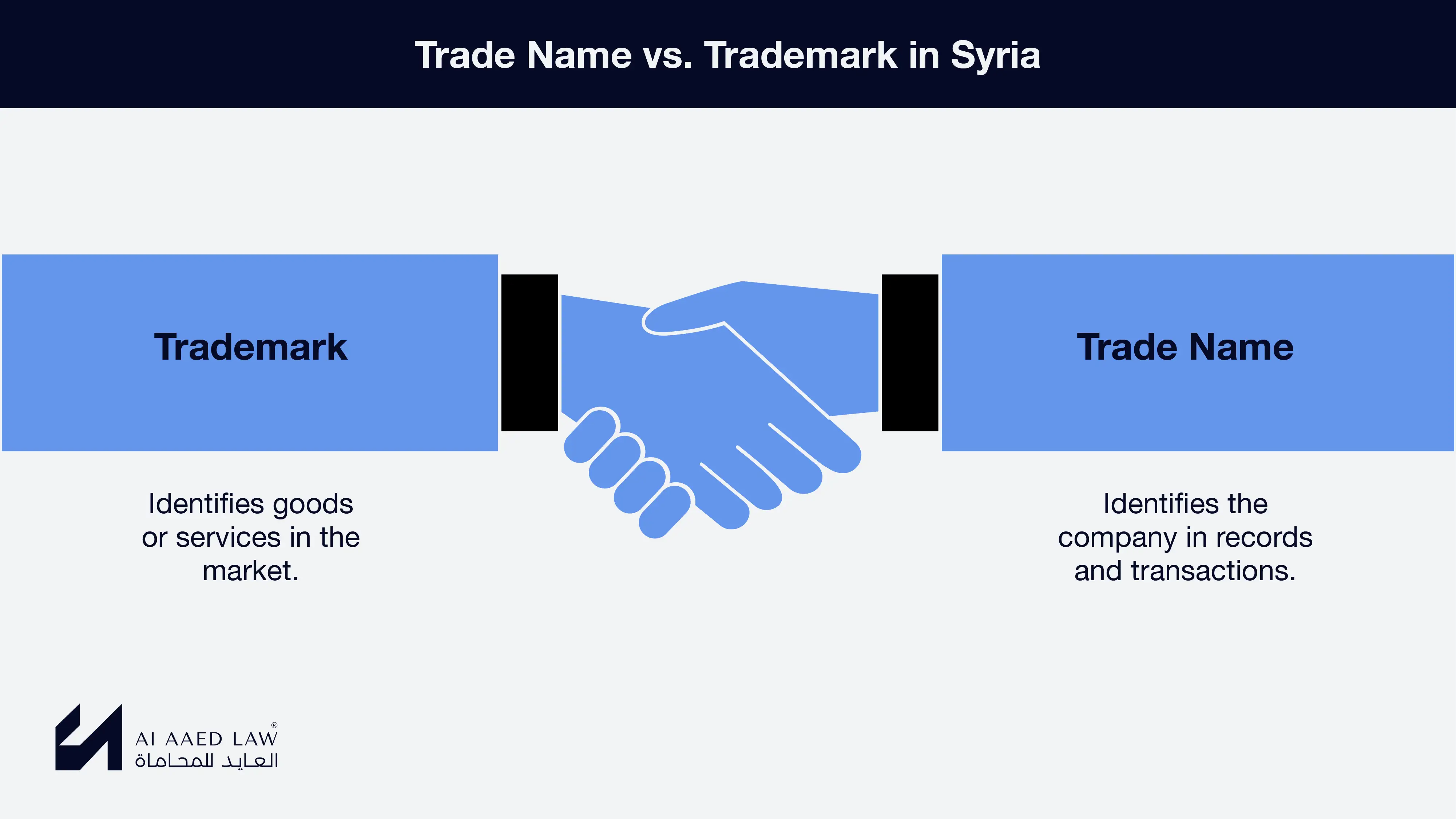
<figure><img src="https://qqzmfnzeoktzgqeugipq.supabase.co/storage/v1/object/public/assets/insights/trademark-syria/trade-vs-trademark-en.webp" alt="Trade name vs trademark in Syria" loading="lazy"></figure><p>A trade name identifies a company or establishment in commercial records and transactions, while a trademark distinguishes the goods or services it provides in the market. A trade name and trademark may be identical or different.</p>
<p>Registering a company or recording its name in the commercial register does not automatically protect that name as a trademark in every class. A company may therefore need to submit a separate application to protect its mark in relation to the products or services for which it is actually used.</p>

<h2>Steps for Trademark Registration in Syria</h2>
<figure><img src="https://qqzmfnzeoktzgqeugipq.supabase.co/storage/v1/object/public/assets/insights/trademark-syria/steps-en.webp" alt="Steps for trademark registration in Syria" loading="lazy"></figure><h3>1. Select a Registrable Mark</h3>
<p>It is preferable to select a distinctive and non-descriptive name or logo while avoiding generic words, official symbols, and elements that may mislead the public about the nature or origin of a product. The availability of the name as a domain name and on social media platforms should also be checked, but online availability does not prove that the mark is legally registrable.</p>

<h3>2. Conduct a Prior Search for Similar Marks</h3>
<p>A prior search reduces the risk of refusal or opposition. The search should not be limited to exact matches. It should examine similarities in pronunciation, spelling, meaning, appearance, and overall impression, as well as the relevant goods, services, and target consumers.</p>
<p>The law allows a written request to be filed with the Directorate for a preliminary search covering no more than five marks in a single request. Under the statutory text, the Directorate is required to respond within 15 days. The search result does not create a right for the requester or impose liability on the Directorate. A broader legal review therefore remains necessary before filing.</p>

<h3>3. Identify the Classes Under the Nice Classification</h3>
<p>Goods and services are categorised under the international Nice Classification, which contains 45 classes: 34 classes for goods and 11 for services. The relevant goods or services must be identified precisely because the scope of protection is connected to what is listed in the application.</p>
<p>Syrian law treats each requested class through a separate application. Selecting an incorrect class or filing in only one class when the mark is used across several business areas may therefore leave important parts of the activity without adequate protection.</p>

<h3>4. Prepare the Application and Supporting Documents</h3>
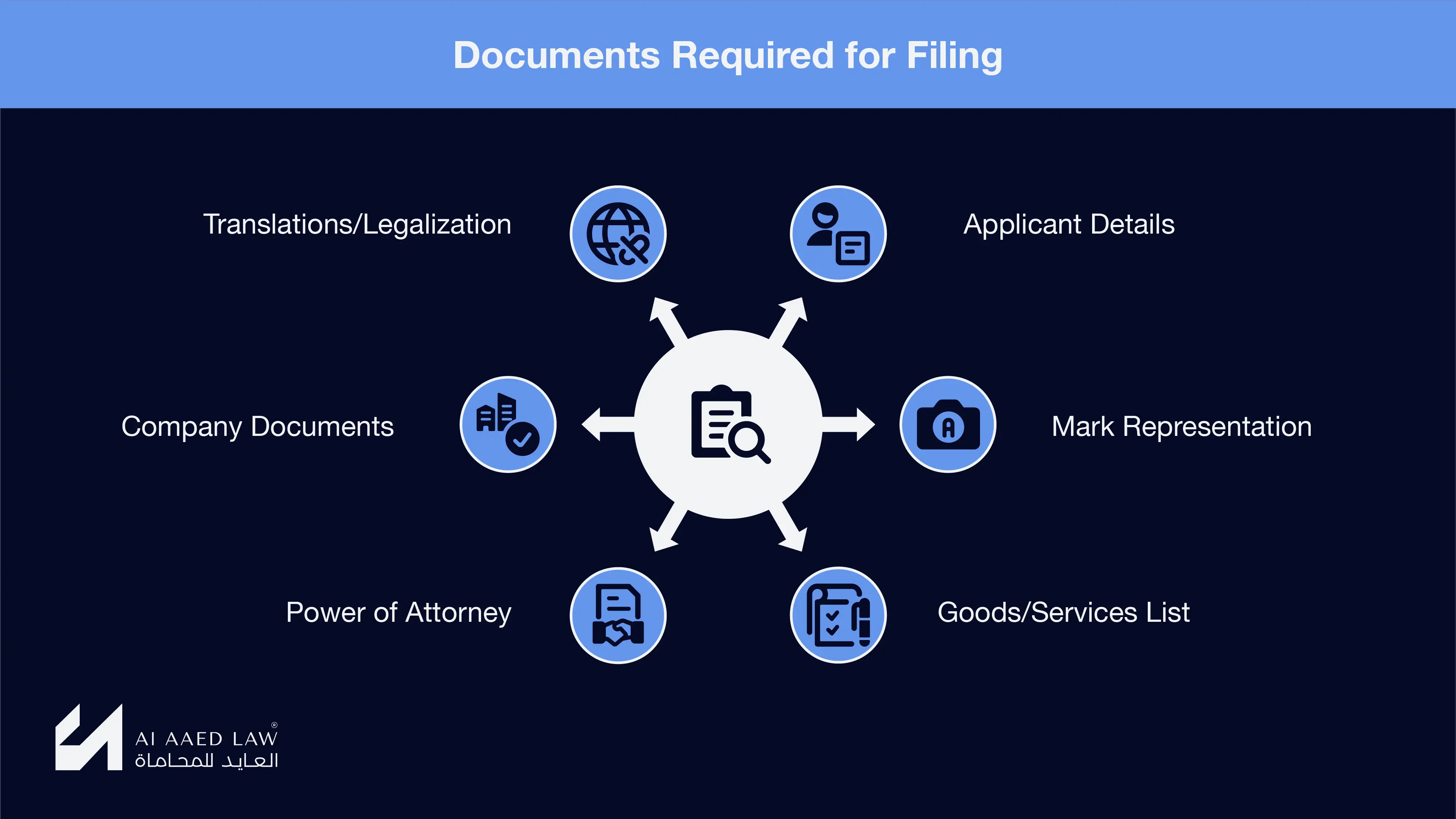
<figure><img src="https://qqzmfnzeoktzgqeugipq.supabase.co/storage/v1/object/public/assets/insights/trademark-syria/documents-en.webp" alt="Documents required for trademark filing in Syria" loading="lazy"></figure><p>The required documents differ depending on whether the applicant is an individual or a company and whether the applicant is Syrian or foreign. The application file will generally include:</p>
<ul>
<li>The applicant's details, address, and legal capacity.</li>
<li>A clear representation of the mark to be registered.</li>
<li>A precise statement of the goods or services and the requested class.</li>
<li>A receipt confirming payment of the prescribed fees.</li>
<li>A power of attorney where the application is filed through a representative.</li>
<li>Company documents where the applicant is a legal entity.</li>
<li>An Arabic translation or explanation of foreign words appearing in the mark.</li>
<li>Any translations or legalisations required for foreign documents, depending on the case.</li>
</ul>
<p>If the applicant is not resident in Syria, the applicant must appoint a person residing in Syria to follow the registration procedures.</p>

<h3>5. File the Application and Pay the Fees</h3>
<p>The application is submitted to the Directorate of Commercial and Industrial Property Protection using the approved form, together with the supporting documents and fee receipt. It is recorded under a serial number according to its filing date and time, and the applicant receives proof of filing.</p>
<p>The cost is affected by the number of classes, the application, publication, and registration fees, the nature of the documents, and the need for translation, legalisation, or legal representation. An updated fee schedule should therefore be obtained before filing instead of relying on previously published figures.</p>

<h3>6. Examination and Response to the Directorate's Observations</h3>
<p>The Directorate examines the application and its supporting documents to confirm compliance with the formal and legal requirements, the distinctiveness of the mark, and the absence of conflicts with earlier marks or rights.</p>
<p>The Directorate may request that the mark be amended or clarified or that the list of goods or services be narrowed to avoid confusion with another mark. If the application is refused or its acceptance is made subject to conditions or amendments, the applicant may challenge the Directorate's decision before the competent committee within 30 days of receiving notice. The committee's decision may then be appealed before the competent court within the legally prescribed period.</p>

<h3>7. Publication and Third-Party Opposition</h3>
<p>If the application is accepted and satisfies the requirements, a representation of the mark and a statement of the relevant goods or services are published in the Property Protection Journal at the applicant's expense.</p>
<p>Any interested party may oppose the application within 90 days from the publication date. If an opposition is filed, the Directorate provides the applicant or its representative with a copy. A written and reasoned response must be submitted within 30 days of notification; otherwise, the applicant will be deemed to have abandoned the application.</p>
<p>After reviewing the parties' documents, the Directorate issues a reasoned decision on the opposition. That decision may be challenged in accordance with the statutory procedures and deadlines.</p>

<h3>8. Complete Registration and Obtain the Certificate</h3>
<p>After the publication period expires without opposition, or after an opposition is finally decided in the applicant's favour, the registration procedures and certificate issuance must be completed within the statutory period. The application may be deemed legally void if these steps are not completed within 90 days following the end of the publication period or the issuance of a final court judgment in the applicant's favour.</p>
<p>The Directorate records the accepted mark in the Trademark Register and publishes its registration in the Property Protection Journal. It then issues the registration certificate to the owner within 30 days from the date of entry in the register.</p>

<h2>How Long Does Trademark Registration Take?</h2>
<p>There is no single practical timeframe that applies to every application. The duration depends on how quickly the documents are completed, the examination process, official observations, oppositions, and any resulting appeal. The third-party opposition stage alone lasts 90 days from publication, and the process may take longer if observations or disputes arise. Any fixed processing estimate should therefore be treated with caution, and the Directorate's actual processing timeframe should be confirmed at the time of filing.</p>

<h2>Trademark Protection Period and Renewal</h2>
<p>A registered trademark is protected for ten years beginning from the filing date, with expiry calculated by reference to the end of the month in which the application was filed. Registration may be renewed for successive ten-year periods.</p>
<p>A renewal application should be filed during the final year of the protection period. The law also gives the trademark owner a six-month grace period after expiry, subject to payment of the applicable late fees. If the mark is not renewed during this period, the registration expires by operation of law.</p>
<p>New classes, goods, or services cannot be added through renewal, although goods or services may be deleted. Expanding the scope of protection requires a new application, depending on the circumstances.</p>

<h2>Can a Trademark Be Cancelled for Non-Use?</h2>
<p>Yes. At the request of an interested party, the competent court may cancel a trademark registration if the mark has not been genuinely used for three consecutive years in relation to the registered goods or services, unless the owner provides a valid justification for non-use.</p>
<p>Obtaining a registration certificate is therefore not sufficient on its own. The mark should be used in practice, and evidence of use should be retained, including invoices, contracts, advertisements, product and packaging photographs, and sales records.</p>

<h2>Rights of the Trademark Owner After Registration</h2>
<p>Registration gives the owner title to the trademark in relation to the goods or services covered by the registration. It allows the owner to prevent others from copying or using the mark without authorisation on identical goods or services. Protection also extends to similar marks and similar goods or services where there is a likelihood of consumer confusion.</p>
<p>Subject to the applicable legal procedures, the trademark owner may:</p>
<ul>
<li>License one or more persons to use the mark.</li>
<li>Transfer ownership of the mark in whole or in part.</li>
<li>Mortgage the mark or create other rights in rem over it.</li>
<li>Take civil or criminal action against infringement.</li>
<li>Seek precautionary measures to stop an existing or imminent infringement.</li>
<li>Request customs action against goods that infringe a registered right, depending on the circumstances.</li>
</ul>
<p>Licensing agreements, ownership transfers, and restrictions affecting the mark must be recorded and published where required by law to be enforceable against third parties.</p>

<h2>Can a Trademark Be Registered Internationally Through Syria?</h2>
<p>Syria is a member of the Madrid System for the International Registration of Marks. A trademark owner who satisfies the system's requirements may request protection in designated countries through an international application filed in accordance with the approved procedures and processed by the Directorate and the World Intellectual Property Organization.</p>
<p>An international application does not result in unified and automatic protection across all countries. The trademark office of each designated country examines the application under its own law and decides whether to grant or refuse protection within its jurisdiction.</p>

<h2>What Should You Do If Your Trademark Is Copied?</h2>
<p>When trademark copying or the misleading use of a similar mark is discovered, the infringement should be documented before contacting the other party. Relevant evidence may include:</p>
<ul>
<li>Photographs of products, packaging, and signs.</li>
<li>Invoices or purchased samples.</li>
<li>Links to websites, sales pages, and advertisements.</li>
<li>Information about the store, supplier, or importer.</li>
<li>Dates of use and correspondence connected to the infringement.</li>
</ul>
<p>The nature and urgency of the infringement should then be assessed to determine the appropriate response. This may involve sending a legal notice and demanding that the use stop, requesting a precautionary measure, filing a civil or criminal claim, or pursuing customs action where the infringement concerns imported or cross-border goods.</p>
<p>Action should not be unnecessarily delayed because continuing infringement may increase the distribution of the products and make the resulting damage more difficult to identify and prove.</p>

<h2>Common Mistakes in Trademark Registration</h2>
<ul>
<li>Selecting a generic or descriptive mark that lacks sufficient distinctiveness.</li>
<li>Filing before searching for identical and similar marks.</li>
<li>Selecting an incorrect class or overlooking classes connected to the activity.</li>
<li>Providing an excessively broad or inaccurate description of the goods or services.</li>
<li>Filing an unclear logo or one that does not match the version that will actually be used.</li>
<li>Ignoring Arabic-lettering rules or the translation of foreign words.</li>
<li>Missing deadlines for responses, oppositions, appeals, or renewal.</li>
<li>Failing to use the trademark or retain evidence of its use.</li>
<li>Assuming that commercial registration or reserving a domain name protects the trademark.</li>
<li>Claiming that a trademark is registered before registration has been officially completed.</li>
</ul>

<h2>Trademark Registration for Startups</h2>
<p>Startups may postpone trademark registration to reduce costs, even while they are building their name and attracting customers and investors. The more a business invests in its identity and marketing, the greater the cost of changing the name if a legal conflict later arises.</p>
<p>It is therefore preferable to examine the mark before launching a website or advertising campaign or printing product packaging. The business can then identify its priority classes and expand the scope of protection in a planned manner as its activities grow.</p>

<h2>The Lawyer's Role in Trademark Registration and Protection</h2>
<p>A lawyer can help assess whether a trademark is registrable, examine similarities with earlier rights, select the appropriate classes, prepare the application and supporting documents, and respond to observations and oppositions before the Directorate.</p>
<p>The lawyer's role may also include drafting licence or assignment agreements, recording transactions affecting the mark, building an evidence file in infringement matters, and selecting the most appropriate judicial, administrative, or customs-related procedure for the particular infringement. Al AAED's <a href="/en/practice-areas/ip">Intellectual Property &amp; Technology team</a> can support you through the full lifecycle.</p>

<h2>How Al AAED Can Help</h2>
<p>Al AAED assists companies and business owners with trademark searches, class selection, application preparation, filing procedures, and responses to observations and oppositions. It also provides legal support for trademark renewal, the registration of licensing or ownership-transfer agreements, and appropriate action against copying or infringement.</p>
<p>If you are preparing to launch a new mark or want to protect a mark that is already in use, it is preferable to review its legal position before increasing your investment in marketing or expanding in the market. <a href="/en/contact">Get in touch with our team</a> to discuss your case.</p>

<p><em><strong>Legal notice:</strong> This article has been prepared for general informational purposes and does not constitute legal advice. Requirements and procedures vary according to the facts, the applicant's status, and the nature of the trademark. Fees and administrative instructions may also change. The applicable rules and the circumstances of the matter should be reviewed before taking any action.</em></p>
    ]]></content>
  </entry>
</feed>