Introduction
A missed delivery, unpaid invoice or suspended project does not answer the legal question by itself. The affected party must identify the obligation that became due, prove the counterparty's failure, check whether notice or a cure period is required, decide whether its own obligations remain payable, and choose a remedy that fits the contract and Syrian law. An incorrect termination or unjustified suspension can turn the claimant into the party in breach.
The principal rules appear in the Syrian Civil Code issued by Legislative Decree No. 84 of 1949. Commercial contracts may also engage Commercial Code Law No. 33 of 2007, the Evidence Law, the Civil Procedure Law, Arbitration Law No. 4 of 2008 and sector-specific legislation. A contract with a public entity, a consumer, an employee or a regulated activity requires a separate statutory review.[1][2]
This guide addresses what happens after performance has failed or become disputed. It is intentionally distinct from Al AAED Law's guide to drafting commercial agreements, which focuses on creating contract terms before a dispute. Here, the focus is breach classification, notices, remedies, force majeure, hardship, proof, procedure and settlement strategy.
Quick answer
In a bilateral contract, Article 158 of the Syrian Civil Code generally allows the performing party, after placing the defaulting party on formal notice, to seek performance or rescission, with compensation where appropriate. A court may allow additional time or refuse rescission when the unperformed part is minor in relation to the contract as a whole.[3]
Article 162 separately permits a party to withhold a corresponding obligation when both reciprocal obligations are due and the other party has not performed. This is a temporary defence designed to preserve contractual balance, not an automatic termination right.[4]
Damages must be connected to the breach and proved. Contractual recovery ordinarily addresses the actual loss and lost profit that are a natural consequence of the breach. In the absence of fraud or gross fault, foreseeability at the time of contracting can limit recovery. An agreed damages clause is not always conclusive because the Civil Code gives the court authority over the amount in defined circumstances.[5]
Force majeure and hardship are different. Force majeure concerns an external event that makes performance impossible. Hardship under Article 148 concerns exceptional, general and unforeseeable circumstances that leave performance possible but oppressively burdensome and threatening grave loss; the court may then reduce the onerous obligation to a reasonable level. Neither doctrine should be invoked merely because performance became less profitable.[6]
The legal framework
| Source | Main role in a contract dispute | Practical question |
|---|---|---|
| Civil Code Legislative Decree 84 of 1949 | Contract force, good faith, performance, rescission, damages, impossibility, hardship and limitation rules | What right or remedy exists |
| Commercial Code Law 33 of 2007 | Special rules for traders and commercial transactions | Does a commercial rule replace or supplement the Civil Code |
| Evidence Law 359 of 1947 | Proof, documents, admissions, testimony and evidentiary treatment | Can the contract, breach and loss be proved |
| Civil Procedure Law 1 of 2016 | Court jurisdiction, pleadings, service, interim measures and enforcement procedure | Where and how should the claim proceed |
| Arbitration Law 4 of 2008 | Domestic and international arbitration seated or enforced in Syria | Does an arbitration agreement displace ordinary court jurisdiction |
| Contract and special legislation | Notice, cure, termination, governing law, forum, guarantees and sector rules | What did the parties agree and what mandatory law still applies |
The Civil Code remains the starting point
The Civil Code is a foundational source of Syrian private law and contains 1,130 provisions. It covers obligations and many named contracts, while later specific legislation can supersede or supplement its general rules. The Commercial Code therefore matters for commercial acts and traders, but the Civil Code continues to fill gaps.[1][2]
The first review should identify the legal character of the transaction. A supply contract between traders is not analysed in precisely the same way as a public procurement contract, employment agreement, consumer sale, construction arrangement or property transaction. The remedy may also depend on whether the disputed obligation concerns payment, delivery, quality, exclusivity, confidentiality, licensing or continuing services.
The contract has binding force
Article 148 reflects the rule that a valid contract binds the parties and may be revoked or varied only by mutual consent or for a legal cause. This makes the signed terms the starting point, including the scope of work, specifications, acceptance process, payment schedule, notices, cure periods, force majeure language and dispute forum.[6]
The contract is not read in isolation from law, custom and the nature of the transaction. Clear terms normally control. If language requires interpretation, the inquiry concerns the parties' common intention rather than a literal phrase detached from the agreement and surrounding circumstances.[2]
Performance must follow good faith
Article 149 requires contractual performance in accordance with the contract and good faith. The principle can affect how a party exercises a discretion, demands documents, evaluates performance, cooperates with approvals, invokes a deadline or relies on a technical breach. It does not authorize a court to disregard clear obligations merely because one party later dislikes the bargain.[7]
A credible breach file should therefore record both parties' conduct. Selective enforcement, contradictory instructions, obstruction of access, acceptance of performance without reservation, repeated waiver of a deadline or refusal to cooperate may change how the dispute is understood.
Identify the breach before choosing the remedy
Nonperformance
Nonperformance occurs when a due obligation is not performed. Examples include failure to deliver goods, complete agreed work, transfer an asset, provide an approval under the party's control or pay an amount when due. The claimant must still show that the obligation existed, became due and was not excused or suspended.
The contract may make performance conditional on an earlier event. A contractor may not owe mobilisation before access is granted, and a buyer may not owe a milestone payment before the required acceptance certificate. A condition precedent that has not occurred can mean that the alleged obligation never became due.
Delay
Delay is not always equivalent to final nonperformance. The legal effect depends on the deadline, the purpose of the transaction, any grace period, the consequences of late delivery and whether the contract makes time essential. A short delay in a continuing service may justify compensation but not rescission; missing a date tied to a one-time event may defeat the commercial purpose.
The record should identify the original deadline, approved extensions, change orders, access restrictions, instructions, concurrent delay and the date on which the delay began causing measurable loss. Informal schedule changes should be preserved even when the contract required formal amendments because conduct can become relevant to interpretation and waiver.
Defective or partial performance
Goods or services may be delivered but fail to meet agreed quantity, quality, technical, safety or documentary requirements. The claimant should distinguish a correctable defect from a failure that defeats the contract's essential purpose. Inspection reports, rejection notices, samples, photographs and expert analysis may be decisive.
Partial performance also affects remedy and valuation. Rescission may be refused where the remaining breach is minor, while damages may be limited to the cost of cure, replacement, price difference, delay or another proved consequence. Accepting partial performance without reservation can complicate later arguments, although it does not necessarily waive every right.
Anticipated refusal and abandonment
A party may announce that it will not perform or act in a way that makes future performance doubtful. Syrian legal analysis should not simply import common-law labels such as anticipatory repudiation. The response must be grounded in the actual maturity of obligations, contract terms, good faith, protective measures and any available request for assurance or interim relief.
Do not terminate solely because negotiations deteriorate or a party expresses concern. Separate an unequivocal refusal from a request to renegotiate, a temporary obstacle or a disputed interpretation.
Minor and material breach
The size of the breach matters. Article 158 allows a court to refuse rescission where the unperformed portion is slight compared with the obligation as a whole.[3] A materiality assessment should consider the importance of the term, the economic effect, whether cure remains possible, recurrence, loss of the expected benefit and the contract's express classification of the obligation.
Calling every term a condition or every breach material does not guarantee that the chosen remedy will be upheld. The facts and proportionality of the response remain important.
The immediate response to a suspected breach
Preserve performance and communications
Secure the executed contract, amendments, appendices, purchase orders, specifications, approvals, invoices, delivery records, meeting notes, emails, messaging exports, accounting records and relevant system data. Keep original files and metadata where possible. Record who collected each item and avoid editing the original evidence.
Operational teams should continue ordinary document-retention processes unless counsel directs a targeted legal hold. Deleting inconvenient messages or creating a retrospective narrative can damage credibility and may remove evidence that would have supported the claim.
Confirm the obligation and the due date
Create a short chronology matching each disputed obligation with its source, responsible party, condition, due date, actual performance and supporting evidence. This prevents the dispute from becoming a collection of general complaints.
The review should include amendments and course of dealing. The signed contract may state one process while later written instructions, accepted change orders or repeated practice show that the parties implemented another. Whether that conduct legally modified or waived the written term requires case-specific analysis.
Continue undisputed obligations where appropriate
A dispute over one invoice does not necessarily excuse every remaining obligation. Continuing undisputed performance can protect the business, reduce losses and support good-faith conduct. Conversely, further performance may increase exposure when payment security has disappeared or the counterparty's breach affects the reciprocal obligation.
The decision should be documented. The company should identify what will continue, what will be withheld, the legal and contractual basis, and the conditions for resumption.
Control external statements
Communications with customers, banks, regulators, insurers, employees and the public should be accurate and coordinated. A breach allegation is not yet a judgment. Overstated accusations can damage settlement prospects and create defamation, confidentiality or commercial risk.
Notice and default
Why formal notice matters
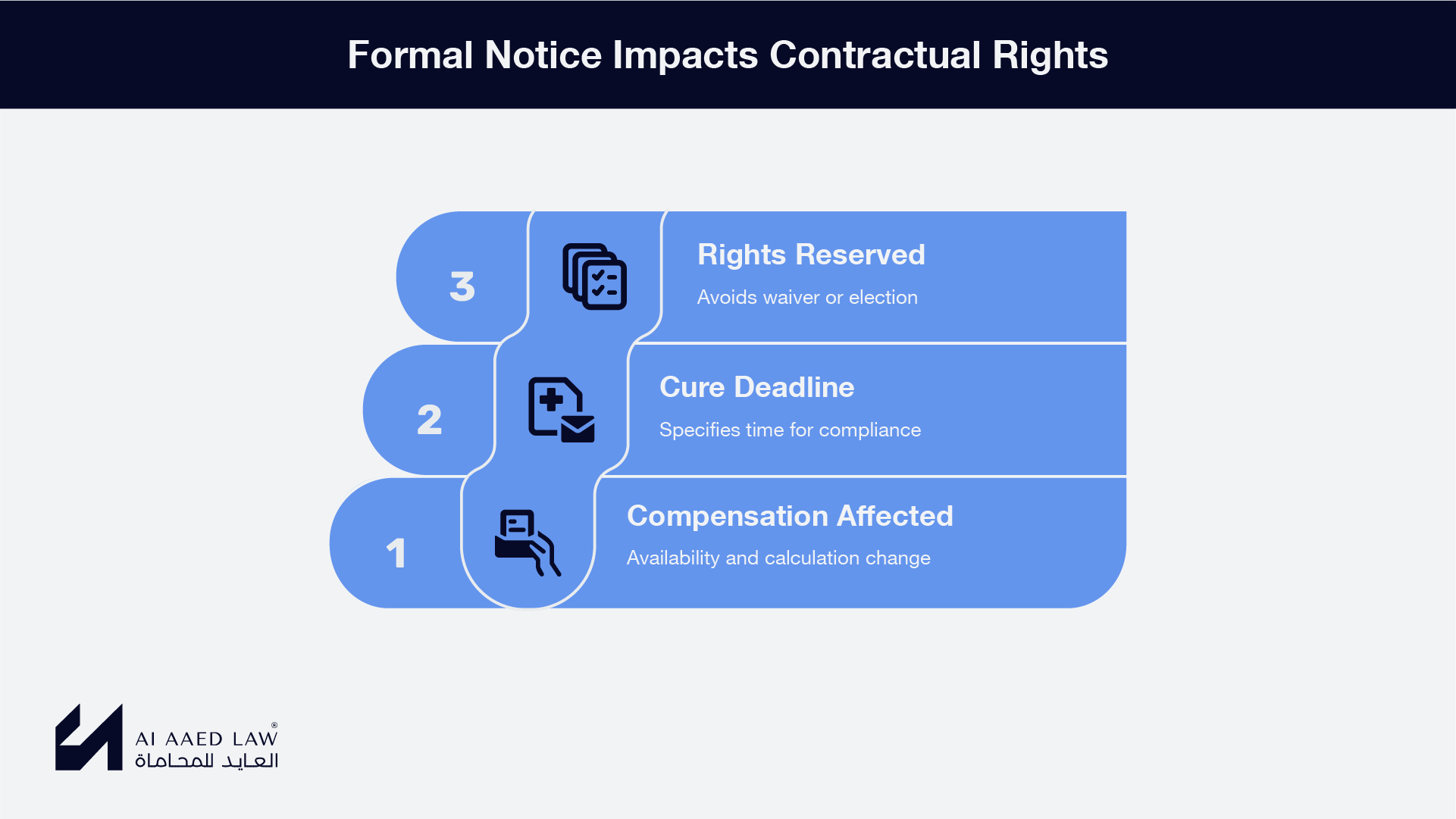
Article 158 links the ordinary rescission route to formal notice of the debtor. Notice may also affect the availability or calculation of compensation and interest. The Civil Code and contract contain exceptions, but relying on an exception without analysis is dangerous.[3]
A notice should identify the contract, the specific obligation, the facts constituting default, the legal and contractual basis, the performance demanded, the cure deadline where applicable, reserved rights and the required delivery method. It should not make admissions about responsibility for delay or promise a remedy the sender is not entitled to use.
Follow the contractual notice clause
Notice clauses commonly specify an address, person, language, delivery channel and deemed receipt rule. Sending an email to an operating contact may not satisfy a clause requiring registered post or delivery to a legal address. Use every required method and retain transmission, delivery and receipt evidence.
If the notice period is ambiguous, calculate conservatively. Consider non-working days, time zones, public holidays, contractual definitions and whether the period starts on dispatch or receipt.
Cure and reservation of rights
A cure notice should define what compliant performance requires. A vague demand to “fix all breaches” can create later disagreement about whether cure occurred. When performance can be tested, state the inspection or acceptance method.
A reservation of rights helps avoid an inference that the sender elected only one remedy or accepted nonconforming performance. It is not a substitute for consistent conduct. A party that repeatedly confirms the contract, accepts benefits or delays action may create waiver or election issues despite boilerplate wording.
The principal remedies
Specific performance
Article 204 gives priority to performance in kind when the debtor can perform and the statutory conditions are met. A creditor may seek completion, delivery or another promised act rather than immediately converting the obligation into money. If performance would be impossible or unduly oppressive in the circumstances recognized by law, compensation may become the practical remedy.[8]
Specific performance is most useful where the promised item, document, transfer or service cannot readily be replaced. Before seeking it, the claimant should assess whether the court or tribunal can supervise the obligation and whether the counterparty still has the capacity and assets to perform.
Rescission
Under Article 158, the performing party may seek performance or rescission after formal notice, with damages where appropriate. Judicial rescission is not automatic merely because a breach occurred. The judge may grant the debtor additional time and may refuse rescission for a minor unperformed part.[3]
Rescission generally unwinds the reciprocal contract and triggers restitutionary consequences so far as the law and nature of performance permit. Continuing contracts and services already consumed may require financial accounting rather than literal return.
Express termination or automatic rescission clauses
Article 159 allows parties to agree that a contract will be rescinded automatically upon nonperformance. The wording and required notice still matter. A clause that identifies the triggering breach, cure period, notice step and consequences is safer than a general statement that the contract “may be terminated.”[9]
Do not confuse contractual termination for convenience with rescission for breach. A convenience right depends on its agreed conditions and may require notice or compensation even without fault. A breach remedy depends on default and the applicable law.
Damages
Damages require a breach, loss and causal connection. Article 222 addresses judicial assessment when compensation is not fixed by the contract or law. Recoverable loss includes actual loss and lost profit to the extent they are a natural result of the failure or delay. In contractual liability, absent fraud or gross fault, the debtor ordinarily answers only for damage that could normally have been foreseen when the contract was concluded.[5]
The claimant should prove each amount with a document and explanation. A damages schedule should show the category, calculation, date, source record, causal link, mitigation and whether the figure includes tax, financing or currency effects. Large round numbers unsupported by records weaken the entire claim.
Agreed compensation and liquidated damages
Article 224 permits the parties to determine compensation in advance, but the agreed amount remains subject to the Civil Code. Judicial control can arise where no loss occurred, the estimate is grossly excessive or part of the principal obligation was performed. The application of the clause depends on its wording and the proven facts.[5]
An agreed damages clause should not be treated as a guaranteed payment or as the exclusive remedy unless the contract clearly produces that result under applicable law. The claimant must also check whether the clause applies to the specific breach, period and cap relied upon.
Withholding reciprocal performance
Article 162 allows either party to a bilateral contract to withhold its due obligation when the other party has not performed the corresponding due obligation. The relationship between the two obligations is essential. A disputed obligation unrelated to the payment or performance being withheld may not support the defence.[4]
This right suspends performance; it does not dissolve the contract. A party that withholds too much, acts too early or ignores the agreed order of performance risks committing a separate breach.
Interim protection
A claimant may need interim protection before final judgment or award, particularly when assets may be transferred or evidence may disappear. Syrian procedure recognizes protective measures including provisional attachment where the statutory conditions are met. The request must be coordinated with the underlying claim and any arbitration agreement.[2]
Interim relief is not a substitute for proving the merits. The claimant should assess urgency, evidence, security requirements, asset location, enforceability and the risk of liability for an unjustified measure.
Force majeure hardship and ordinary breach
| Issue | Ordinary breach | Force majeure and impossibility | Exceptional hardship |
|---|---|---|---|
| Core problem | A due obligation was not properly performed for a reason attributable to the debtor | An external and uncontrollable event makes the obligation objectively impossible | Exceptional general and unforeseeable circumstances make performance possible but oppressively burdensome and threatening grave loss |
| Typical legal result | Performance, rescission, damages or justified withholding depending on the facts | Extinction or suspension consequences depend on impossibility, duration, contract and the affected obligation | A court may reduce the onerous obligation to a reasonable level |
| Damages | Available when breach, loss and causation are proved | May be excluded where the debtor proves the qualifying external cause and absence of responsibility | Not automatically erased; judicial adjustment depends on the legal test |
| Evidence | Obligation, due date, failure, attribution and loss | Event, causation, impossibility, timing, notice, mitigation and absence of alternatives | General exceptional event, unforeseeability, serious burden, projected grave loss and continuing possibility |
| Frequent error | Terminating for a minor or curable breach | Treating higher cost or inconvenience as impossibility | Treating an ordinary business risk or party-specific difficulty as general hardship |
Force majeure requires more than difficulty
Article 160 addresses the effect of impossibility on reciprocal obligations, while the damages rules recognize an external cause beyond the debtor's responsibility. The party relying on force majeure must connect the event to the precise obligation. A border closure may affect one delivery route without making all delivery impossible; a banking restriction may affect one payment channel while lawful alternatives remain.[6][10]
The analysis asks whether the event was external, unavoidable, outside the party's control and causally responsible for actual impossibility. The contract may define events and consequences, but labels do not replace the legal test. A party's lack of funds, poor planning or supplier default is not automatically force majeure.
Temporary and permanent effects
Temporary impossibility may suspend an affected obligation if performance can resume and the delay does not destroy the contract's purpose. Permanent impossibility may extinguish the obligation and affect the reciprocal obligation. Partial impossibility requires a clause-by-clause and commercial analysis.
The party invoking the event should provide timely notice, preserve evidence, propose mitigation and continue unaffected obligations. Amounts accrued before the event are not necessarily excused.
Hardship under Article 148
Hardship applies when exceptional public circumstances that could not reasonably have been foreseen make performance excessively onerous and threaten the debtor with grave loss, although performance remains possible. The court may balance the parties' interests and reduce the onerous obligation to a reasonable level. An agreement excluding this judicial authority is ineffective under Article 148.[6]
The threshold is demanding. Inflation, exchange movement, input cost increases or supply disruption must be assessed by timing, degree, foreseeability, general character, contractual allocation and actual financial effect. A gradual or already visible risk may be treated differently from a sudden exceptional change.
Do not suspend first and justify later
A party facing hardship should not assume it may unilaterally rewrite the price or stop work. The safer path is to give detailed notice, continue performance where reasonably possible, request negotiation, document the burden and seek the contractual or judicial remedy available. A wrongful suspension may itself constitute breach.
Proving the contract the breach and the loss
Contract formation and authority
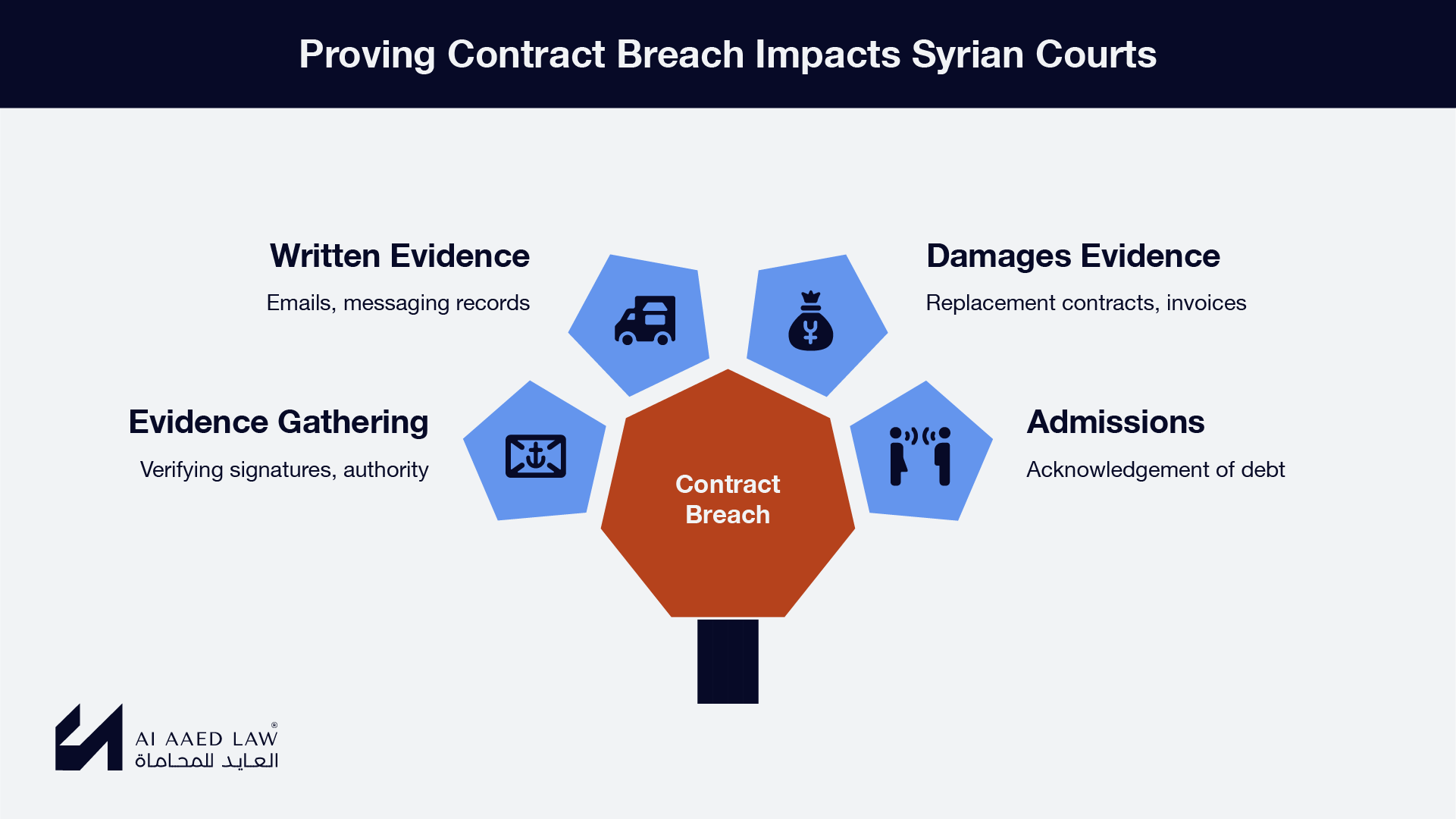
Evidence begins with the operative agreement. Verify signatures, authority, corporate approvals, powers of attorney, amendments, incorporated schedules and governing-language clauses. Where the counterparties executed several versions, identify which version controls.
Syrian law can recognize agreements formed through conduct, correspondence or other means, but formal requirements and evidentiary rules vary by transaction. A party should not assume that an unsigned draft is either automatically binding or automatically irrelevant.
Written and electronic evidence
The Evidence Law governs the treatment of documents, admissions, testimony and other proof before Syrian courts. Emails and messaging records may assist in proving an agreement, demand, admission, delivery or objection, but their origin, integrity, completeness and relationship to other evidence must be established.[11]
Export conversations in a manner that preserves dates, participants and attachments. A screenshot alone may omit metadata and surrounding context. Keep the device or account information needed to authenticate the record and prepare a certified Arabic translation where required for proceedings.
Performance records
Useful evidence may include signed delivery notes, warehouse entries, bills of lading, inspection certificates, timesheets, site diaries, progress reports, acceptance records, defect lists, change orders, payment certificates and expert tests. The strongest file links each record to a contractual obligation and date.
Silence can be ambiguous. A lack of immediate complaint may support acceptance in some circumstances, while concealed defects may emerge later. The contract's inspection, rejection and warranty provisions must be read with applicable law.
Damages evidence
Actual loss may be supported by replacement contracts, repair invoices, wasted expenditure, storage charges, financing records, payroll allocation or additional professional costs. Lost profit requires a defensible model grounded in contracts, orders, capacity, historical performance, market evidence and avoided costs.
Separate the consequences of the breach from losses caused by unrelated market conditions, the claimant's own conduct or events that would have occurred anyway. Expert accounting or technical evidence may be needed.
Admissions and settlement communications
An acknowledgement of debt, promise to pay, acceptance of delay responsibility or agreed defect list can be important evidence. Communications should therefore be prepared on the assumption that a Syrian court may examine their content. A common-law label such as “without prejudice” does not by itself guarantee exclusion from evidence in a Syrian proceeding.[2]
Settlement discussions should use a carefully designed confidentiality and process agreement where needed, while recognizing that mandatory evidentiary or judicial powers may still apply.
Causation mitigation and valuation
Link each loss to the breach
The claimant should explain how the particular failure produced the particular loss. If replacement goods cost more, show the original quantity, specification, market timing, procurement process and price difference. If delay caused lost revenue, show why the revenue would probably have been earned but for that delay.
Correlation is insufficient. A business decline during the breach period may also reflect demand, currency, access, financing or operational problems. The damages analysis must separate them.
Take reasonable mitigation steps
A claimant should take reasonable steps to avoid unnecessary loss. That may involve seeking alternative supply, preserving perishable goods, allowing a reasonable cure, reallocating work, stopping avoidable expenditure or securing assets. Mitigation does not require acceptance of unsafe, unlawful or commercially irrational alternatives.
Keep a record of options considered, quotations received, decisions made and why an alternative was rejected. The same file can demonstrate that replacement costs were reasonable.
Address currency and payment rules carefully
Contracts involving foreign currency, cross-border payment or changing exchange conditions require current regulatory review. The contract's currency language, place of payment, applicable mandatory rules, payment-channel availability and date of valuation may all affect the claim.
Do not convert losses using a convenient rate without identifying its legal and evidentiary basis. Counsel and the financial expert should use consistent dates and explain the source of every rate.
Ending the contract and managing the consequences
Check authority and procedure before termination
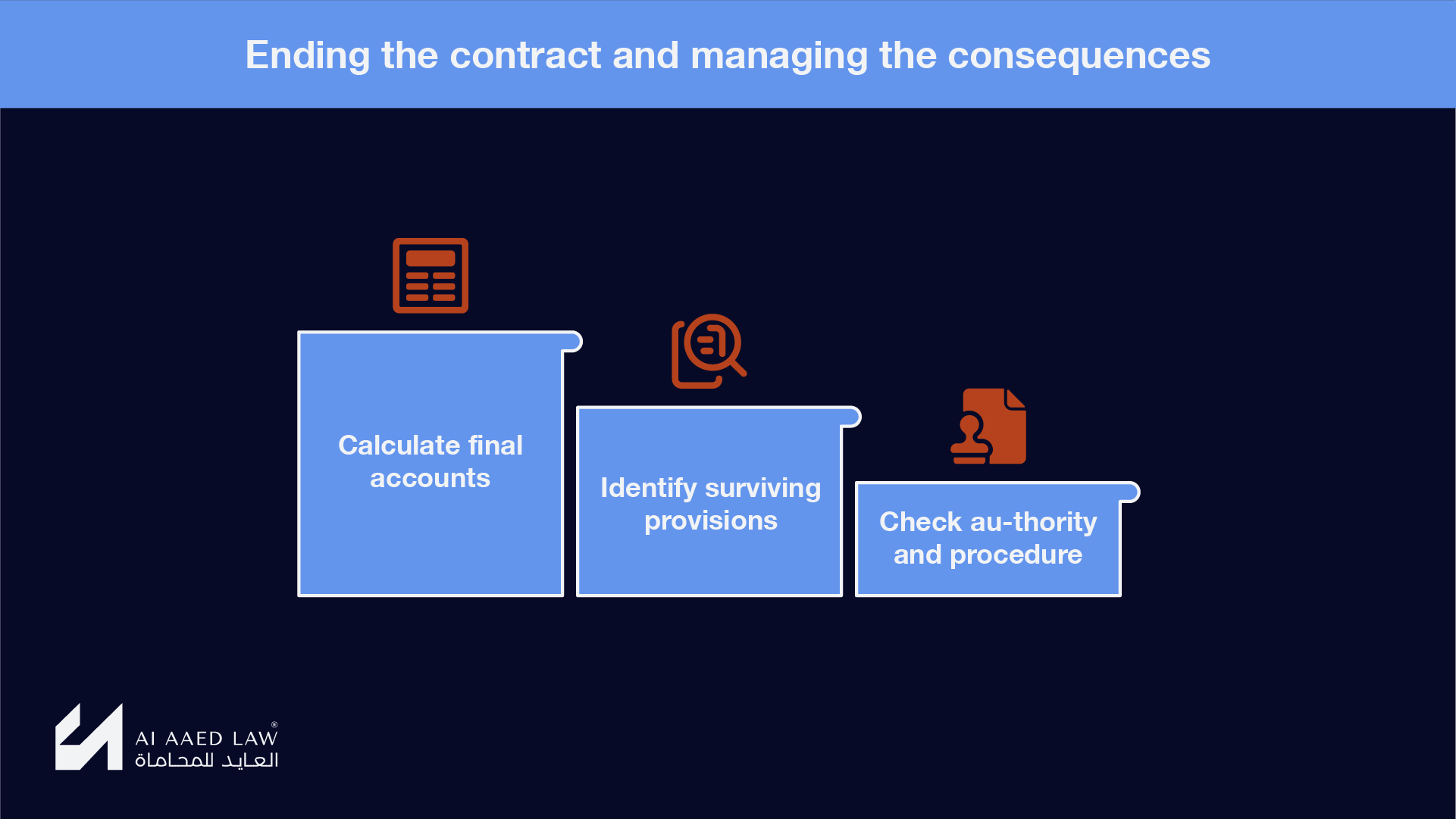
Confirm who may issue termination, the address and delivery method, required approvals, cure period, event relied upon and effective date. A notice from an unauthorized employee or sent by the wrong method may be challenged.
The notice should state whether the party seeks rescission, invokes an express clause, terminates for convenience, accepts expiry or records impossibility. These routes have different legal foundations and consequences.
Identify provisions that survive
Termination may end future performance while leaving accrued payment rights, confidentiality, intellectual-property ownership, records, audit, indemnity, dispute resolution, governing law and return-of-property obligations in force. Survival depends on the contract, the nature of the term and applicable law.
Prepare a closeout matrix covering final delivery, work in progress, customer data, equipment, inventory, licences, guarantees, insurance, employees, subcontractors, accounts and access credentials.
Calculate restitution and final accounts
Rescission can require restoration of benefits received so far as possible. Long-term projects may require valuation of accepted work, usable materials, advance payments, retention, defects and demobilisation rather than physical return of every performance.
Do not net competing claims informally unless the legal basis is clear. Prepare a gross account for each side and identify any agreed or statutory right of setoff.
Cross border contracts and dispute forums
Governing law
Parties may select a governing law, subject to Syrian mandatory rules and public policy where Syrian courts or enforcement are involved. If no effective choice exists, Syrian conflict rules may point to the parties' common residence, the place of contracting or another sufficiently connected law depending on the facts.[2]
Foreign-law clauses require proof of that law in Syrian proceedings. The chosen law should be coordinated with jurisdiction, arbitration, enforcement, currency, security and the location of assets.
Courts and arbitration
An enforceable arbitration agreement can refer disputes to arbitration. The clause should be checked for scope, seat, institution or rules, language, number of arbitrators, appointment process and interim measures. A defective clause can create a preliminary jurisdiction fight before the underlying breach is addressed.[12]
Where the Syrian courts have jurisdiction, Civil Procedure Law No. 1 of 2016 governs the litigation process. Public contracts may fall within the administrative judicial system rather than ordinary civil jurisdiction. Forum analysis should occur before sending a notice that assumes the wrong procedure.
International sale of goods
Syria is a Contracting State to the United Nations Convention on Contracts for the International Sale of Goods. The CISG may therefore govern qualifying international sales unless effectively excluded. Its rules on conformity, notice, remedies and damages differ in some respects from domestic law, so the applicable regime must be identified at the outset.[13]
Enforcement and assets
A favourable judgment or award has commercial value only if it can be enforced against reachable assets. Before proceedings, identify the counterparty's legal name, registration, bank relationships, receivables, inventory, real estate, shares, guarantees and assets outside Syria.
Enforcement of foreign judgments and arbitral awards depends on the applicable Syrian rules, treaties, reciprocity, procedural conditions and public policy. Obtain country-specific advice before choosing a forum solely because its proceedings appear convenient.
Time limits and delay risk
Civil Code claims are generally described as subject to a fifteen-year limitation period, while commercial matters may carry a ten-year period unless a shorter period applies. Specific claims, instruments, goods, transport, employment, insurance, company and procedural matters may follow shorter rules.[2]
The correct period, starting date, suspension, interruption and effect of acknowledgement require a claim-specific analysis. A contractual notice period or arbitration deadline can also expire well before the general limitation period.
Do not use a general limitation period as permission to wait. Delay can weaken evidence, imply acceptance or waiver, allow asset dissipation and make performance commercially useless.
A practical response plan
- Secure the signed contract, amendments, evidence and original electronic records.
- Identify the exact obligation, due date, conditions and alleged failure.
- Separate undisputed performance from disputed or reciprocal obligations.
- Check notice, cure, termination, force majeure and dispute clauses.
- Determine whether the issue is breach, impossibility, hardship or a mixed event.
- Preserve operations and take reasonable steps to limit avoidable loss.
- Prepare and serve a compliant notice with evidence of receipt.
- Quantify actual loss and lost profit in a documented damages schedule.
- Review governing law, forum, arbitration, interim relief and asset location.
- Compare performance, rescission, damages, justified withholding and settlement.
- Obtain internal authority before suspension, termination or proceedings.
- Record all deadlines and reassess the remedy as facts develop.
Common mistakes
- Treating every late or imperfect act as a material breach permitting termination.
- Suspending all obligations when Article 162 applies only to corresponding due obligations.
- Sending a complaint but failing to satisfy the formal notice clause.
- Allowing a cure period to expire without preparing the next lawful step.
- Invoking force majeure when performance is merely more expensive or inconvenient.
- Calling a party-specific financial problem a general exceptional hardship event.
- Claiming lost profit without a documented model and evidence of causation.
- Ignoring mitigation because the counterparty committed the first breach.
- Continuing performance or accepting benefits in a way inconsistent with termination.
- Assuming an agreed damages figure can never be reviewed by the court.
- Relying on “without prejudice” as an automatic Syrian evidence exclusion.
- Choosing litigation before checking arbitration, jurisdiction and enforceable assets.
- Waiting for the general limitation period while contractual deadlines expire.
Legal notice
This article provides general information about breach of contract under Syrian law as reviewed on 9 September 2026. It does not determine whether a particular party is in default, whether termination is valid, whether force majeure or hardship applies, what evidence is admissible, or what damages may be recovered. Laws, judicial interpretation, procedure and regulatory requirements may change. Obtain legal advice before withholding performance, admitting liability, sending a final notice, terminating a contract, commencing proceedings or allowing a deadline to expire.