Introduction
A commercial dispute is rarely improved by discovering, after the relationship has failed, that the dispute clause is incomplete or impossible to operate. Parties may have written only “arbitration in Damascus,” named an institution that does not administer the case, omitted the seat or language, selected an even number of arbitrators, or authorized a signatory who lacked power to waive court jurisdiction.
Commercial arbitration in Syria is governed principally by Arbitration Law No. 4 of 2008. The Law regulates domestic arbitration and, in defined circumstances, international commercial arbitration. It addresses the written agreement, jurisdiction, tribunal appointment, procedure, applicable law, time limits, awards, annulment and enforcement.[1]
This guide explains those rules as reviewed on 9 September 2026. It also shows how businesses can turn an arbitration clause into an enforceable dispute-management system. Every clause and dispute still requires a transaction-specific review, particularly where a public body, regulated activity, immovable property, foreign award, sanctions issue or urgent protective measure is involved.
Quick answer
Commercial arbitration is an agreement to submit defined disputes to one or more arbitrators instead of having the merits decided by an ordinary court. Under Syrian law, the agreement must be written. The parties can choose the seat, language, procedural rules, number and method of appointing arbitrators, and the substantive law, subject to mandatory rules and public policy.
If the clause is valid and invoked in time, a Syrian court hearing the same matter must rule the court claim inadmissible unless the agreement is void, terminated, ineffective or incapable of performance. The tribunal can decide objections to its own jurisdiction. The resulting award is final rather than ordinarily appealable, but it may be challenged through the limited annulment procedure and generally requires an executory formula before compulsory enforcement.[2][5][7]
Why commercial arbitration matters in Syria in 2026
Arbitration can be valuable where parties want a neutral decision-maker, specialist experience, a defined procedure, a chosen language or a route to cross-border recognition. It is particularly relevant to construction, supply, distribution, investment, shareholder, technology, financing and long-term commercial arrangements.
It is not automatically faster, cheaper or more confidential in every case. A three-member tribunal, institutional charges, expert evidence, translation and international counsel can make a case expensive. Interim relief and enforcement may still require court assistance. Confidential hearings do not automatically prevent disclosure required by law, regulators, auditors, lenders or enforcement proceedings.
The choice should therefore be made at contract stage by comparing the likely disputes, asset locations, parties, evidence, urgency and desired remedy. Arbitration is a designed process, not a sentence added at the end of a contract.
The legal framework
Arbitration Law No. 4 of 2008
The Law defines arbitration as an agreed legal method for resolving a dispute instead of litigation, whether administered by a permanent organization or conducted without one. “Commercial arbitration” covers disputes arising from an economic legal relationship, contractual or non-contractual. “International commercial arbitration” includes cases connected with more than one state under the tests in Article 1.[1]
Article 2 applies the Law to arbitration conducted in Syria and to international commercial arbitration abroad where the parties agree to apply it. It preserves the effect of international agreements in force in Syria and separately refers administrative-contract disputes to the special statutory regime applicable to them.[1]
The supporting role of the Syrian courts
Arbitration does not eliminate courts. Article 3 assigns arbitration-related matters to the Court of Appeal in whose circuit the arbitration takes place, unless the parties agree on another Syrian Court of Appeal. That court remains exclusively competent for the statutory arbitration matters through the end of the proceedings.[1]
Courts may become involved in appointment failures, challenges, urgent protective measures, evidence, annulment and enforcement. This support is not a rehearing of every commercial issue; it is the judicial framework that makes the private process legally effective.
International conventions and foreign awards
Syria acceded to the 1958 New York Convention on 9 March 1959. The Convention provides an international framework for recognizing arbitration agreements and enforcing foreign arbitral awards, subject to the Convention’s limited refusal grounds and the procedure of the enforcing state.[8][9]
The Convention does not make every foreign award self-executing. Counsel must still identify the relevant treaty, seat, award status, authenticated documents, translations, local court procedure, public-policy risks and assets against which enforcement is sought.
Arbitration compared with court litigation
| Issue | Arbitration | Court litigation | Decision point |
|---|---|---|---|
| Decision-maker | Parties can shape the appointment method and desired expertise | Judge assigned under the court system | Is technical or sector expertise material? |
| Procedure | Can use selected institutional rules or a tailored ad hoc process | Governed by applicable procedural law | Does the dispute need a bespoke timetable or language? |
| Review | Award is final, subject mainly to limited annulment grounds | Ordinary and extraordinary review routes may be available | Is finality more valuable than broad appellate review? |
| Confidentiality | Hearings are confidential under the Law unless parties agree otherwise | Court exposure depends on applicable procedure | What information may still enter enforcement or regulatory records? |
| Enforcement | Domestic executory process; foreign enforcement may use treaties | Judgment-enforcement rules apply | Where are the counterparty’s assets located? |
The value of party control
The parties may agree on procedural rules, the seat, language and substantive rules. They may select one arbitrator for a lower-value dispute or three for a complex case. They may also choose institutional arbitration, which supplies established rules and administrative support, or ad hoc arbitration, which can be more flexible but requires a clause that fills procedural gaps.[1]
The limits of arbitration
Arbitrators obtain authority from consent. They may lack jurisdiction over a non-signatory or a claim outside the clause. Certain matters cannot be settled by arbitration. Coercive powers, third-party evidence and attachment may require court assistance. An award can be commercially successful but practically weak if the opposing party has no reachable assets or enforcement is blocked in the relevant jurisdiction.
What disputes can be arbitrated?
Commercial and economic disputes
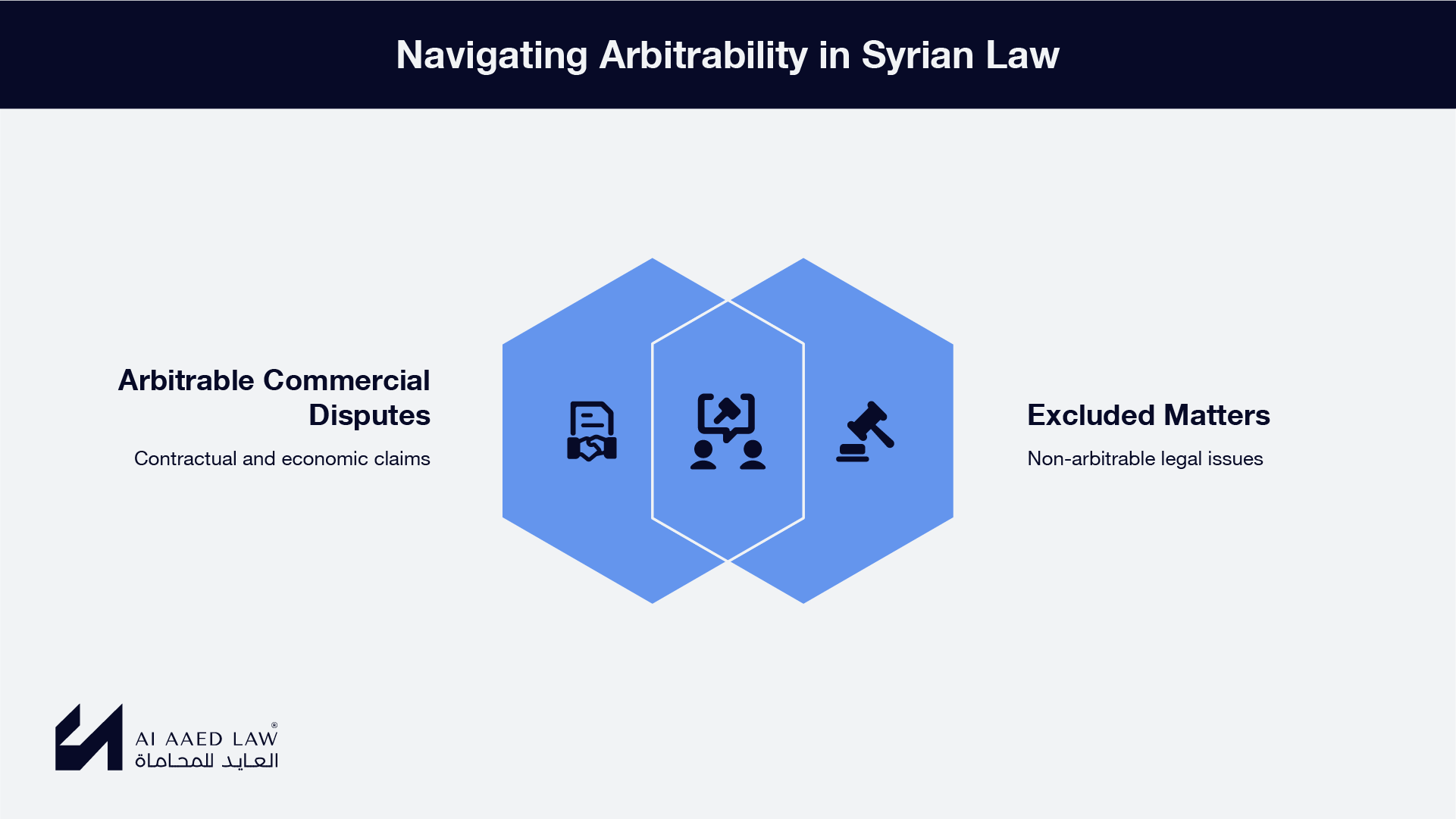
The definition is broad enough to include many contractual and non-contractual disputes arising from an economic relationship. Typical examples may include payment, performance, quality, delay, termination, indemnity, shareholder obligations, distribution, licensing, construction and investment-related claims.
Arbitrability should be reviewed claim by claim. A contract may contain both arbitrable commercial issues and mandatory regulatory, criminal, registration or status questions that a tribunal cannot finally determine.
Matters excluded by law or public policy
Article 9 requires the party agreeing to arbitration to have legal capacity to dispose of the relevant rights. It excludes matters that cannot be settled, matters contrary to public policy, nationality and personal-status matters, except for their resulting financial effects.[3]
The exclusion is important at both the clause and enforcement stages. Relabelling a non-arbitrable matter as a damages claim does not necessarily cure the problem. The tribunal’s jurisdiction, the remedy requested and the public-policy effect should be tested separately.
Administrative contracts require separate analysis
Article 2 does not place public administrative-contract disputes on exactly the same footing as ordinary private commercial disputes. Transactions involving ministries, public bodies, concessions, public procurement or administrative contracts require specific advice on authority, approvals, governing rules and competent forum before an arbitration commitment is made.[1]
Creating a valid arbitration agreement
The writing requirement
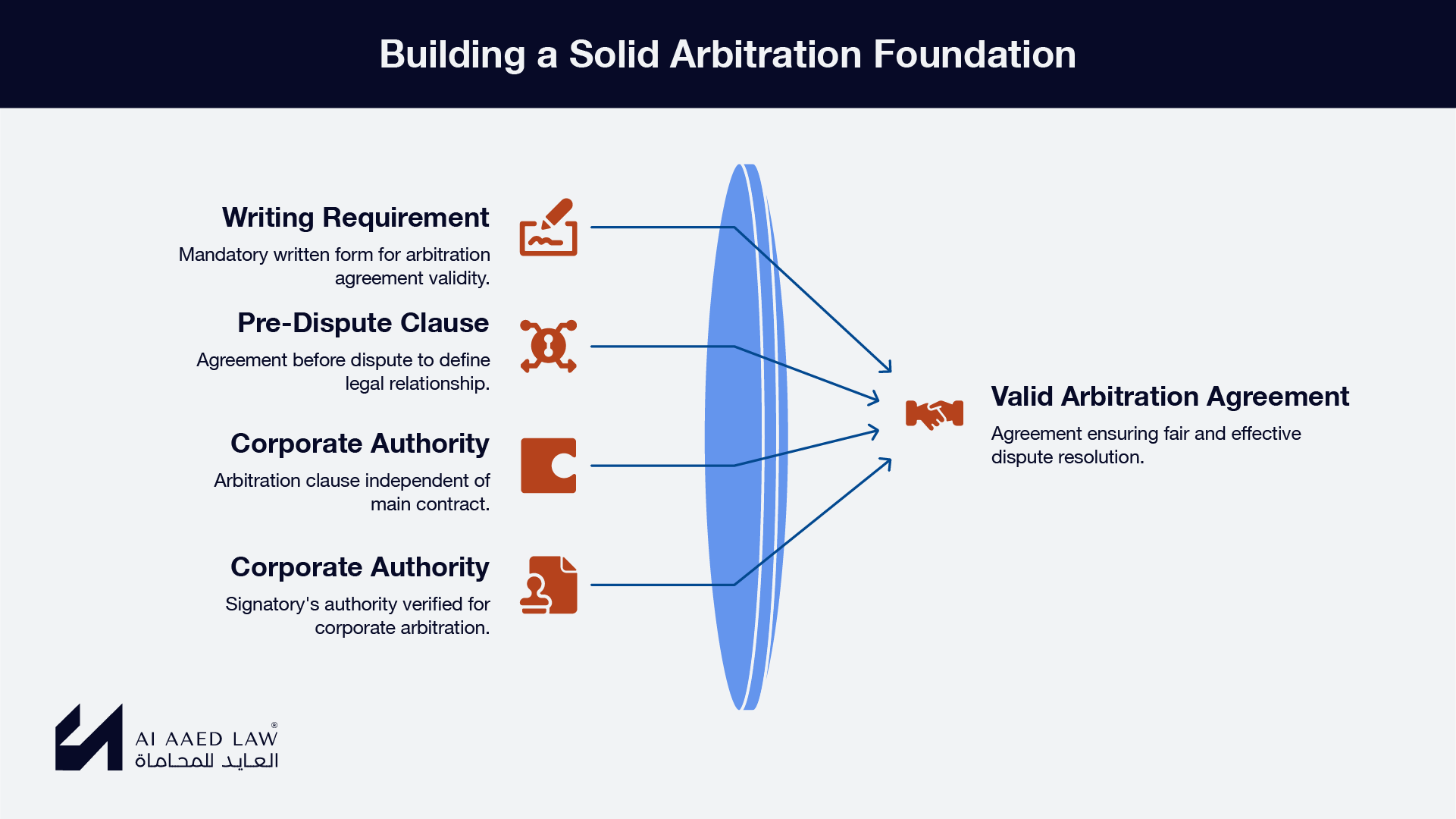
Article 8 makes writing mandatory. The agreement may be in a contract, official or private document, minutes, or written communications—including email, fax or telex—that prove the parties’ matching intention to choose arbitration.[2]
The safest approach is one signed, complete clause in the operative contract. Incorporation by reference, purchase orders, email chains and conflicting standard terms create avoidable disputes about whether consent was actually reached and which terms govern.
A clause before the dispute or a submission agreement afterward
Article 7 permits parties to agree on arbitration before a dispute arises or after it has arisen. A pre-dispute clause should define the legal relationship and covered disputes. A post-dispute submission agreement can be more precise because the parties already know the claims, but agreement is harder once positions have hardened.[1]
Separability protects a properly drafted clause
Article 11 treats the arbitration clause as independent from the remaining contract. Termination, invalidity, rescission or expiry of the main contract therefore does not automatically destroy a clause that is valid in itself, unless the parties agreed otherwise.[2]
Separability does not save a clause affected by its own defect, such as lack of written consent, incapacity, non-arbitrability or invalid authority.
Corporate authority to agree to arbitration
Because arbitration displaces ordinary court determination of the merits, the signatory’s authority should be verified. Review the company’s articles, registered signatories, board or shareholder reserved matters, powers of attorney and any public-body approval requirements. Record the approval in the closing file.
An arbitration clause signed by an operational employee who could place orders but could not agree dispute jurisdiction may generate a preliminary fight before the merits are ever heard.
Drafting an effective arbitration clause
| Clause element | Question to answer | Risk if omitted | Drafting response |
|---|---|---|---|
| Scope | Which contractual and non-contractual disputes are covered? | Fragmented court and arbitration proceedings | Use clear relationship-based scope and address connected agreements |
| Rules | Which institution or ad hoc rules apply? | No workable procedure or mistaken institution | Use the institution’s exact current name and model clause |
| Seat | What is the legal place of arbitration? | Uncertainty over supervisory court and annulment law | State the city and country expressly |
| Tribunal | One or three arbitrators, and how appointed? | Delay, cost or invalid even-number tribunal | Match complexity and value; ensure an odd number |
| Language | What language governs pleadings, evidence and award? | Translation disputes and cost | Choose expressly and address bilingual documents |
| Governing law | Which substantive law governs the contract? | Separate threshold dispute | State it separately from procedural rules and seat |
| Notice | Where and how are arbitration notices validly served? | Default, delay and annulment risk | Align contract notices with institutional rules and current addresses |
| Consolidation | How are related contracts and parties handled? | Parallel inconsistent cases | Use compatible clauses and available joinder/consolidation mechanisms |
Essential elements
A robust clause normally identifies the covered relationship, final referral to arbitration, chosen rules or ad hoc procedure, seat, number and appointment method of arbitrators, language and governing law. It should also be consistent with notice, escalation, governing-law, jurisdiction and sovereign-immunity provisions elsewhere in the contract.
For illustration only, a framework may state that disputes arising out of or in connection with the agreement—including existence, validity, interpretation, performance, breach or termination—will be finally resolved under identified rules, by one or three arbitrators, with a specified seat and language. The final clause must be customized; copying this concept is not legal review.
Institutional or ad hoc arbitration
Article 22 permits the parties to adopt the rules of a permanent arbitration organization or centre inside or outside Syria. Without an agreement, the tribunal selects appropriate procedures subject to the Law.[4]
Institutional arbitration provides appointment, fee and case-management mechanisms. Ad hoc arbitration can avoid institutional administration, but the clause should specify appointment and replacement procedures, rules, fees, communications and the authority that resolves deadlock. Do not name a centre without checking that it exists, accepts the case and offers the intended rules.
Multi-party and multi-contract transactions
A project may include a main agreement, guarantee, supply contract, licence, shareholder agreement and financing documents. If their clauses use different seats, rules or forums, one factual dispute can become several proceedings.
Map the whole transaction before signature. Decide which parties must be bound, whether claims should be consolidated, how non-signatories and guarantors are treated, and whether interim or insolvency-related remedies require court access. Compatible wording is more important than identical wording copied without analysis.
Seat, venue, language and governing law
Seat is a legal choice, not a meeting room
Article 23 allows parties to choose a place of arbitration in Syria or abroad. Without agreement, the tribunal selects it considering the case and convenience. The tribunal may still meet elsewhere for hearings, witnesses, experts, inspections or document review after proper notice.[4]
The seat typically connects the arbitration to supervisory courts and procedural law. A hearing held online or in another city does not necessarily change the agreed seat. Use “seat” or “legal place” expressly rather than relying only on “venue.”
Language and translation
Arabic is the default under Article 24 unless the parties agree otherwise or the tribunal determines another language. The tribunal may require sworn Arabic translations of documents.[4]
For a bilingual transaction, state the arbitration language and which contract version prevails. Budget for certified translation of corporate records, notices, expert material and the award where enforcement in Syria may be needed.
Substantive law is separate from procedural rules
Articles 5 and 38 respect the parties’ choice of substantive rules. If the parties choose a state’s law, the tribunal applies its substantive rules rather than its conflict rules unless agreed otherwise. In the absence of a choice, the tribunal applies the substantive law it considers most closely connected, while respecting contract terms and relevant trade usages.[1][5]
Naming institutional rules does not automatically choose the contract’s governing law, and choosing Syrian law does not by itself select Damascus as the seat. State each choice separately.
Selecting and appointing the tribunal
Number and appointment method
The parties may choose one or more arbitrators. If they do not agree, the default is three. Where there is more than one, the number must be odd or the arbitration is void. Appointment provisions should include deadlines and a fallback appointing authority.[2]
One arbitrator may be proportionate for a focused dispute. Three can add expertise and confidence in a high-value or cross-border matter but increase time and cost. The clause should not require qualifications so narrow that no eligible arbitrator can be found.
Independence, impartiality and disclosure
Article 17 requires written acceptance and disclosure of circumstances that may raise doubts about independence or impartiality, whether existing at acceptance or arising later. Article 18 permits challenge on the grounds applicable to judges or loss of statutory qualifications.[4]
Parties should conduct conflict checks early and update them. Professional familiarity is not automatically disqualifying, but undisclosed financial, personal or professional connections can damage the process and award.
The tribunal decides its jurisdiction first
Article 21 authorizes the tribunal to decide objections about the existence, expiry, invalidity or scope of the arbitration agreement. An objection that a new issue falls outside the clause must be raised immediately or the right may be lost. A rejected jurisdiction objection can later be relied on through an annulment action against the award.[4]
Starting and managing the proceedings
Notice, claim and defence
The contract and selected rules should identify how a notice of arbitration is served and when proceedings commence. Preserve proof of delivery, corporate authority and the clause relied upon. The claimant should define relief, facts, legal basis and evidence; the respondent should preserve objections while answering the merits within the timetable.
Delay can prejudice appointment rights, evidence, protective relief, limitation arguments and settlement leverage. A dispute team should be formed as soon as a credible notice or claim appears.
Equal treatment and the right to be heard
Article 25 requires equal treatment and a sufficient, equivalent opportunity for each party to present its case and defend its rights. Defective notice, refusal to hear material evidence or an inability to present a defence can later support annulment or resistance to enforcement.[4][6]
Procedural efficiency must therefore remain fair. A tribunal may control repetition and late material, but the file should show that each party received notice and a real opportunity to respond.
Hearings, evidence, experts and confidentiality
The tribunal may decide on written materials or hold hearings under Article 29. Hearings are confidential unless the parties agree otherwise; minutes are signed and supplied to the parties. The Law also addresses experts, witnesses and court assistance for procedures the tribunal cannot compel itself.[4]
Businesses should issue a legal hold, preserve emails and accounting data, stop routine deletion, identify custodians and protect privilege and confidentiality. Evidence management often decides the case before the hearing begins.
Interim and protective measures
Tribunal and court routes
Article 38 permits interim or partial awards. It also allows either party to apply to the urgent-matters judge before or during arbitration for a protective measure under the Civil Procedure rules.[5]
The correct route depends on the relief, seat, selected rules, location of assets or evidence and whether coercion against a third party is required. Seeking protective relief should be coordinated with the arbitration strategy so that a party does not undermine its jurisdiction position or miss notice requirements.
Protecting assets and evidence
Common objectives include preserving goods, records, project sites, funds or the status quo. The applicant should establish urgency, the legal basis, the asset or evidence, the harm threatened and the connection to the claim. A generic fear that the respondent may not pay is not a substitute for the evidence required by the competent authority.
Time and cost control
The statutory award period
The parties may agree a time for the final award. Without agreement, Article 37 requires the award within 180 days from the tribunal’s first session. The tribunal may extend once for no more than 90 days. A party may then request a further court extension of no more than 90 days within ten days after expiry. If time expires without an award, either party may return to the competent court unless they agree to arbitrate again.[5]
These periods should be calendared from the correct procedural event. Parties should not assume that institutional rules silently displace mandatory statutory consequences.
Budgeting the case
The budget should include arbitrator and institution fees, lawyers, experts, translators, hearing facilities, technology, travel, court applications and enforcement. Cost control begins with a proportionate tribunal, clear issues, document protocols, a realistic timetable and early analysis of settlement and collectability.
The arbitral award
Form, reasons and required content
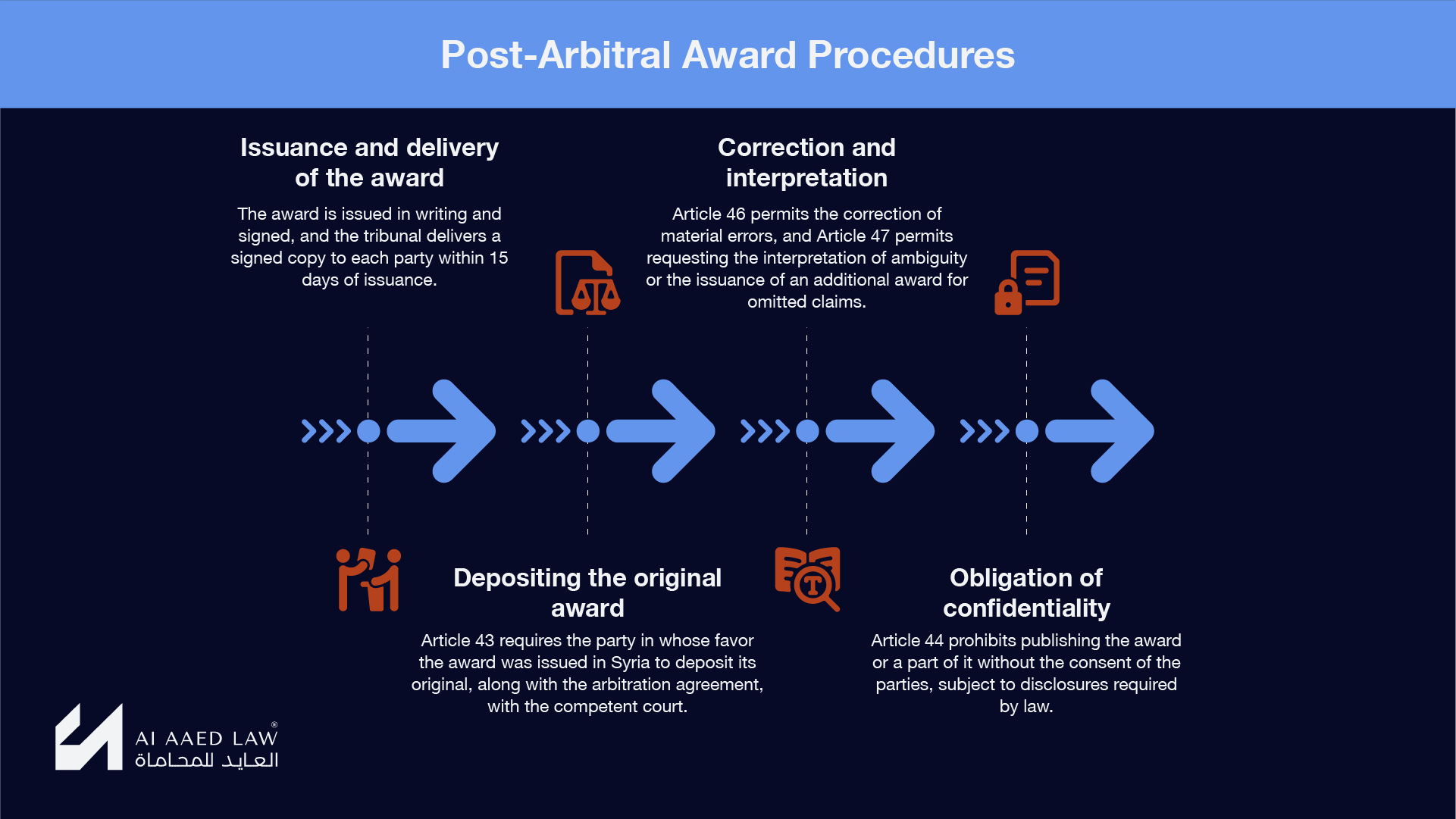
The award must be written and signed under Article 41. Article 42 requires party and arbitrator details, the arbitration agreement, claims and submissions, operative decision, date and place, fees and their allocation. It should be reasoned unless the parties agree otherwise or the applicable procedural law does not require reasons, and it is issued in the arbitration language.[1]
The tribunal must provide a signed copy to each party within 15 days of issuance. Where the award is made in Syria, Article 43 requires deposit of the original award and arbitration agreement with the competent court by the successful party.[1]
Correction, interpretation and omitted claims
Article 46 permits correction of purely material, arithmetic or writing errors within the statutory period. Article 47 permits a party to request interpretation of ambiguity in the operative part or an additional award on claims presented but omitted, generally within 30 days after notification.[1]
These mechanisms do not reopen the merits. A party should review the award immediately and distinguish a correctable error from an annulment issue.
Confidentiality after the award
Article 44 prohibits publication of the award or part of it without both parties’ consent.[1] That rule does not remove disclosure duties arising from enforcement, law, regulation, audit or financing. The contract and procedural order should address who may receive confidential material, redaction, data security and permitted disclosures.
Annulment is not an appeal on the merits
Limited grounds
Article 49 makes awards final and not subject to ordinary methods of appeal, while preserving the annulment action. Article 50 limits annulment to specified defects: no valid or continuing agreement; incapacity; inability to present a defence due to defective notice or another external reason; exclusion of the agreed substantive law; improper tribunal formation; decisions outside the clause; or invalidity in the award or procedure that affected it. The court must also annul an award that violates Syrian public policy.[6]
Disagreement with the tribunal’s interpretation or factual conclusion is not, by itself, an annulment ground. The challenge must be tied to the statute and supported by the procedural record.
Deadline, court and effect
The annulment action must be filed within 30 days after the award is notified to the losing party. The competent court is the court identified by Article 3. If the court rejects the annulment action, its decision operates as the executory formula for the award.[6]
Filing an annulment action does not automatically stay enforcement. The court may grant a stay for no more than 60 days where requested in the claim and serious irreparable harm is feared, potentially subject to security.[7]
Recognition and enforcement
Domestic awards and the executory formula
Awards have res judicata effect and bind the parties under Article 53. Compulsory execution follows after the executory formula. The application requires the original or certified award, the arbitration agreement or contract clause, a sworn Arabic translation if the award is in another language, and the court-deposit record required by Article 43.[7]
Execution cannot occur before the annulment period expires. Before granting the formula, the court verifies that the award does not conflict with an earlier Syrian judgment on the dispute, violate Syrian public policy, or lack valid notification to the losing party.[7]
Foreign awards and the New York Convention
For a foreign award, the analysis begins with the New York Convention and any other applicable treaty, then moves to Syrian procedural requirements. The applicant should expect to establish an enforceable arbitration agreement and final award and to supply authenticated documents and Arabic translations. The opposing party may rely on the limited refusal grounds in the Convention and applicable Syrian law.[8][9]
Do not assume that an award made abroad will be treated exactly like a Syria-seated award. The seat, treaty relationship, court jurisdiction, public policy and procedural route must be confirmed for the particular case.
Plan enforcement before filing the claim
Identify assets, ownership, security, competing creditors, corporate structure and relevant jurisdictions before choosing the seat or spending heavily on the merits. Review whether the desired relief is enforceable where the assets are located and whether a guarantor, parent, shareholder or public entity is actually bound by the clause.
An award is a legal result; recovery is an asset and procedure question.
Cross-border arbitration checklist
Identify every contracting party, guarantor and intended beneficiary accurately.
Confirm each signatory’s legal capacity and corporate or public authority.
Map the whole contract suite and make dispute clauses compatible.
Define the disputes and relationships covered, including non-contractual claims where intended.
Choose a functioning institution or a complete ad hoc mechanism.
State the legal seat, tribunal number, appointment route and fallback authority.
State the arbitration language and prevailing contract language.
State substantive governing law separately from procedural rules.
Align notices, escalation, limitation, expert determination and interim-relief wording.
Review arbitrability, public policy, sector approvals and administrative-contract issues.
Identify evidence, assets, enforcement countries and treaty coverage.
Obtain transaction-specific Syrian and seat-law advice before signature.
Arbitration-clause warning signs
The clause says only “arbitration” without scope, seat, rules or appointment method.
It names a centre incorrectly or uses an outdated institution name.
It requires two arbitrators without a mechanism for an odd-number tribunal.
It confuses governing law, procedural rules, seat and hearing venue.
Connected contracts send related disputes to different forums.
The clause covers only “breach” but not validity, termination or non-contractual claims.
Notice details no longer match the parties’ legal names or addresses.
A multi-step negotiation period can be used indefinitely to block commencement.
A public body or company signatory lacks documented authority to arbitrate.
The remedy sought may affect rights or parties outside the tribunal’s jurisdiction.
The clause promises absolute confidentiality that enforcement cannot preserve.
No one examined where the respondent’s assets are located.
A 30-day dispute-response plan
Preserve the contract, amendments, clause, approvals, notices and complete communications.
Record the date and method of every notice received or sent.
Check scope, seat, rules, tribunal appointment, language and governing law.
Identify jurisdiction, arbitrability, authority and limitation objections immediately.
Issue a legal hold covering email, messaging, accounting, project and device data.
Build a claim chronology, loss model, defence map and key-document index.
Locate assets and assess whether urgent protective relief is justified.
Complete arbitrator and counsel conflict checks before nominations.
Prepare a realistic budget, decision authority and settlement range.
Coordinate arbitration, court, regulatory, insurance and communications workstreams.
Legal notice
This article provides general information on the Syrian legal framework as reviewed on 9 September 2026. It is not legal advice and does not address every contract, public-body approval, regulated sector, foreign law, treaty, sanctions measure, procedural fact or enforcement jurisdiction. Laws, instructions and administrative practice may change. Obtain advice on the clause, dispute, assets and current requirements before taking or delaying action.



.webp)