Research date 21 September 2026
A business can pay for a website, receive the finished files and still face uncertainty about whether it may modify the content, reuse the photographs or transfer the software to another company. The difficulty often lies in the contract: delivery of a work and ownership of the rights in that work are separate questions.
Copyright law in Syria protects qualifying creative works automatically. It also sets specific rules for authorship, employee contributions, transfers of economic rights and permitted uses. For businesses, the practical task is to identify the work, establish who controls each right and record the uses the business needs before publication or commercial exploitation. Articles 2, 8, 10 and 13–18 of Legislative Decree 62 of 2013.
This guide explains those rules for businesses, software developers, agencies, publishers and independent creators. It focuses on copyright ownership and use of creative and digital works, including the evidence and remedies that matter when copying occurs.
Which law governs copyright in Syria
The principal statute used in this guide is the Law on the Protection of Copyright and Related Rights issued by Legislative Decree No. 62 of 2013. Article 104 repealed the earlier Copyright Law No. 12 of 2001. The 2026 date identifies this guide’s research year; it does not refer to a new copyright law enacted in 2026. Official legislative text in WIPO Lex.
The law covers authors’ rights and related rights held by performers, producers and broadcasters. One commercial project can therefore contain several protected layers: a video may involve a script, music, performances and a recording. Permission from one contributor may leave other rights unresolved.
What copyright protects
Creative content and original expression
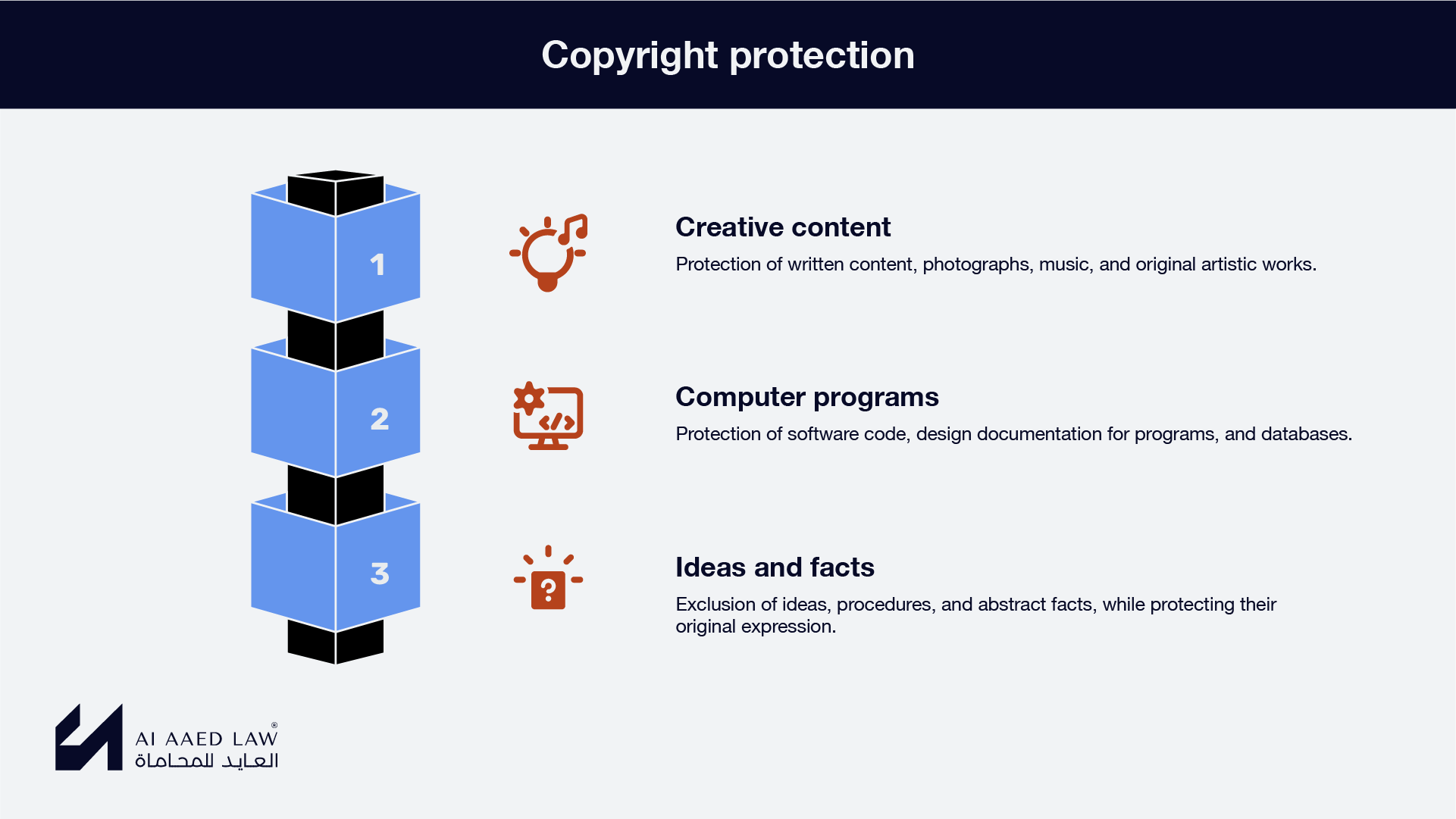
Article 2 protects original literary, scientific and artistic works from creation, regardless of their value, purpose or form. Examples include written content, photographs, music, audiovisual works, drawings and architectural plans. Protection does not depend on publication or on the work being fixed on a physical carrier. An original title can also qualify. Article 2.
For a company, potentially protected assets include product photography, training materials, website copy and commissioned illustrations. Whether a particular item qualifies depends on its creative characteristics; a routine phrase or basic layout should not automatically be treated as an exclusive asset.
Software and databases
Article 2 expressly includes computer programs in source and machine language, together with specified design documentation. It excludes the program interface and the underlying ideas and theories from that provision. A business should therefore distinguish code and documentation from the general functionality it wants to protect.
Databases may qualify where the selection, arrangement or relationship of their contents is original. Protection of that structure does not create ownership of the underlying data or remove separate rights in material included in the database. Article 2 paragraphs b9 and b10.
Ideas facts and other exclusions
Article 4 excludes mere ideas, procedures, working methods, mathematical concepts, abstract facts, discoveries and data, while allowing protection for their original expression. It also excludes official legal texts and mere news information, subject to the law’s treatment of original compilations. Articles 3 and 4.
An app concept and the code implementing it require different analyses. Likewise, copyright in a logo’s artwork does not by itself settle trademark protection for the brand. For the broader distinction between these rights, see Al AAED’s guide to intellectual property protection in Syria.
Automatic protection and copyright deposit
Copyright protection does not begin only after registration. Article 2 provides protection without formalities, and Article 67 expressly confirms that deposit is not a condition of protection. Articles 2 and 67.
Deposit can nevertheless support evidence. Under Articles 66–68, the statutory system involves the Ministry of Culture’s Directorate for the Protection of Copyright and Related Rights. The law describes an application identifying the author or rights holder, the work and its specifications, accompanied by two copies and evidence of entitlement where the applicant is a successor. Agents must establish their authority. Information technology works have an additional verification requirement involving the communications and technology authority named in the statute.
Article 68 treats a deposit document as rebuttable evidence of the information it records. It is not an unchallengeable judgment that the depositor owns every right. Current submission arrangements, responsible departments and fees should be confirmed before filing; this guide does not assume that the administrative process remains identical to the wording of the 2013 statute. Articles 66–68.
Keep original files, dated drafts, version histories, signed contracts and publication records whether or not deposit is used. Together they help explain creation and the sequence of ownership transfers.
Economic rights and moral rights
Rights to exploit the work
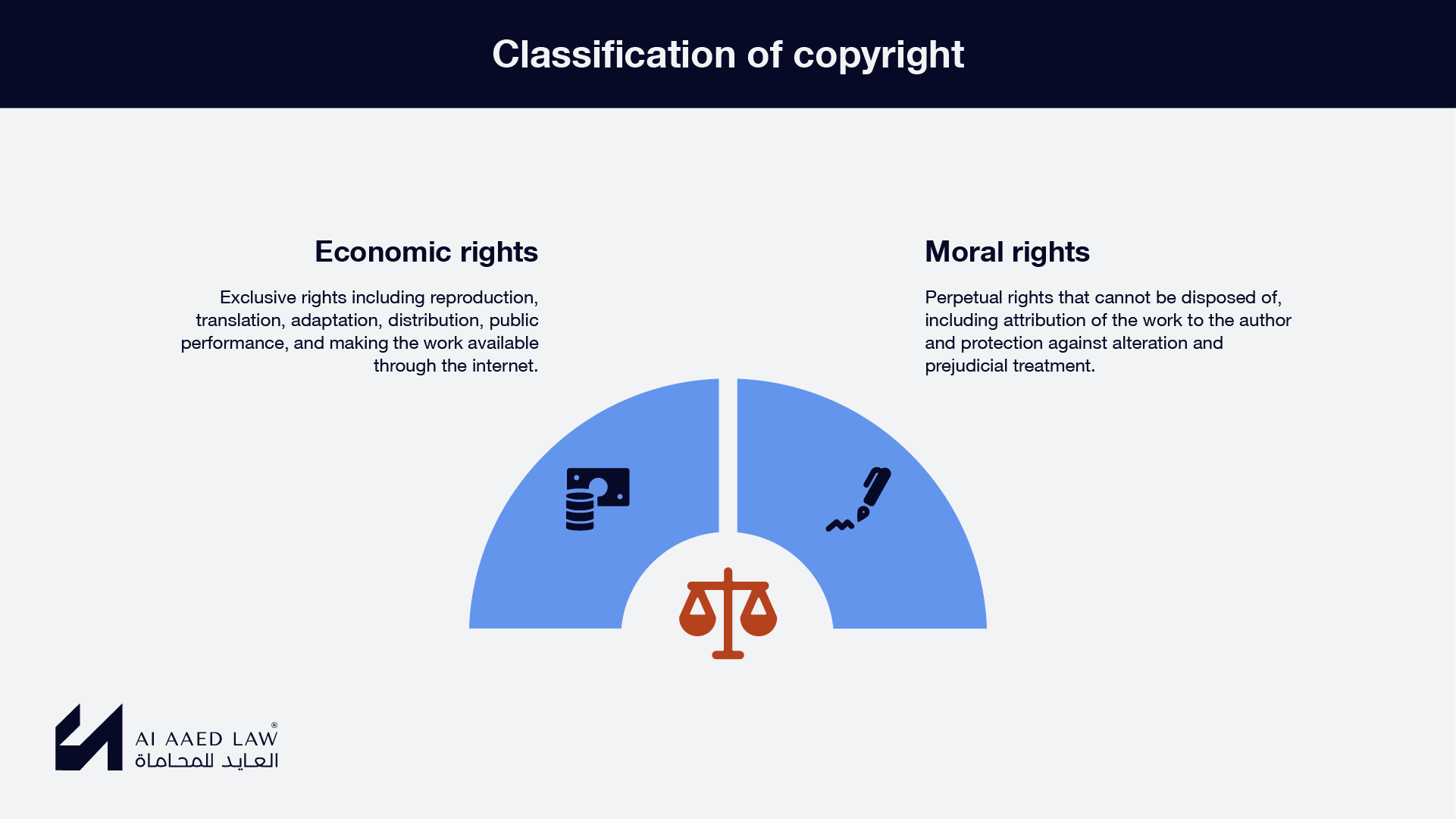
Article 6 gives the author or successor exclusive economic rights including reproduction, translation and adaptation, distribution of physical copies, public performance and making the work available through computers, the internet and other networks. The relevant permission depends on the intended use. A print licence, for example, should not be assumed to cover an online campaign or a translation. Article 6.
Rights that remain separate from a transfer
Article 5 protects moral rights, including attribution, decisions about first publication and protection against alteration and prejudicial treatment. These rights are perpetual and cannot be disposed of. A transfer of economic rights does not transfer or extinguish the author’s moral rights.
The law also allows an author to seek a court order preventing circulation or withdrawing a work for serious reasons, with fair compensation paid in advance to the economic rights holder as ordered by the court. This is a qualified statutory process, not an unrestricted right to cancel a commercial licence. Article 5.
Who owns work created for a business
The author as the starting point
Article 13 starts with the author as the holder of moral and economic rights unless another provision applies. The name appearing on a work is relevant to the statutory authorship presumption, but contrary evidence can rebut it. An invoice, website footer or company watermark should not replace a documented ownership analysis. Article 13.
Joint works and collective works
A joint work under Article 14 involves several authors and is distinct from a collective work. Unless a signed written or electronic agreement provides otherwise, the joint authors hold rights equally and cannot exercise them individually. The law makes specific provision for separable contributions and permits each joint author to seek protective measures against infringement.
Article 17 addresses a collective work produced through contributions combined under the initiative and direction of a person or entity that publishes it in its own name. Subject to the statutory conditions and any contrary signed agreement, the person or entity described in that article owns the moral and economic rights in the collective work. A project does not become a collective work simply because a company paid several contributors. Articles 14 and 17.
Employee work under Article 18
Article 18 needs particular care because its paragraphs operate together:
- Paragraph a allocates rights to the worker who creates the work in performance of a contract or obligation to devote effort to creating it, unless a signed written or electronic agreement provides otherwise.
- Subject to paragraph a, paragraph b allocates rights to the employer where a worker creates, during employment, a work connected with the employer’s or funder’s activities, or uses employer equipment or materials made available to the worker, unless agreed otherwise in the required form.
- Paragraph c preserves the worker’s rights in an unrelated creation made without using the employer’s expertise, information, tools or raw materials, unless agreed otherwise in the required form.
These provisions do not support a blanket rule that every employee creation belongs to the employer. Review the contractual assignment, duties, circumstances of creation and resources used, then record the intended allocation clearly. Article 18.
Independent contractors and agencies
For commissioned work, identify the actual author and any applicable special ownership rule before relying on the contractor’s promise. Paying a photographer, designer or agency is not a substitute for a valid transfer or licence. Article 10 specifically separates ownership of the physical copy from copyright, while Article 8 prescribes the form and detail required for transactions in economic rights.
An agency agreement should address its employees, subcontractors and third party materials. Ask for evidence that the agency can grant the rights it promises, rather than relying only on a general statement that the client owns the finished project. Articles 8, 10 and 13–18.
Software producers and audiovisual producers
Articles 15 and 16 contain special provisions for contributors to audiovisual works and computer programs. They also provide for a producer to represent authors in exploitation unless a signed written or electronic agreement provides otherwise. Article 27 separately grants producers specified related rights.
Production, representation and ownership therefore need separate treatment in the contract. Funding software or a video should not be treated as proof that every contributor’s rights have been assigned. Articles 15, 16 and 27.
How to structure an assignment or licence
Specify each right and its limits
An assignment transfers the economic rights identified in the agreement. A licence authorizes defined uses while ownership remains with the rights holder to the extent it has not been transferred. The commercial label alone does not resolve the arrangement.
Article 8 requires a legally acceptable written or electronic instrument identifying each right separately and specifying its purpose, exploitation period and place. It declares undocumented assignments and assignments expressed in general terms invalid. A clause stating only “all intellectual property belongs to the client” is therefore a poor substitute for a detailed rights schedule. Article 8.
For a website, software product or content campaign, address:
- The work. Identify deliverables, versions, source files and excluded pre-existing material.
- The rights. Specify copying, translation, adaptation, distribution and online availability as applicable.
- The scope. State territory, term, permitted media and whether use is exclusive.
- Further permissions. Address sublicensing, group company use and transfer with a business sale.
- Payment. Define the amount or royalty basis and when the relevant rights become effective.
- Third party content. Identify stock photographs, fonts, music, code libraries and their licence restrictions.
- Delivery and disputes. Specify editable files, access credentials, attribution, approval of contemplated edits and the response to ownership claims, while respecting moral rights.
The statutory requirements and practical commercial provisions should be drafted together. Al AAED’s commercial agreement drafting guide discusses the wider contract structure.
Avoid unrestricted future assignments
Article 9 permits percentage based remuneration, a lump sum or a combination. Article 11 allows an author to terminate where the contracting party has unjustifiably failed to exploit the work for two calendar years, without prejudice to compensation.
Article 12 invalidates an assignment of all the author’s future intellectual production, subject to the special collective management provisions in Articles 49 and 50. Identify the project and deliverables rather than using an unlimited assignment of everything a creator may produce in the future. Articles 9–12 and 49–50.
How long copyright protection lasts
The economic protection period depends on the category of work. Applying one duration to all content can produce the wrong result. The principal statutory periods are:
| Category | Economic protection period |
|---|---|
| Ordinary author work | Author’s life plus 50 years following the end of the year of death |
| Joint work | Lives of the authors plus 50 years following the end of the year of the last surviving author’s death |
| Audio or visual works and collective works | 50 years from the beginning of the year after first publication; if unpublished within 50 years of completion, the statutory calculation runs from the beginning of the year after completion |
| Anonymous or pseudonymous work | 50 years from first publication; the ordinary or joint authorship rules apply if the author is known or identified within that period |
| Applied art | 25 years from the beginning of the year after completion |
| Database | 15 years from the beginning of the year after completion |
Articles 19–23. These are economic rights periods; moral rights remain governed by Article 5. Before reusing an older work, check its category, relevant dates and any separate rights in a later translation, adaptation, performance or recording. Article 24 addresses entry into the public domain when protection expires.
When use without permission may be allowed
The law contains specific exceptions. Their conditions matter, and giving credit does not by itself make copying lawful.
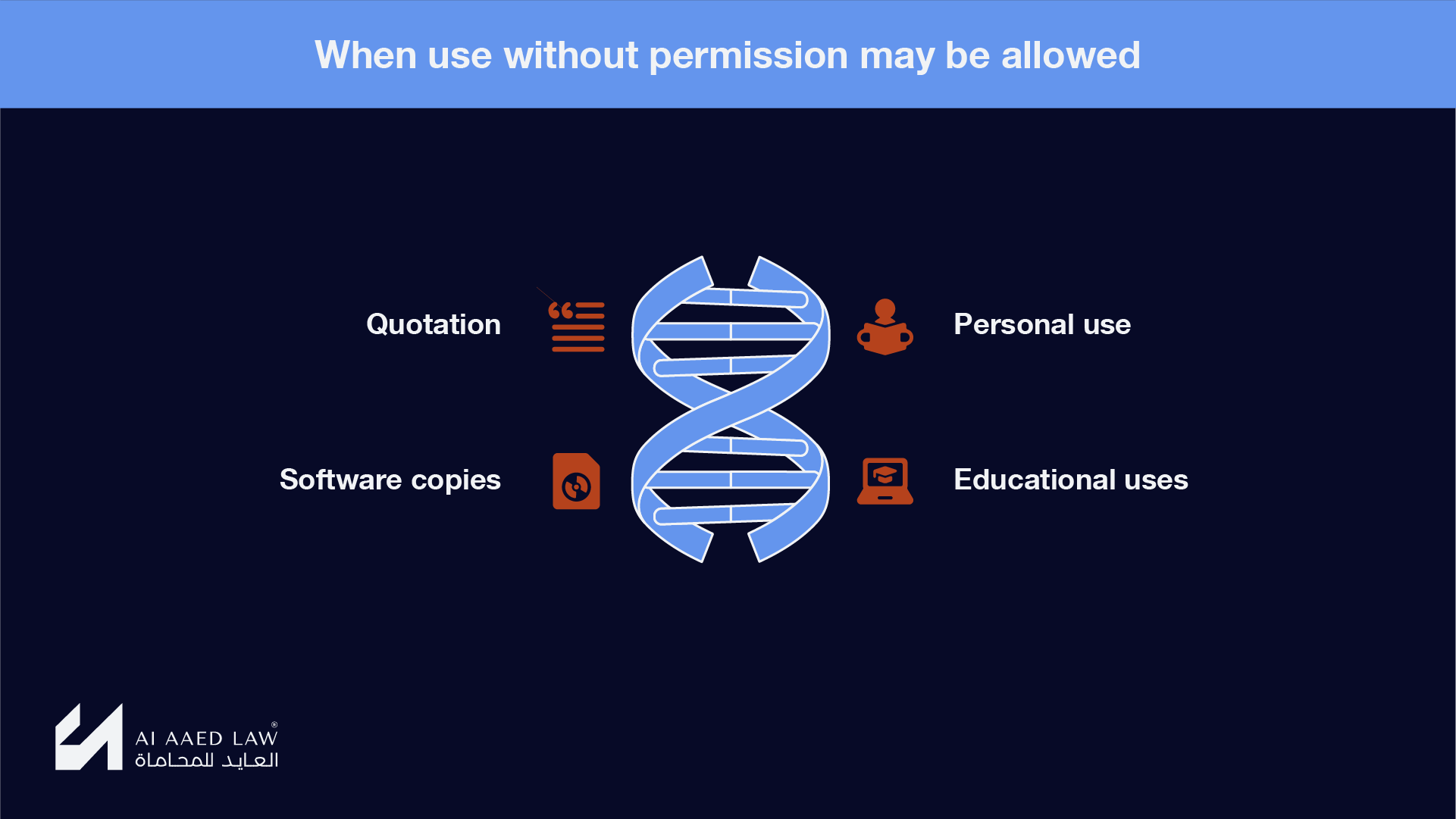
Article 35 permits a short quotation from a published work to the extent necessary for its purpose, with the source and author identified where stated in the source. It also provides defined educational uses. These provisions do not establish a general permission to republish an article or use an entire commercial image collection. Article 35.
Article 33 allows a single copy of a lawfully published work for strictly personal use, with exclusions including substantial photocopying, certain digital databases and software except under Article 40. Article 40 gives a lawful software copy holder specific permissions, including up to three copies for the purposes it specifies and necessary migration between computing environments for private use. It also imposes conditions when lawful possession ends. Articles 33 and 40.
Business use should be assessed against the actual exception or licence. A foreign platform’s “fair use” explanation does not establish that a Syrian statutory exception applies. Article 46 also preserves moral rights when exceptions operate.
A practical example when buying a website
Consider a hypothetical company commissioning a website from an agency. The site contains custom code, original product photographs, stock images and a licensed font. The agency delivers administrator access and an invoice marked “paid”.
Before translating the site, launching it in another market or selling the business, the company should check four separate points: the agency’s authority over its original contributions, the rights actually granted to the company, restrictions attached to third party components, and access to the files required for future changes.
The contract may need a rights schedule for custom material and a separate list of third party licences. Source code delivery should be an express obligation where required. Photographs of identifiable people can also raise consent issues distinct from ownership of the photograph; Article 99 contains specific portrait rules and exceptions. Articles 8, 10, 13–18 and 99.
This example illustrates why a signed specification and rights schedule are useful before launch. It is not a reported case or a guarantee that every website requires the same arrangement.
What to do when your work is copied
Preserve evidence and establish entitlement
Keep the original files and a record of the suspected copy, including URLs, dates, screenshots and the relevant material in context. Preserve contracts, licence terms, creation records and any deposit certificate. Record how the copying differs from an authorized use and what loss or commercial benefit can be evidenced.
The purpose is to establish both ownership and the alleged act. Similarity alone may not resolve whether protected expression was copied, whether a licence applies or whether a statutory exception permits the use.
Choose an appropriate response
A lawyer can assess a demand to stop use, negotiations over a licence, a platform complaint or judicial action. A platform complaint must meet that service’s rules and should accurately identify the rights claimed. Removing material from one platform does not resolve every claim or prevent copies elsewhere.
Where loss of evidence or continuing harm is a concern, obtain advice on urgent measures before taking steps that may alert the other party or cause evidence to disappear.
Understand court measures and deadlines
Articles 75 and 76 provide for protective measures, including stopping infringement, documenting the act and attachment of specified copies or equipment. Orders depend on supporting evidence, and the court may require security.
Article 76 paragraph a3 requires a claim on the merits within eight days from issuance of the attachment decision described there, otherwise that decision loses effect. This deadline should not be generalized to every copyright complaint, but it makes prompt procedural advice essential when that measure is sought.
Article 77 provides for fair compensation assessed by the court with reference to commercial value, lost profit, loss suffered and the infringer’s gain. Articles 82–87 also address offences and complaint requirements. Civil liability and criminal liability have different elements; no fixed recovery or outcome should be assumed. Articles 75–77 and 82–87.
Protection when work crosses borders
Articles 93 and 97 address the law’s territorial and treaty related scope. WIPO records the Berne Convention as in force for Syria since 11 June 2004. Treaty protection can be relevant to Syrian work used abroad and foreign work used in Syria. Articles 93 and 97; WIPO Berne membership record.
This does not create a single worldwide registration or enforcement procedure. Identify where the conduct occurs, the applicable local law, the parties and any contractual choice of forum. An online licence should expressly address its intended geographic reach. WIPO overview of the Berne Convention.
A copyright checklist for businesses
- List commercially important content, software, photographs and other creative assets.
- Identify the creators and the statutory or contractual basis for ownership.
- Obtain specific signed transfers or licences where needed.
- Record third party permissions and restrictions in one accessible register.
- Agree attribution, contemplated changes and the files to be delivered.
- Retain dated originals, correspondence and evidence of the sequence of transfers.
- Assess whether deposit would strengthen the evidence available.
- Review rights before translation, a new campaign, sublicensing or a business sale.
These steps are practical recommendations. Their application depends on the work, the contract and the statutory rules described above.
Legal notice
This article provides general information based on sources checked on 21 September 2026. It is not legal advice for a particular work, contract or dispute. Applicable amendments, administrative arrangements and procedural requirements should be verified for the matter concerned.