Introduction
An invention can lose much of its commercial value before a patent application is filed. A founder may demonstrate a prototype to a buyer without confidentiality terms, a researcher may publish a paper, or an employer may fail to document who owns an employee invention. The technical work may be strong, yet the legal position becomes uncertain because novelty, ownership and filing priority depend on actions taken before public disclosure.
Patent law in Syria is governed principally by Law No. 18 of 2012 on the granting, registration and publication of patents and the rights arising from registration. The Law covers invention patents, utility models, integrated-circuit layout designs and undisclosed information. This guide concentrates on invention patents and explains the filing route, examination, opposition, ownership, maintenance, transactions and enforcement rules reviewed on 9 September 2026.[1]
The article is intentionally narrower than Al AAED Law's general guide to intellectual-property protection. It addresses the decisions that arise when a specific technical invention may be patentable. Filing requirements, official forms, fees and administrative practice should be confirmed with the competent Directorate immediately before submission.
Quick answer
A Syrian invention patent may be granted when an invention is industrially applicable, new and based on an inventive step. It can concern a product, a manufacturing process, both of them, or a new application of a known industrial process. The Law excludes several categories, including scientific theories, mathematical methods, software as such, business methods, certain biological subject matter and methods of medical treatment or diagnosis.[1]
The application is filed with the Directorate responsible for commercial and industrial property protection. It must identify one invention or a linked inventive concept and include a sufficiently complete technical description, the elements claimed as new and drawings where needed. The Directorate conducts formal and substantive examination. Accepted applications are published and may face opposition before a patent is granted.[2]
An invention patent lasts twenty years from the Syrian filing date and cannot be renewed beyond that term. Annual fees are due from the second year. A foreign applicant who is not resident in Syria must appoint a resident representative for national filing formalities. International applicants may also use the Patent Cooperation Treaty route and enter the Syrian national phase within the applicable deadline.[3][4]
Why patent strategy begins before filing
The first legal question is not how to complete a form. It is whether the invention should be disclosed at all, which entity should own it, and where protection is commercially justified. Patent publication trades secrecy for a time-limited exclusive right. A weak filing may disclose the technology without securing claims broad enough to protect the business.
Before a product launch, investment presentation, tender, university paper or manufacturer briefing, the owner should control disclosure and record the development history. The filing plan should reflect the countries where the product will be made, sold, licensed or copied and where a competitor's activity can realistically be detected and challenged.
Early review also prevents the company from confusing different rights. A patent protects a qualifying technical invention. A trademark protects brand identifiers. Copyright may protect software code or drawings as expression, but not the technical idea itself. An industrial design protects appearance under a separate statutory regime. A trade secret protects valuable confidential information only while effective secrecy measures are maintained.
The Syrian patent framework
Law No 18 of 2012
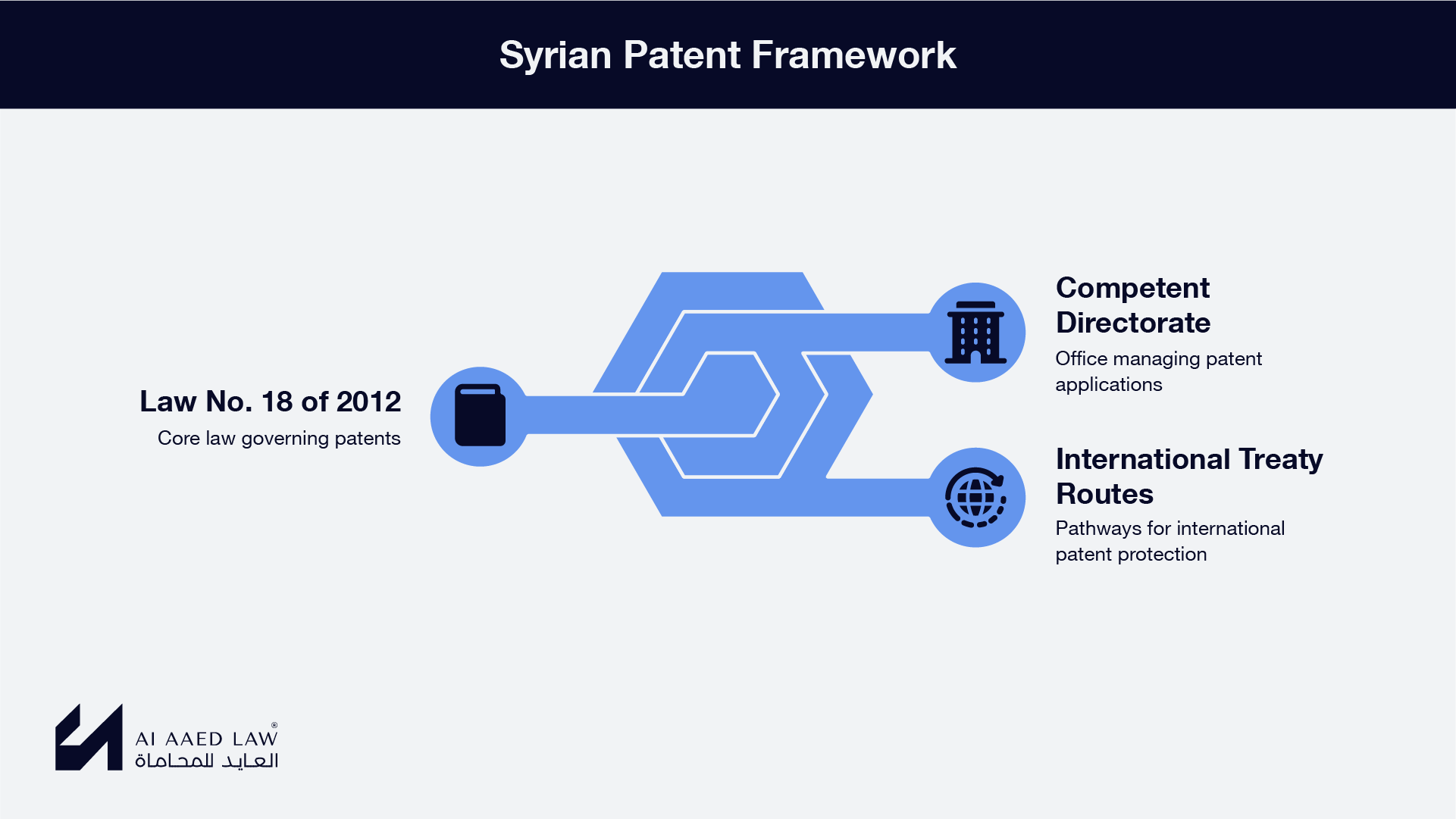
Law No. 18 of 2012 entered into force sixty days after its publication in the Official Gazette. It replaced inconsistent earlier provisions and created the current framework for applications, examination, publication, opposition, ownership, annual fees, licensing, compulsory licences, invalidity and infringement.[1]
The Law also regulates utility models, integrated-circuit layout designs and undisclosed information. These categories should not be treated as interchangeable. Each has its own eligibility, term and commercial purpose.
The competent Directorate
The statutory Directorate maintains the patent register and records applications, exploitation and transactions affecting registered rights. WIPO's current PCT Applicant's Guide identifies the Syrian office as the Directorate of Industrial and Commercial Property Protection within the Ministry of Internal Trade and Consumer Protection.[4]
Ministry names, addresses, forms, working methods and payment channels can change even when the statute remains the same. Applicants should verify the current office details and filing method before relying on older forms or third-party fee tables.
International treaty routes
Syria is party to the Paris Convention and the Patent Cooperation Treaty. The Paris Convention supports priority claims based on an earlier qualifying application. The PCT permits an international application followed by national-phase entry in selected states; it does not create a single worldwide patent.[5][6]
The Syrian Law treats international applications registered with the Directorate under the PCT as national applications. The current WIPO guide states that the national-phase time limit is 31 months from the priority date and requires an Arabic translation of the relevant application contents.[4]
Patentability requirements
Industrial applicability
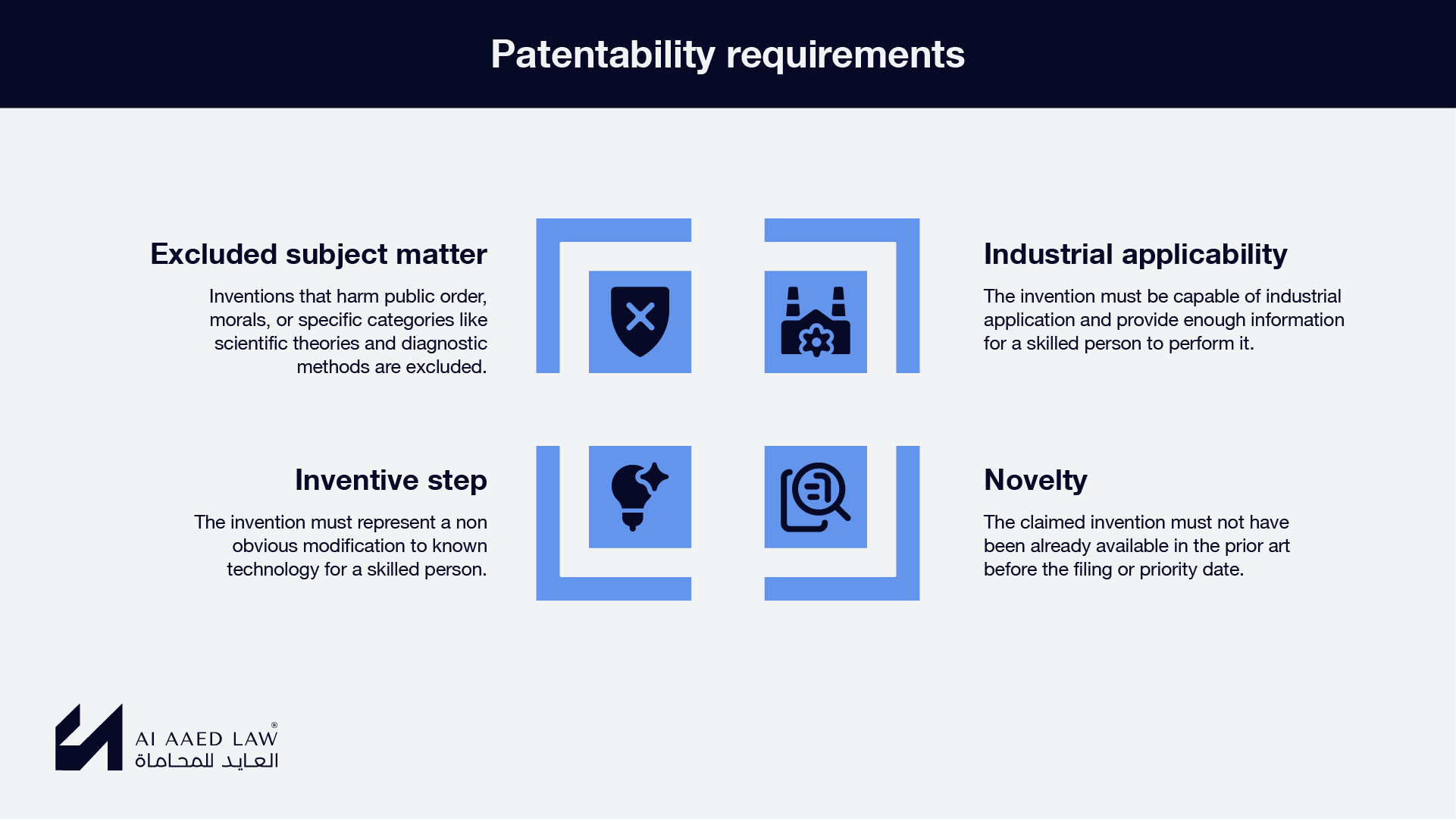
The invention must be capable of industrial application. The application should explain a concrete technical use and provide enough information for a skilled person to perform the invention. A concept described only as an aspiration, result or commercial objective may fail because the specification does not teach a workable technical solution.
Industrial applicability does not mean that the applicant must already operate a factory. It means the invention can be made or used in an industrial sense under the statutory and technical standards applied to the field.
Novelty
Novelty asks whether the claimed invention was already available in the prior art before the relevant filing or priority date. Public disclosure can arise through a publication, product release, presentation, website, sale, catalogue, conference, thesis, patent document or another accessible source.
An applicant should conduct a prior-art search before drafting claims, but a search result is not a guarantee of validity. Search databases differ, documents can be classified under unexpected terminology, and unpublished applications may later become relevant. The search should guide claim strategy and commercial decisions rather than serve as a simple pass or fail certificate.
Inventive step
The invention must also represent an inventive step. Novelty alone is insufficient if the difference from known technology would be an obvious modification for a skilled person. The specification should identify the technical problem, the solution and the features that produce the claimed effect without adding unsupported marketing language.
Inventive-step analysis is claim-specific. A broad claim may be obvious or anticipated even when a narrower technical combination could be defensible. Drafting should therefore begin with the commercially important embodiments and plausible competitor workarounds.
Excluded subject matter
Article 3 excludes inventions whose exploitation would harm national security, public order, public morals, the environment, or human, animal or plant life or health. It also excludes discoveries, scientific theories, mathematical methods, databases, schemes, pharmaceutical formularies, plants and animals subject to stated exceptions, purely intellectual or economic activities, computer programs as such, treatment and diagnostic methods, and specified natural biological material.[1]
An exclusion should be assessed precisely. A software-controlled industrial system, a medical product or a microbiological process may require a different analysis from a claim directed only to software, a treatment method or naturally occurring material. The wording of the claims and the technical contribution are decisive.
Choosing the correct form of protection
| Protection | Best suited to | Principal legal point |
|---|---|---|
| Invention patent | New technical products and processes with an inventive step | Twenty-year term from the Syrian filing date subject to annual fees |
| Utility model | New industrially applicable inventions without enough inventive activity for an invention patent | Ten-year non-renewable term and possible conversion between application types |
| Trade secret | Valuable information that can remain confidential | Protection depends on commercial value from secrecy and effective secrecy measures |
| Industrial design | The external appearance of a product rather than its technical function | Governed principally by the separate industrial-design regime |
| Copyright | Original code, drawings, manuals and other expression | Does not substitute for patent protection of a technical concept |
Patent and utility model choice
Article 47 permits a utility-model patent for a new, industrially applicable invention that lacks sufficient inventive activity for an invention patent. The applicant or Directorate may convert between an invention-patent application and a utility-model application where the legal conditions are met, with the effect relating back to the original filing date.[7]
The lower inventive threshold does not make a utility model suitable for every product. Its scope, ten-year term, enforcement value and fit with foreign filing plans should be evaluated before conversion.
Patent and trade secret choice
Patent filing requires a disclosure capable of enabling a skilled person to carry out the invention. A trade secret, by contrast, depends on continued confidentiality and effective protective measures. Manufacturing know-how that cannot be reverse-engineered may be kept secret, while a product visible in the market may be difficult to protect through secrecy alone.
Some businesses combine both methods by patenting the core invention while preserving unclaimed tolerances, quality-control data, recipes or process know-how as confidential information. The boundary must be managed carefully so the patent remains sufficiently disclosed and the remaining information is actually protected as secret.
Ownership of the invention
Inventor and successor in title
Article 26 gives the patent right to the inventor or the person to whom the inventor's rights have passed. Joint inventors own equally unless they agree otherwise. If independent inventors reach the same invention, priority belongs to the first applicant.[8]
The filing record should distinguish the human inventor from the applicant or owner. Corporate ownership needs a valid legal route such as an employment rule, assignment or other transfer. Naming the company on a form cannot repair a missing transfer by itself.
Employee inventions
Article 27 contains specific rules for employee inventions unless a written agreement more favourable to the inventor applies. Inventions made under work that includes an inventive mission, or through research and testing expressly assigned by the employer, belong to the employer. Other inventions normally belong to the employee, subject to statutory employer rights where the invention resulted from the employee's duties, the employer's activities or the use of work-specific knowledge or resources.[8]
The inventor remains entitled to attribution, and compensation issues can arise. Employment agreements, invention-assignment clauses, research policies and project records should therefore address disclosure, ownership, assistance with filing, confidentiality, remuneration and post-employment cooperation.
Contractors universities and collaborators
The employee-invention rules should not be assumed to transfer rights from consultants, founders, university researchers, suppliers or joint-development partners. Their contracts should state background IP, newly developed IP, patent-filing control, cost allocation, inventor cooperation, publication review, licensing rights and the treatment of improvements.
An investor or purchaser should trace the title from every inventor to the current owner. Missing signatures become harder to obtain after a dispute, departure, financing or acquisition.
Preparing before the application
Control disclosure
Use confidentiality agreements and limited-access project controls before sharing enabling technical information. Marking a document confidential is useful only when access, purpose, onward disclosure, return, destruction and permitted use are actually governed.
Do not rely on a nondisclosure agreement as a cure for every disclosure. A defective agreement, an unauthorized recipient or a public release can still create risk. Filing before non-confidential disclosure is the safer default when patent protection is intended.
Document inventorship and development
Maintain dated technical notebooks, design files, test results, source records, contributor lists and decision logs. Inventorship follows contribution to the claimed invention rather than seniority, funding or job title. Legal counsel and the patent drafter should map each claim to the individuals who contributed to it.
The same evidence supports ownership, priority, enablement and responses to later challenges. It should be preserved under an appropriate confidentiality and retention policy.
Search prior art and freedom to operate
A patentability search asks whether the invention may qualify for protection. A freedom-to-operate review asks whether commercialising the product may infringe someone else's enforceable claims. These are different questions and may produce different answers.
Neither review should be reduced to a keyword search. Claims, patent families, status, jurisdictions, expiry dates, assignments and the proposed product configuration all matter.
Choose filing countries and budget
Patent rights are territorial. A Syrian patent generally protects the invention in Syria, not in every export or manufacturing market. The applicant should rank jurisdictions by revenue, production, licensing, competitor activity, enforcement practicality and budget before the first filing starts the priority calendar.
The budget should cover drafting, translations, official and professional fees, examination responses, foreign associates, annuities, recordals and possible enforcement. The cost of a patent portfolio continues after the filing date.
The Syrian patent application
One invention and the claims
Article 7 limits an application to one invention or a group of linked inventions forming a single inventive concept. More than ten claims attract an additional fee. Claims define the requested legal boundary, while the description and drawings must support that boundary.[2]
Draft the claims before the commercial disclosure is finalized. Claims that are too broad may fail on novelty or inventive step; claims that are unnecessarily narrow may permit easy design-around. Unsupported features cannot safely be added after filing.
Description drawings and enabling disclosure
Article 8 requires a detailed description stating the subject matter, the best way known to enable skilled persons to perform each claimed product or process, the new technical elements for which protection is sought, and drawings where appropriate. Special disclosure may apply to microorganisms, genetic resources and traditional knowledge.[2]
The specification should use consistent terminology, explain alternatives and include enough examples or technical detail for the field. A vague application cannot be repaired later by introducing subject matter beyond the original disclosure.
Foreign applications and priority documents
The applicant must disclose information about earlier foreign applications concerning the same or related invention and their outcomes. A Paris Convention priority claim requires the earlier filing details and, within the statutory period, a certified copy translated into Arabic according to the Law.[9]
The priority document, translation and assignment chain should be prepared early. A technically sound application can still lose priority through missed formalities.
Applicants outside Syria
A non-resident applicant must appoint a person resident in Syria to act in filing and registration matters. For the PCT route, WIPO states that a registered patent attorney or patent agent, or an attorney or lawyer registered in Syria, may act and that representation is required for a non-resident.[2][4]
Legalization, certification, translation and power-of-attorney requirements should be confirmed for the specific filing route. Do not rely on a checklist prepared for trademarks or for an earlier administrative practice.
Filing examination publication and grant
Filing and the deposit record
The application is filed by the applicant or legal representative with the first-year fee. The Directorate prepares a deposit record showing the date and time the documents arrived and the fee was paid. That record should be checked immediately because the filing date affects priority and the patent term.[2]
Electronic filing or payment is possible only where enabled by a ministerial decision and current office practice. Applicants should verify whether the intended channel is operational before a deadline.
Formal and substantive examination
The Directorate examines compliance with formal requirements and may permit missing formal documents to be completed within three months, subject to delay fees and the statutory exceptions. Failure to complete the requirements within the period can cancel the application.[10]
The Directorate also examines novelty, inventive step and industrial applicability. It may use scientific bodies, experts or advanced patent offices, with examination costs borne by the applicant. A response should address the examiner's reasoning claim by claim and preserve fallback positions supported by the original specification.
Amendments and office requirements
The Directorate may require conditions or amendments. If the applicant does not respond within three months after notification, the application is treated as abandoned. The applicant may challenge the decision within the statutory period. Voluntary amendment of the specification or drawings is allowed within three months of filing, but it cannot change the identity of the invention or extend beyond the original disclosure or claims.[10]
Every notification should be logged with the service date, response deadline, responsible person and evidence of submission. Patent rights can be lost through administrative silence even when the invention is patentable.
Publication and opposition
After procedures and technical examination are completed, acceptance is announced and the accepted application is published in the Industrial Property Protection Gazette at the applicant's expense. The application remains confidential before that stage.[10]
An interested person may oppose in writing within six months from publication. The Directorate notifies the applicant, who generally has thirty days to file a reasoned written response. Decisions can proceed through the competent committee and court routes within the statutory deadlines.[10]
Grant and certificate
The patent is granted by ministerial decision or delegated authority, subject to any required sector-related approvals. The certificate is published with identifying and technical information. If an accepted applicant does not complete registration and obtain the certificate within one year after the publication period or final favourable judgment, the application is cancelled by law.[11]
Grant is not the end of portfolio management. The owner must maintain fees, record transactions, monitor infringement and retain the evidence supporting ownership and validity.
Key deadlines and decision points
| Event | Statutory position | Practical control |
|---|---|---|
| Complete formal requirements | Generally within three months of filing subject to the statutory rules | Create a filing checklist and confirm every accepted document |
| Voluntary technical amendment | Within three months of filing without adding new matter | Preserve supported fallback claims before filing |
| Respond to Directorate requirement | Three months from notification | Record the service date and assign responsibility immediately |
| Oppose an accepted application | Six months from publication | Monitor the Gazette and relevant competitor applications |
| Applicant response to opposition | Generally thirty days from notification | Prepare technical and legal evidence before the deadline |
| Paris priority | Twelve months for invention patents | File foreign applications before the priority period expires |
| PCT national phase | Current WIPO guide states 31 months from the priority date | Prepare Arabic translation and representation early |
| Patent term | Twenty years from the Syrian filing date and non-renewable | Track the filing date independently of the grant date |
| Annual fees | Due from the second year with statutory grace and restoration rules | Maintain a verified annuity calendar and payment evidence |
| Record assignment or licence | The Law applies a ninety-day recordal framework and delay consequences | Make recordal a closing deliverable rather than a later task |
Paris priority and the PCT route
Paris Convention priority
Article 53 provides a twelve-month priority period for invention patents based on an earlier qualifying filing. The later Syrian application must claim the priority and satisfy the document, certification, Arabic-translation and fee requirements within the prescribed periods.[9]
Priority preserves the earlier date for defined purposes; it does not extend the twenty-year term beyond the statutory calculation or guarantee grant. The Syrian application still faces national examination and exclusions.
Patent Cooperation Treaty entry
The PCT allows one international application to preserve options across designated states while search and preliminary information develop. It does not itself grant an enforceable Syrian patent. Protection in Syria requires timely national-phase entry, the required translation, fees, representation and compliance with Syrian law.[4][6]
WIPO's guide applicable from 1 January 2026 states a 31-month entry deadline from the priority date and requires Arabic translation of the description, claims, text in drawings and abstract, including specified amended materials where applicable. Applicants should check the current version of the guide before acting because office fees and requirements may be updated.[4]
International filing choices
A direct Paris filing may suit a small and known country list. A PCT filing can defer several national decisions and provide an international search, but it adds its own fees and does not remove later national costs. The choice depends on budget, investment timing, technical development and target markets.
The filing sequence must also respect any Syrian rule or office guidance affecting applications first filed abroad by Syrian nationals or residents. Obtain current advice before transmitting sensitive inventions or filing instructions across borders.
Patent term and annual fees
The twenty-year term
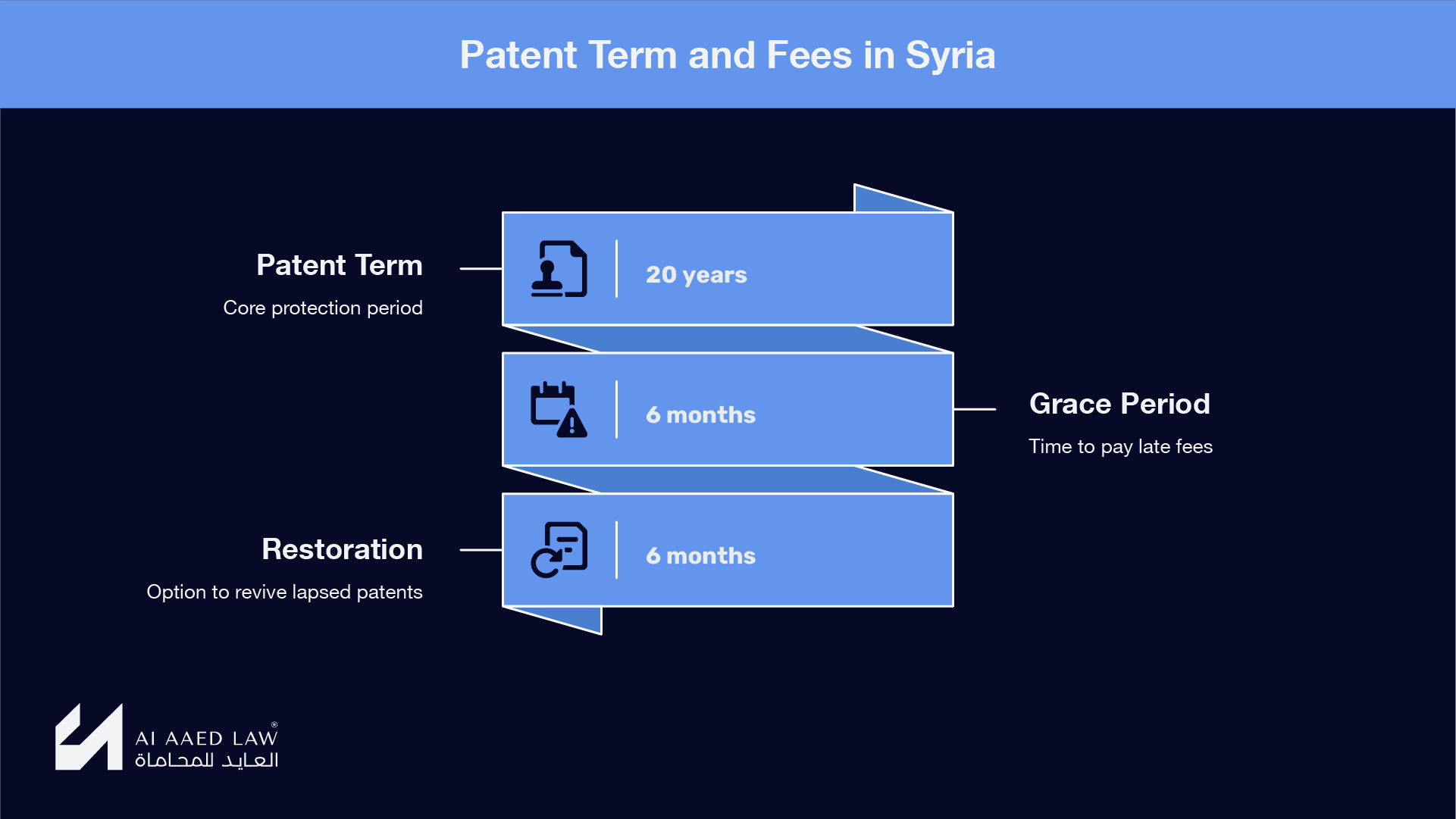
Article 22 sets a non-renewable twenty-year term from the date the patent application is filed in Syria. Delay during examination does not ordinarily restart the term at grant. Commercial plans should therefore use the filing date rather than the certificate date.[3]
The useful commercial life may be shorter if the product changes, competing technology replaces it, regulatory approval is delayed or the claims do not cover the final product. Portfolio reviews should test continuing value rather than pay every annuity automatically.
Annual fees and restoration
Annual fees increase from the second year. If the owner misses the fee before the start of the relevant year, the Law gives a six-month grace period with a late fee. If payment and penalty remain unpaid, the patent falls. A further statutory restoration route may be available within six months from lapse, subject to the prescribed application and doubled amounts.[3]
The owner should retain official receipts and reconcile the register after payment. For licensed, financed or jointly owned patents, the contract must state who pays, who verifies payment and who may cure a default.
Working and nonuse risk
The Law contains consequences connected with failure to exploit the invention, subject to statutory excuses and evidence that the owner offered it to capable industrial operators on appropriate terms. It also provides compulsory-licensing mechanisms for defined public-interest and other circumstances.[12]
The owner should document manufacturing, imports, licences, offers, negotiations and reasons for delay. A bare statement that exploitation was intended may be weaker than a dated record of concrete commercial steps.
Rights created by registration
Exclusive acts
Article 24 allows the patent owner to prevent unauthorized exploitation. For a patented product, this includes manufacture, offer, trade, use, import and possession for those purposes. For a patented process, the right covers use of the process and specified dealings in products obtained directly from it.[3]
Enforcement depends on the claims and the accused product or process. The patent title, abstract or commercial similarity does not decide infringement. Counsel needs a claim chart comparing every relevant claim element with evidence about the allegedly infringing activity.
Statutory limitations and exhaustion
The Law recognizes exhaustion where the protected product or process was marketed outside Syria by the owner, through another person, under licence or with the owner's consent. It also lists exceptions for private non-commercial activity, research, certain pharmacy preparation, qualifying prior use, temporary foreign transport, regulatory preparation before expiry and other limited acts.[13]
These exceptions are fact-dependent. A research label does not automatically protect commercial development, and a prior user's rights are limited by the statutory conditions.
Validity remains contestable
Registration creates enforceable rights, but a final court judgment may invalidate a patent obtained contrary to the Law, inadequately disclosed, unsupported by its description, expanded beyond the original filing or affected by other statutory grounds.[14]
The owner should keep the prosecution file and technical evidence. A defendant should assess invalidity separately from non-infringement because either may determine the dispute.
Assignment licensing and finance
Assignment and security interests
Article 38 permits a patent to be transferred wholly or partly by sale, assignment, inheritance or will, and permits pledges and other real rights. A transaction is not effective against third parties until recorded in the Directorate's special register with the supporting authenticated document. The Law requires recordal within ninety days and applies additional fees for delay.[15]
An acquisition agreement should identify application and patent numbers, inventors, territories, included improvements, pending oppositions, annuity status and responsibility for recordal. A general transfer of “all intellectual property” may be commercially intended but still require patent-specific documents and registry action.
Patent licences
The owner may license one or more persons to use the patent without losing its own right to use unless the contract states otherwise. The licence cannot extend beyond the patent term. It becomes effective against third parties only after recordal, and delayed recordal beyond ninety days attracts the statutory consequence. The licence must also include quality-control arrangements.[16]
Drafting should address field, territory, exclusivity, sublicensing, improvements, technical assistance, royalties, audit, tax, confidentiality, enforcement control, settlement authority, warranties, indemnities, change of control and termination. The licence and the registered right must describe the same asset.
Patent due diligence
Before investment, financing or acquisition, verify legal title, inventor assignments, filing and priority data, prosecution status, oppositions, annual fees, working evidence, recorded licences and security, disputes, claim scope, validity risks and freedom to operate.
A granted patent is not a valuation by itself. Commercial value depends on enforceable claim coverage, remaining term, product relevance, market size, detectability of infringement and the cost of enforcement.
Compulsory licences and public interest
Statutory grounds
Article 39 allows compulsory licences after approval through the statutory committee process in defined circumstances. These include specified public, emergency, development, health, non-working, anti-competitive and related grounds. The Law addresses notice, negotiation exceptions, scope, remuneration and review.[12]
The mechanism does not make every useful patent freely available. It requires the legal conditions and an official decision. Owners and prospective licensees should document negotiations, capacity, proposed terms and the public-interest basis relied upon.
Government needs and expropriation
The Law also permits expropriation of a patent, or only its right of exploitation for state needs, for national-security reasons and extreme necessity where compulsory licensing is insufficient, subject to compensation and challenge rules.[12]
Projects involving health, defence, food, environment or critical infrastructure need early regulatory and public-law analysis in addition to ordinary patent strategy.
Infringement and enforcement
Evidence and claim analysis
Start with the patent register, certificate, claims, prosecution history, ownership record and annuity status. Preserve samples, invoices, catalogues, import records, photographs, online material and technical tests through lawful evidence procedures. For a process patent, Article 37 contains a burden-related rule for identical products under stated conditions while requiring protection of the defendant's industrial and commercial secrets.[14]
Technical expertise may be necessary to interpret claim language and compare the accused product or process. Public allegations should be controlled because inaccurate statements can create separate commercial and legal exposure.
Civil and criminal routes
The Law provides penalties for defined commercial counterfeiting, knowing trade or import of infringing goods and false patent marking, with enhanced consequences for recidivism. The monetary amounts written in the 2012 statute should not be quoted as current financial exposure without checking later legislation and applicable penalty-adjustment rules.[17]
The correct route depends on the conduct, evidence, requested remedy and procedural law. A cease-and-desist letter should follow, not replace, a validity, title and infringement review.
Invalidity and settlement
An alleged infringer may dispute claim coverage and attack validity. A negotiated settlement may include a licence, product redesign, phase-out, inventory treatment, territory limits, payment, confidentiality and dismissal terms. Settlement should also address recordal where the agreement creates or changes registrable rights.
The commercial decision should compare enforceability, evidence, remaining term, counterparty assets, business disruption and the risk of an adverse validity decision.
Cross-border patent checklist
- Identify the inventors from their technical contributions rather than job titles.
- Secure written assignments from founders, employees, consultants and collaborators.
- Stop public disclosure until the first filing strategy is approved.
- Search prior art and assess patentability separately from freedom to operate.
- Choose patent, utility model, trade secret, design or a coordinated combination.
- Define the Syrian applicant and verify its corporate authority.
- Prepare an enabling description, supported claims and necessary drawings.
- Choose direct foreign filings or the PCT route before the priority deadline.
- Calendar Syrian formalities, examination responses, publication and opposition.
- Prepare Arabic translations, certifications and local representation early.
- Track annual fees, exploitation evidence and registry status throughout the term.
- Record assignments, licences, pledges and ownership changes promptly.
Common patent mistakes
- Publishing, presenting, selling or demonstrating the invention before filing.
- Naming only the company without obtaining rights from every inventor.
- Treating the title or abstract as the legal scope instead of the claims.
- Filing a short commercial description that does not enable the invention.
- Adding important technical material after filing when it was absent originally.
- Confusing patentability with freedom to operate.
- Assuming a PCT application is an issued international patent.
- Missing a three-month response, twelve-month priority or 31-month national-phase deadline.
- Ignoring the six-month opposition period after publication.
- Paying annuities without confirming that the register reflects the payment.
- Signing a licence or assignment without recording it against third parties.
- Enforcing before checking title, validity, claim coverage and evidence.
Legal notice
This article provides general information about the Syrian patent framework as reviewed on 9 September 2026. It does not assess the patentability, ownership, validity, infringement or filing strategy of a particular invention and is not a substitute for legal or patent-agent advice. Laws, ministerial decisions, official fees, forms and administrative practice may change. Obtain advice before disclosure, filing, investment, assignment, licensing, enforcement or the expiry of any deadline.