Trademark registration in Syria is an essential step for protecting the name, logo, or symbol that distinguishes a business's goods or services in the market. The risk does not begin only when a mark is copied. It may also arise when someone else registers an identical or similar mark first, or when a company invests in its website, marketing campaigns, and product packaging before confirming that the mark does not conflict with earlier rights.
Effective protection begins with selecting a registrable mark, conducting a prior search, identifying the appropriate classes, and then filing the application and following the examination, publication, and any opposition proceedings until the registration certificate is issued. This guide explains the process of trademark registration in Syria, the duration of protection, how registration is renewed, and how infringement can be addressed. Our Intellectual Property & Technology practice handles each of these stages end-to-end.
business: Summary of key points
| Topic | Key point |
|---|---|
| What Law Governs Trademark Registration in Syria? | Trademark registration in Syria is governed by Law No. |
| What Is Trademark Registration? | Trademark registration is the official recording of a sign capable of distinguishing the goods or services of a natural or legal person from those of others. |
| Why Do Companies Need to Protect Their Trademarks? | A trademark brings together the business's reputation, customer trust, and marketing value in a single asset. |
| What Can Be Registered as a Trademark? | Any visible sign that has distinctive character and is capable of indicating the commercial source of goods or services may be registered. |
| Requirements for Accepting a Trademark for Registration | A trademark should be distinctive and should not consist merely of a generic, necessary, or customary designation for the relevant goods or services. |
| Must the Trademark Include Arabic Letters? | Syrian law contains specific rules for marks placed on goods and services of national origin that are produced or used in Syria. |
What Law Governs Trademark Registration in Syria?
Trademark registration in Syria is governed by Law No. 8 of 2007 concerning trademarks, geographical indications, industrial designs and models, and unfair competition, as amended by Legislative Decree No. 47 of 2009.
The Directorate of Commercial and Industrial Property Protection, currently affiliated with the Ministry of Economy and Industry, is responsible for receiving, examining, registering, and publishing trademark applications. It also handles oppositions, infringement complaints, and international registration under the applicable agreements.
The forms, fees, and procedural requirements in force at the time of filing should always be verified because they may be changed by subsequent decisions or administrative instructions.
What Is Trademark Registration?
Trademark registration is the official recording of a sign capable of distinguishing the goods or services of a natural or legal person from those of others. A mark may consist of a name, word, letters, drawing, logo, symbol, image, signature, seal, combination of colours, distinctive product or packaging shape, or a combination of these elements.
Syrian law requires a trademark to be capable of visual perception. Registration does not protect the underlying business or product idea itself. It protects the mark in relation to the goods, services, and classes specified in the application.
Why Do Companies Need to Protect Their Trademarks?
A trademark brings together the business's reputation, customer trust, and marketing value in a single asset. Registration helps a business to:
- Establish ownership of the mark in relation to the goods or services covered by the registration.
- Prevent others from using an identical or similar mark where the use may confuse the public.
- Take legal action against counterfeiting or misleading use.
- License the mark to others or transfer its ownership in accordance with the applicable procedures.
- Support business expansion and provide a clearer legal basis when negotiating with investors, partners, or distributors.
Although trademark registration is not mandatory for every activity unless a specific legal provision states otherwise, it gives the owner a stronger legal position than relying only on use of the mark or company registration.
What Can Be Registered as a Trademark?
Any visible sign that has distinctive character and is capable of indicating the commercial source of goods or services may be registered. A trademark may include:
- Words, names, and designations.
- Letters, drawings, logos, and symbols.
- Images, signatures, and seals.
- Combinations or distinctive arrangements of colours.
- The distinctive shape of a product or its packaging.
- A combination of two or more of these elements.
It is not enough for a mark to appear visually different. Similarity in pronunciation, spelling, meaning, and overall impression must also be considered, together with the likelihood of consumer confusion.
Requirements for Accepting a Trademark for Registration
A trademark should be distinctive and should not consist merely of a generic, necessary, or customary designation for the relevant goods or services. It may not be limited to a direct description of the product's type, quality, quantity, use, value, or geographical origin.
A trademark application may be refused, among other circumstances, where the mark is:
- Devoid of distinctive character or directly descriptive.
- Misleading as to the nature, quality, or origin of the product.
- Contrary to public order or public morals.
- Composed of protected official emblems, flags, or symbols without authorisation.
- Identical or similar to an earlier mark in a manner likely to mislead the public.
- In conflict with a well-known mark or another earlier right protected by law.
Registrability is assessed in relation to the goods or services the mark is intended to distinguish. A word may be descriptive for one product but distinctive for a different product or service.
Must the Trademark Include Arabic Letters?
Syrian law contains specific rules for marks placed on goods and services of national origin that are produced or used in Syria. As a general rule, these marks must be written in Arabic letters. Foreign letters may appear alongside the Arabic letters at an equal size, subject to the cases and exceptions provided by law.
The proposed presentation and use of a mark on products or display materials should therefore be reviewed before filing, particularly when a foreign-language name or bilingual mark is being adopted.
What Is the Difference Between a Trade Name and a Trademark?
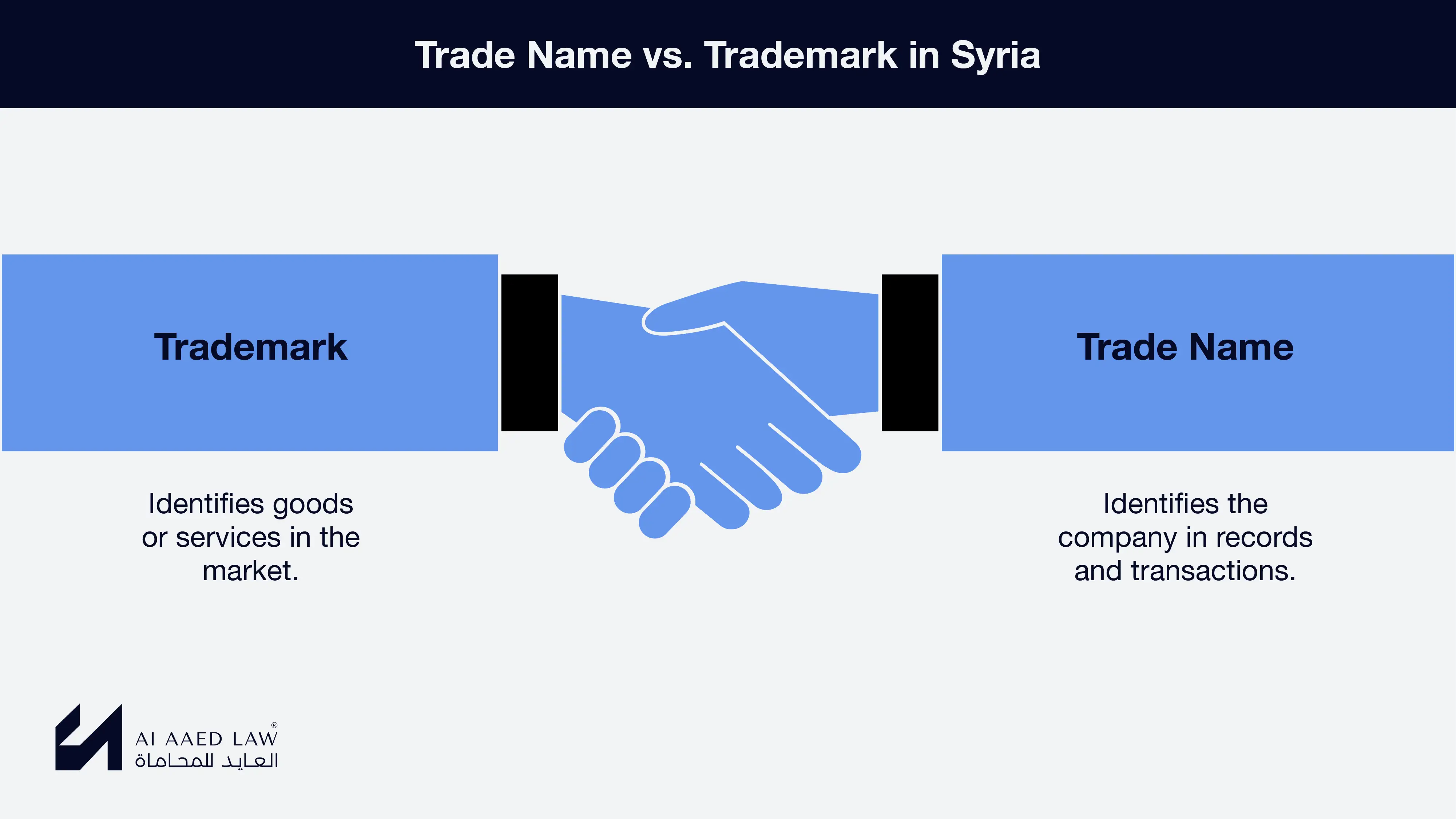
A trade name identifies a company or establishment in commercial records and transactions, while a trademark distinguishes the goods or services it provides in the market. A trade name and trademark may be identical or different.
Registering a company or recording its name in the commercial register does not automatically protect that name as a trademark in every class. A company may therefore need to submit a separate application to protect its mark in relation to the products or services for which it is actually used.
Steps for Trademark Registration in Syria
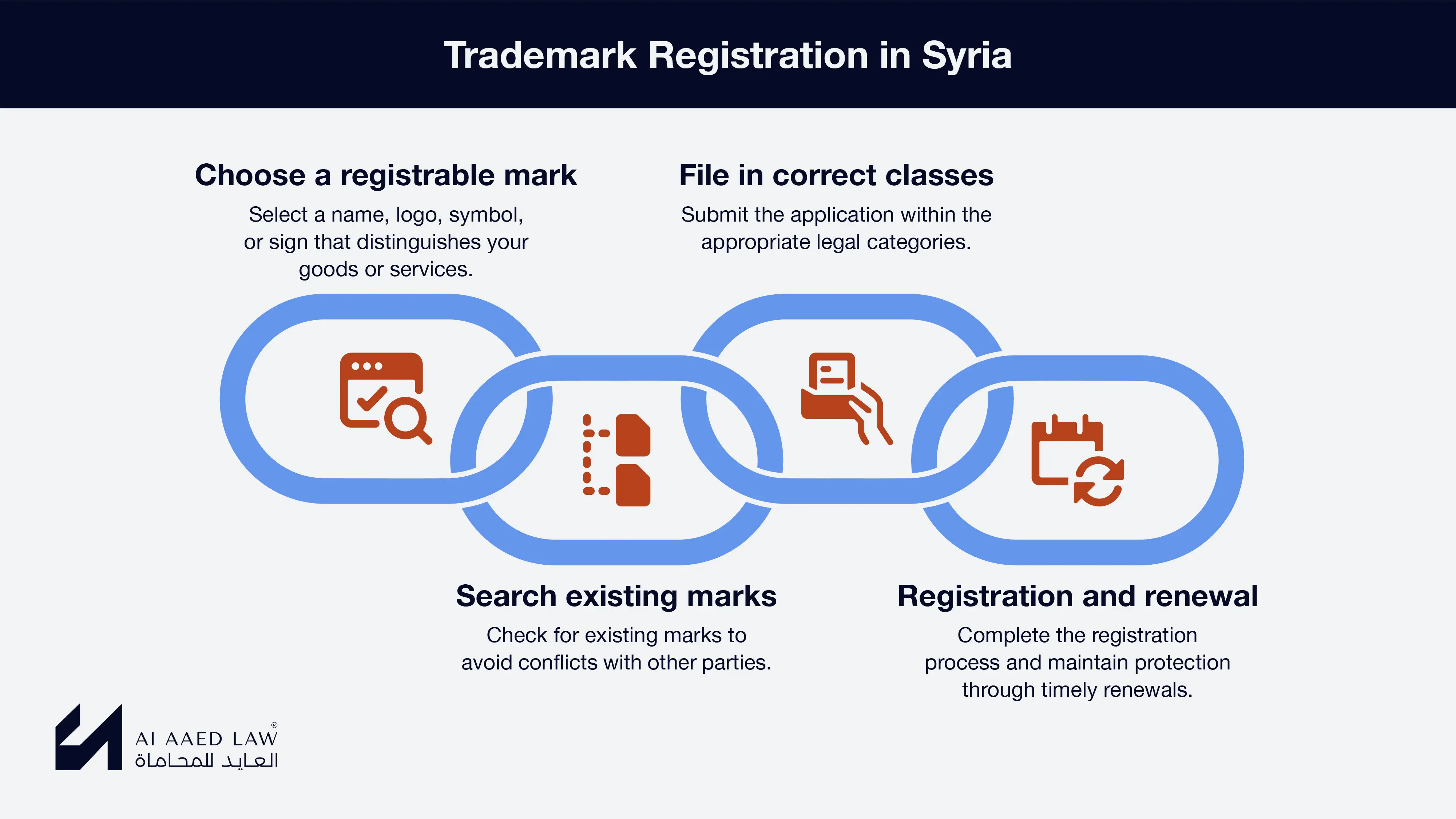
1. Select a Registrable Mark
It is preferable to select a distinctive and non-descriptive name or logo while avoiding generic words, official symbols, and elements that may mislead the public about the nature or origin of a product. The availability of the name as a domain name and on social media platforms should also be checked, but online availability does not prove that the mark is legally registrable.
2. Conduct a Prior Search for Similar Marks
A prior search reduces the risk of refusal or opposition. The search should not be limited to exact matches. It should examine similarities in pronunciation, spelling, meaning, appearance, and overall impression, as well as the relevant goods, services, and target consumers.
The law allows a written request to be filed with the Directorate for a preliminary search covering no more than five marks in a single request. Under the statutory text, the Directorate is required to respond within 15 days. The search result does not create a right for the requester or impose liability on the Directorate. A broader legal review therefore remains necessary before filing.
3. Identify the Classes Under the Nice Classification
Goods and services are categorised under the international Nice Classification, which contains 45 classes: 34 classes for goods and 11 for services. The relevant goods or services must be identified precisely because the scope of protection is connected to what is listed in the application.
Syrian law treats each requested class through a separate application. Selecting an incorrect class or filing in only one class when the mark is used across several business areas may therefore leave important parts of the activity without adequate protection.
4. Prepare the Application and Supporting Documents
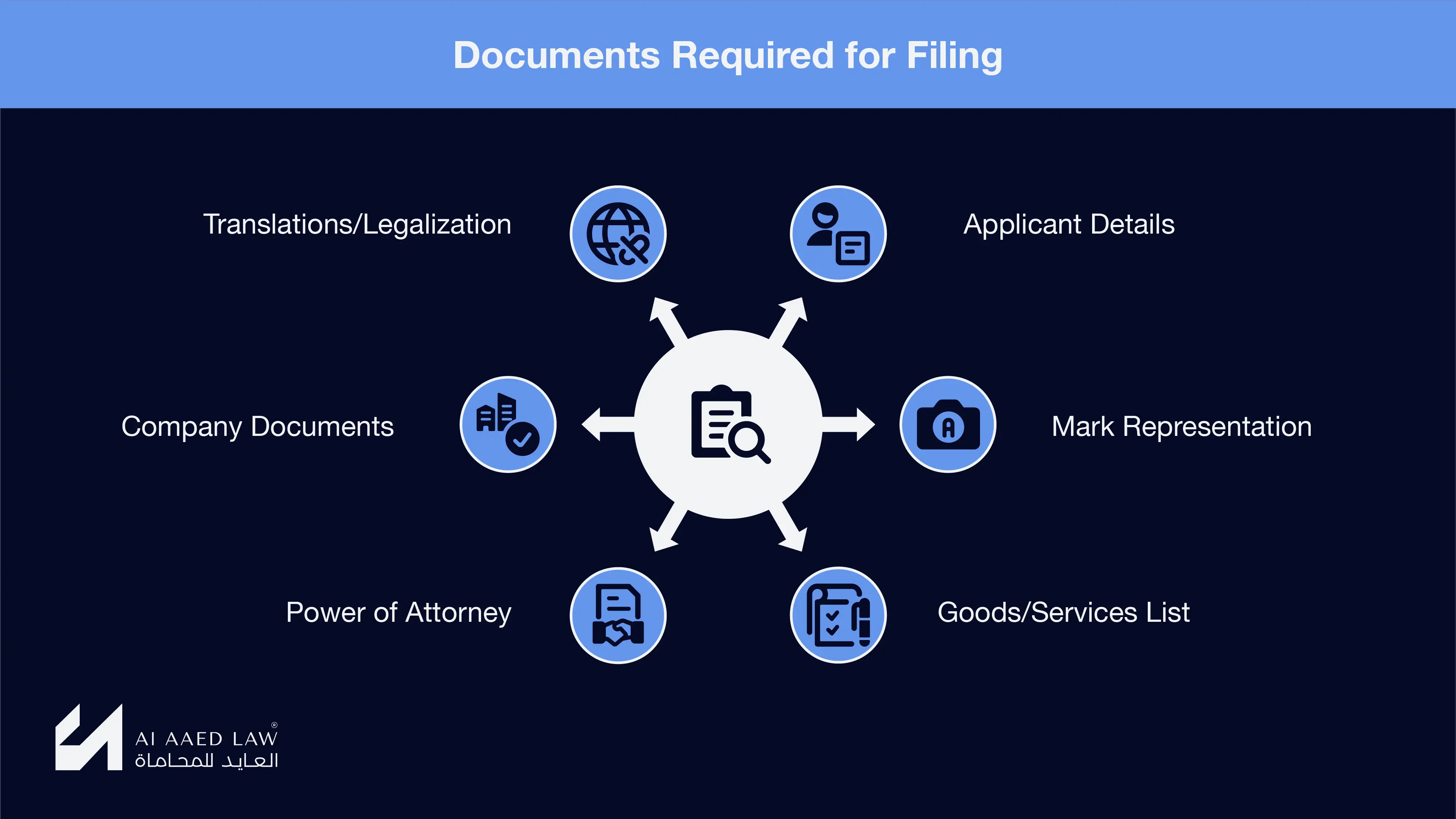
The required documents differ depending on whether the applicant is an individual or a company and whether the applicant is Syrian or foreign. The application file will generally include:
- The applicant's details, address, and legal capacity.
- A clear representation of the mark to be registered.
- A precise statement of the goods or services and the requested class.
- A receipt confirming payment of the prescribed fees.
- A power of attorney where the application is filed through a representative.
- Company documents where the applicant is a legal entity.
- An Arabic translation or explanation of foreign words appearing in the mark.
- Any translations or legalisations required for foreign documents, depending on the case.
If the applicant is not resident in Syria, the applicant must appoint a person residing in Syria to follow the registration procedures.
5. File the Application and Pay the Fees
The application is submitted to the Directorate of Commercial and Industrial Property Protection using the approved form, together with the supporting documents and fee receipt. It is recorded under a serial number according to its filing date and time, and the applicant receives proof of filing.
The cost is affected by the number of classes, the application, publication, and registration fees, the nature of the documents, and the need for translation, legalisation, or legal representation. An updated fee schedule should therefore be obtained before filing instead of relying on previously published figures.
6. Examination and Response to the Directorate's Observations
The Directorate examines the application and its supporting documents to confirm compliance with the formal and legal requirements, the distinctiveness of the mark, and the absence of conflicts with earlier marks or rights.
The Directorate may request that the mark be amended or clarified or that the list of goods or services be narrowed to avoid confusion with another mark. If the application is refused or its acceptance is made subject to conditions or amendments, the applicant may challenge the Directorate's decision before the competent committee within 30 days of receiving notice. The committee's decision may then be appealed before the competent court within the legally prescribed period.
7. Publication and Third-Party Opposition
If the application is accepted and satisfies the requirements, a representation of the mark and a statement of the relevant goods or services are published in the Property Protection Journal at the applicant's expense.
Any interested party may oppose the application within 90 days from the publication date. If an opposition is filed, the Directorate provides the applicant or its representative with a copy. A written and reasoned response must be submitted within 30 days of notification; otherwise, the applicant will be deemed to have abandoned the application.
After reviewing the parties' documents, the Directorate issues a reasoned decision on the opposition. That decision may be challenged in accordance with the statutory procedures and deadlines.
8. Complete Registration and Obtain the Certificate
After the publication period expires without opposition, or after an opposition is finally decided in the applicant's favour, the registration procedures and certificate issuance must be completed within the statutory period. The application may be deemed legally void if these steps are not completed within 90 days following the end of the publication period or the issuance of a final court judgment in the applicant's favour.
The Directorate records the accepted mark in the Trademark Register and publishes its registration in the Property Protection Journal. It then issues the registration certificate to the owner within 30 days from the date of entry in the register.
How Long Does Trademark Registration Take?
There is no single practical timeframe that applies to every application. The duration depends on how quickly the documents are completed, the examination process, official observations, oppositions, and any resulting appeal. The third-party opposition stage alone lasts 90 days from publication, and the process may take longer if observations or disputes arise. Any fixed processing estimate should therefore be treated with caution, and the Directorate's actual processing timeframe should be confirmed at the time of filing.
Trademark Protection Period and Renewal
A registered trademark is protected for ten years beginning from the filing date, with expiry calculated by reference to the end of the month in which the application was filed. Registration may be renewed for successive ten-year periods.
A renewal application should be filed during the final year of the protection period. The law also gives the trademark owner a six-month grace period after expiry, subject to payment of the applicable late fees. If the mark is not renewed during this period, the registration expires by operation of law.
New classes, goods, or services cannot be added through renewal, although goods or services may be deleted. Expanding the scope of protection requires a new application, depending on the circumstances.
Can a Trademark Be Cancelled for Non-Use?
Yes. At the request of an interested party, the competent court may cancel a trademark registration if the mark has not been genuinely used for three consecutive years in relation to the registered goods or services, unless the owner provides a valid justification for non-use.
Obtaining a registration certificate is therefore not sufficient on its own. The mark should be used in practice, and evidence of use should be retained, including invoices, contracts, advertisements, product and packaging photographs, and sales records.
Rights of the Trademark Owner After Registration
Registration gives the owner title to the trademark in relation to the goods or services covered by the registration. It allows the owner to prevent others from copying or using the mark without authorisation on identical goods or services. Protection also extends to similar marks and similar goods or services where there is a likelihood of consumer confusion.
Subject to the applicable legal procedures, the trademark owner may:
- License one or more persons to use the mark.
- Transfer ownership of the mark in whole or in part.
- Mortgage the mark or create other rights in rem over it.
- Take civil or criminal action against infringement.
- Seek precautionary measures to stop an existing or imminent infringement.
- Request customs action against goods that infringe a registered right, depending on the circumstances.
Licensing agreements, ownership transfers, and restrictions affecting the mark must be recorded and published where required by law to be enforceable against third parties.
Can a Trademark Be Registered Internationally Through Syria?
Syria is a member of the Madrid System for the International Registration of Marks. A trademark owner who satisfies the system's requirements may request protection in designated countries through an international application filed in accordance with the approved procedures and processed by the Directorate and the World Intellectual Property Organization.
An international application does not result in unified and automatic protection across all countries. The trademark office of each designated country examines the application under its own law and decides whether to grant or refuse protection within its jurisdiction.
What Should You Do If Your Trademark Is Copied?
When trademark copying or the misleading use of a similar mark is discovered, the infringement should be documented before contacting the other party. Relevant evidence may include:
- Photographs of products, packaging, and signs.
- Invoices or purchased samples.
- Links to websites, sales pages, and advertisements.
- Information about the store, supplier, or importer.
- Dates of use and correspondence connected to the infringement.
The nature and urgency of the infringement should then be assessed to determine the appropriate response. This may involve sending a legal notice and demanding that the use stop, requesting a precautionary measure, filing a civil or criminal claim, or pursuing customs action where the infringement concerns imported or cross-border goods.
Action should not be unnecessarily delayed because continuing infringement may increase the distribution of the products and make the resulting damage more difficult to identify and prove.
Common Mistakes in Trademark Registration
- Selecting a generic or descriptive mark that lacks sufficient distinctiveness.
- Filing before searching for identical and similar marks.
- Selecting an incorrect class or overlooking classes connected to the activity.
- Providing an excessively broad or inaccurate description of the goods or services.
- Filing an unclear logo or one that does not match the version that will actually be used.
- Ignoring Arabic-lettering rules or the translation of foreign words.
- Missing deadlines for responses, oppositions, appeals, or renewal.
- Failing to use the trademark or retain evidence of its use.
- Assuming that commercial registration or reserving a domain name protects the trademark.
- Claiming that a trademark is registered before registration has been officially completed.
Trademark Registration for Startups
Startups may postpone trademark registration to reduce costs, even while they are building their name and attracting customers and investors. The more a business invests in its identity and marketing, the greater the cost of changing the name if a legal conflict later arises.
It is therefore preferable to examine the mark before launching a website or advertising campaign or printing product packaging. The business can then identify its priority classes and expand the scope of protection in a planned manner as its activities grow.
The Lawyer's Role in Trademark Registration and Protection
A lawyer can help assess whether a trademark is registrable, examine similarities with earlier rights, select the appropriate classes, prepare the application and supporting documents, and respond to observations and oppositions before the Directorate.
The lawyer's role may also include drafting licence or assignment agreements, recording transactions affecting the mark, building an evidence file in infringement matters, and selecting the most appropriate judicial, administrative, or customs-related procedure for the particular infringement. Al AAED's Intellectual Property & Technology team can support you through the full lifecycle.
How Al AAED Can Help
Al AAED assists companies and business owners with trademark searches, class selection, application preparation, filing procedures, and responses to observations and oppositions. It also provides legal support for trademark renewal, the registration of licensing or ownership-transfer agreements, and appropriate action against copying or infringement.
If you are preparing to launch a new mark or want to protect a mark that is already in use, it is preferable to review its legal position before increasing your investment in marketing or expanding in the market. Get in touch with our team to discuss your case.
Legal notice: This article has been prepared for general informational purposes and does not constitute legal advice. Requirements and procedures vary according to the facts, the applicant's status, and the nature of the trademark. Fees and administrative instructions may also change. The applicable rules and the circumstances of the matter should be reviewed before taking any action.
Official source: Syrian Ministry of Justice
Keyword in Slug
To optimize for SEO, ensure the focus keyword, business, is included in the URL slug of this article. A keyword-rich slug improves search visibility and aligns content with search queries, making it easier for potential clients to find relevant information on trademark registration in Syria.
Comparison of Trademark Classes and Fees
Understanding the various trademark classes and associated fees can assist businesses in making informed decisions during the registration process.
Trademark Classes
- Class 1: Chemicals for use in industry, science, and photography.
- Class 25: Clothing, footwear, headgear.
- Class 35: Advertising, business management, business administration.
- Class 41: Education, providing of training, entertainment.
Fees Overview
The fees for trademark registration vary depending on the class and services selected. It is recommended to verify specific costs at the time of filing with the Directorate of Commercial and Industrial Property Protection.
Understanding Trademark Registration in Syria
Trademark registration is crucial for safeguarding the identity of a business. It distinguishes a company's products or services from those of others. The registration process involves several important steps, including selecting a distinctive mark, conducting a prior search, and determining the appropriate classes for application.
First, a registrable mark must be clearly defined and not simply a generic term. It can include various elements such as names, logos, images, or distinctive shapes.
The trademark registration process is managed by the Directorate of Commercial and Industrial Property Protection, part of the Ministry of Economy and Industry. This body handles application submissions, examinations, and any trace of opposition or infringement. Registering a trademark ly enables a business to assert ownership and protect its brand.
Simplifying Trademark Protection
Protecting your trademark is crucial for your business. The process begins by selecting a registrable mark. Next, conduct a prior search to ensure no conflicts with existing marks. Identify the appropriate classes for the goods or services involved. After these steps, you can file the application.
The trademark application goes through examination and publication. During this phase, there may be opposition proceedings. Once completed, a registration certificate is issued, securing your trademark rights.
Trademark registration safeguards your brand identity, enhancing your business's reputation and value in the market.
Trademark Classes and Fees Comparison
The following table outlines the trademark classes available for registration in Syria, along with their corresponding fees:
| Trademark Class | Description | Fee (SYP) |
|---|---|---|
| Class 1 | Chemicals used in industry, science, and photography, as well as in agriculture, horticulture, and forestry | XXXXX |
| Class 2 | Paint, varnish, and lacquers; preservatives against rust and against deterioration of wood | XXXXX |
| Class 3 | Cosmetics and cleaning preparations | XXXXX |
| Class 4 | Industrial oils and greases; lubricants | XXXXX |
| Class 5 | Pharmaceutical and veterinary preparations | XXXXX |
| Class 6 | Common metals and their alloys | XXXXX |
Please verify the latest fee structure as it may change.
Trademark Registration in Syria
Trademark registration in Syria protects the distinct name, logo, or symbol of a business. Early registration is essential to avoid conflicts with prior rights. Here is an overview of the process.
Process Overview
The registration process includes selecting a unique mark, conducting a prior search for conflicts, and identifying the applicable classes. After filing the application, it goes through examination, publication, and any opposition proceedings. Finally, a registration certificate is issued.
Why Protection is Necessary
A trademark combines the business’s reputation, customer trust, and marketing value. It establishes ownership of the mark and helps to prevent others from using it without permission.
Comparison of Trademark Classes and Fees in Syria
The following table summarizes the various trademark classes and their associated fees for registration in Syria:
Trademark Classes and Fees
- Class 1: Chemicals, fee: 10,000 SYP
- Class 2: Paints, fee: 10,000 SYP
- Class 3: Cosmetics, fee: 10,000 SYP
- Class 4: Industrial oils, fee: 10,000 SYP
- Class 5: Pharmaceuticals, fee: 10,000 SYP
- Class 6: Metal goods, fee: 10,000 SYP
- Class 7: Machinery, fee: 10,000 SYP
- Class 8: Hand tools, fee: 10,000 SYP
- Class 25: Clothing, fee: 10,000 SYP
- Class 35: Advertising services, fee: 10,000 SYP
Please refer to the Directorate of Commercial and Industrial Property Protection for the most current details on procedures and fees.