Choosing a project's legal form is not a formality. It determines the owners' liability for debts, who has management authority, how interests or shares may be transferred, and whether the business can attract investors or offer shares to the public. Business owners should therefore understand the types of companies in Syrian law before signing a partnership agreement or starting registration.
This guide explains the main legal forms, their practical differences, and the position of a sole establishment and a single-member company. Capital, fee, and sector-approval requirements should always be checked against the decisions in force when the company is formed.
Syrian company types: What Types of Companies Are Legally Recognized in Syria?
Article 5 of Legislative Decree No. 29 of 2011, the Companies Law, limits the legal forms of Syrian companies to five:
- General partnership.
- Limited partnership.
- Joint venture company.
- Limited liability company.
- Joint-stock company.
A sole establishment or individual commercial registration is a way for one natural person to conduct business, but it is not one of the five company forms listed in Article 5. It must also be distinguished from the single-member limited liability company permitted by Article 55 of the Companies Law.
What Law Governs Companies in Syria?
The main framework is Legislative Decree No. 29 of 2011, the Companies Law, which replaced Companies Law No. 3 of 2008. It applies to companies formed in Syria unless they are established under a special law, with the Civil Code or Commercial Code applying to matters it does not regulate.
The Companies Directorate and company-register offices within the competent bodies of the Ministry of Economy and Industry handle formation, publication, and amendments. As of this guide's review in July 2026, the Ministry had announced an electronic formation service for different company types. Documents, approvals, and fees may nevertheless vary by activity, governorate, and legal form, so the published instructions and forms should be checked when filing.
The availability of a legal form does not mean it can be used for every activity. Investment, banking, insurance, or regulated-profession laws may impose additional requirements or reserve an activity for a particular form.
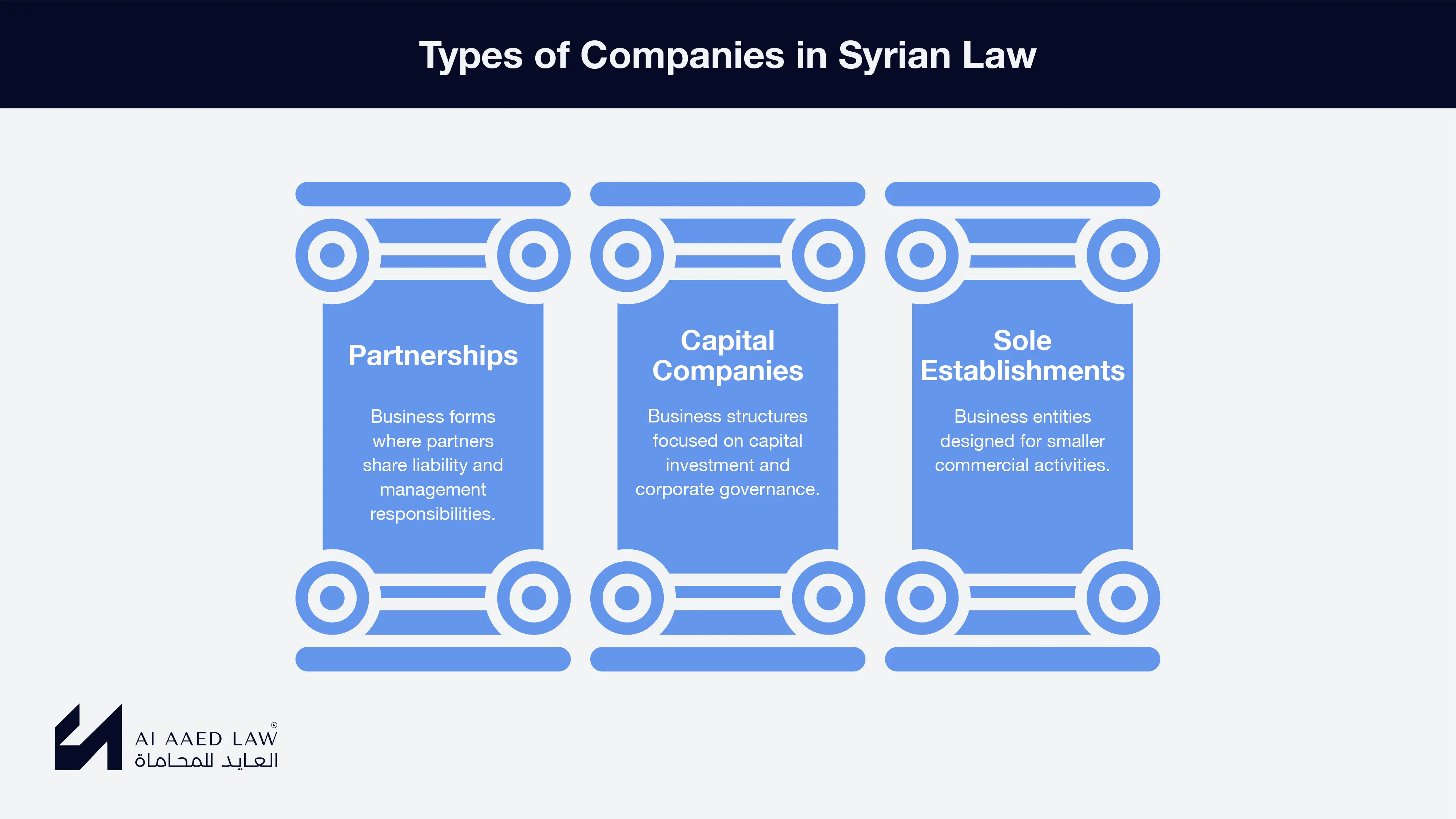
Partnerships and Capital Companies: What Is the Difference?
This doctrinal and practical classification helps explain the importance of partner identity and capital:
- Partnerships depend substantially on trust and the personal identity of the partners, as in a general or limited partnership. The admission, withdrawal, or transfer of a partner's interest is therefore more sensitive.
- Capital companies focus on capital, interests, or shares and on the entity's continuity. The joint-stock company is the clearest example.
- The limited liability company combines some practical features of both groups. Its capital is divided into interests and partner liability is limited in principle, but the transfer of interests and relations among partners remain more restricted than trading joint-stock shares.
- The joint venture company is an internal contractual relationship without legal personality or publication, so it has a special status.
This classification is not a substitute for the rules governing each form, because liability, management, and transfer rights are not determined by the general category alone.
The Five Company Forms Under Syrian Law
1. General Partnership
A general partnership consists of two or more partners, operates under a particular name, and makes its partners personally and jointly liable with all their assets for the company's obligations and debts. A partner in a commercial general partnership also acquires merchant status.
This form usually suits a directly managed project between partners who have a high degree of trust. Its central risk is that creditors may reach a partner's personal assets, and a contrary internal agreement does not protect that partner against third parties.
The partnership agreement should regulate, at a minimum, management powers, transactions requiring prior approval, profit and loss allocation, admission or withdrawal of partners, death or incapacity, and dispute resolution.
2. Limited Partnership
A limited partnership has two classes of partners:
- At least one general partner who may manage and is personally and jointly liable for company debts.
- One or more limited partners who contribute capital, do not manage the company in dealings with third parties, and whose liability is limited in principle to their contributions.
This form may suit a business that needs funding from an investor who does not wish to manage. The distinction between the two roles must be respected: including a limited partner's name in the company name or allowing that partner to intervene in external management may expand liability in the cases specified by law.
3. Joint Venture Company
A joint venture company is an agreement between two or more persons whose effect remains between them, while an apparent partner conducts business with third parties in that partner's own name. It has no legal personality and is not subject to the publication requirements imposed on other companies.
The internal agreement determines the partners' rights and obligations, its duration, how the activity is funded, and how profits and losses are shared. A third party's legal relationship is, in principle, with the partner who contracted with it.
This form is not a simple substitute for registration. If the company appears to third parties as a company, the law allows it to be treated as a de facto company and may impose joint liability on the partners. It should therefore not be used without a precise agreement and an analysis of dealings with customers and suppliers.
4. Limited Liability Company
An LLC consists of at least two persons, but it may be formed by one person as a single-member limited liability company. Each partner's liability is limited in principle to the interests held in the capital.
Capital is divided into interests of equal value. Those interests may not be publicly subscribed for, offered to the public, or listed on a securities market. One or more managers, whether partners or third parties, manage the company within the limits set by law and the articles.
An LLC is often suitable for small and medium-sized businesses and startups seeking a separate entity and clear ownership and management rules without joint-stock governance. Limited liability does not, however, prevent personal claims against a partner or manager arising from a personal guarantee, fraud, management fault, legal violation, or commingling of company and personal funds.
5. Joint-Stock Company
A joint-stock company's capital is divided into equal-value shares, and shareholder liability is limited to the nominal value of the shares held. The law divides this form into:
- Public joint-stock company: It has at least ten shareholders, and its shares may be traded and listed subject to the applicable laws and regulations.
- Private joint-stock company: It has at least three shareholders, and its founders subscribe to its capital under the formation rules without a public offering.
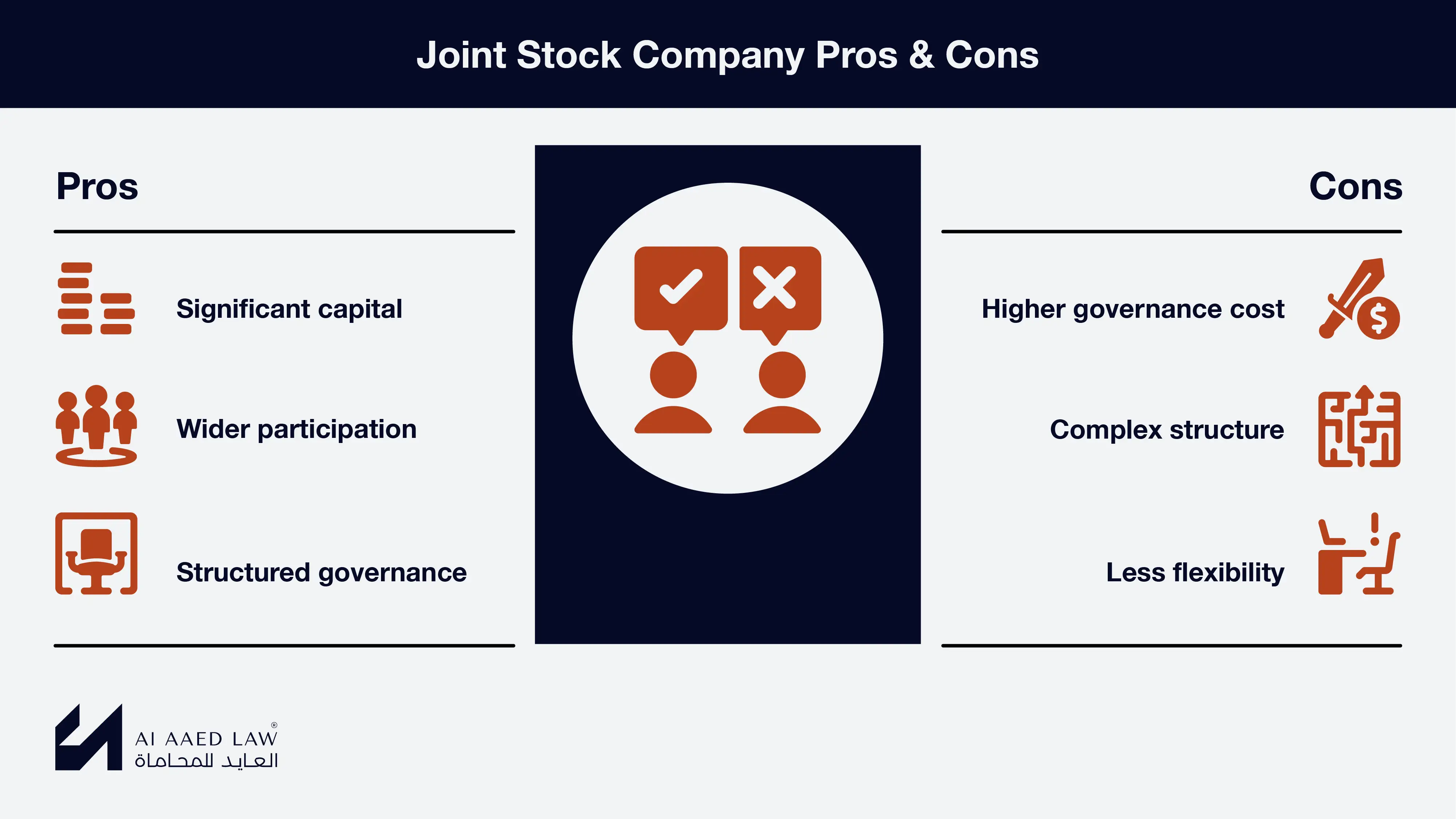
A board of directors manages the company, which is subject to more structured general meetings, registers, resolutions, audits, and disclosures than an LLC. It therefore usually suits larger projects, a broader shareholder base, investment rounds, or a public offering when the company is public and satisfies securities requirements.
Sole Establishment or Single-Member LLC?
The difference is fundamental even though each has one owner:
- Sole establishment: The owner registers as a merchant or business operator in the capacity of a natural person. An individual registration does not itself create a separate corporate barrier between that person and the business, so the business's obligations fall on the owner personally.
- Single-member LLC: This is a company under the Companies Law. After completing formation and publication, it has legal personality, and its owner's liability is limited in principle to the interest held, subject to exceptions concerning personal guarantees, violations, and mismanagement.
A sole establishment may suit a low-risk small activity that does not need investors or partners. If contracts, debts, or operating liabilities are greater, a single-member LLC may be more suitable, provided the owner accepts the costs of formation, governance, and compliance.
Comparison Table of Company Types in Syria
| Form | Owners or partners | Liability in principle | Management | Publication and legal personality | Common use |
|---|---|---|---|---|---|
| General partnership | Two or more | Personal and joint with all assets | Partners or a manager under the agreement | Published and acquires personality against third parties through publication | Project among partners with a high degree of trust |
| Limited partnership | At least one general and one or more limited partners | Unlimited for general partner; contribution limit for limited partner | General partners; limited partner does not manage externally | Subject to publication | Combining active management with non-managing partner finance |
| Joint venture company | Two or more | Third parties deal primarily with the apparent partner; joint liability may arise if the company appears | Internal agreement and apparent partner | No legal personality or publication | Internal contractual cooperation on a particular project after advice |
| Limited liability company | One, or two or more | Limited to interests in principle | One or more managers | Subject to formation and publication | Small, medium-sized, and startup businesses |
| Private joint-stock company | At least three shareholders | Nominal value of shares | Board of directors | Subject to formation, publication, and wider governance | Large or multi-investor projects |
| Public joint-stock company | At least ten shareholders | Nominal value of shares | Board of directors | Subject to governance, disclosure, and securities rules | Large projects that may need a public offering |
| Sole establishment | One natural-person owner | Personal and unlimited | Owner | Individual commercial registration; not an Article 5 company | Low-risk small activity |
How Does Partner Liability Differ by Company Type?
Liability is often the most important selection factor:
- In a general partnership, liability extends personally and jointly to the partners' assets.
- In a limited partnership, liability differs between general and limited partners.
- In a joint venture company, third parties deal primarily with the apparent partner, but the company's appearance may result in de facto-company treatment and joint partner liability.
- In an LLC, partner liability is limited in principle to the interests held.
- In a joint-stock company, shareholder liability is limited in principle to the nominal value of the shares.
- In a sole establishment, the owner is personally responsible for the activity's obligations.
“Limited liability” is not absolute immunity. Personal liability may arise from a personal guarantee or security, signing before publication is complete, exceeding authority, fraud, management errors, or a breach of a manager's or director's duties.
Capital and Funding Requirements
An outdated minimum-capital figure should not be copied from an old article or form, because requirements may change through implementing decisions or vary by sector. The Companies Directorate and relevant sector regulator should be consulted when filing.
When comparing forms, note that:
- LLC interests may not be publicly subscribed for or listed on a securities market.
- LLC capital may include in-kind contributions appraised under the legal procedures, but services or work may not constitute a capital contribution.
- A joint-stock company is the natural form when growth requires shares and a wider investor base. A public offering is associated with a public joint-stock company and securities rules.
- Registered capital does not replace a realistic operating budget or a clear agreement on later finance, loans, and guarantees.
Company Management and Decision-Making
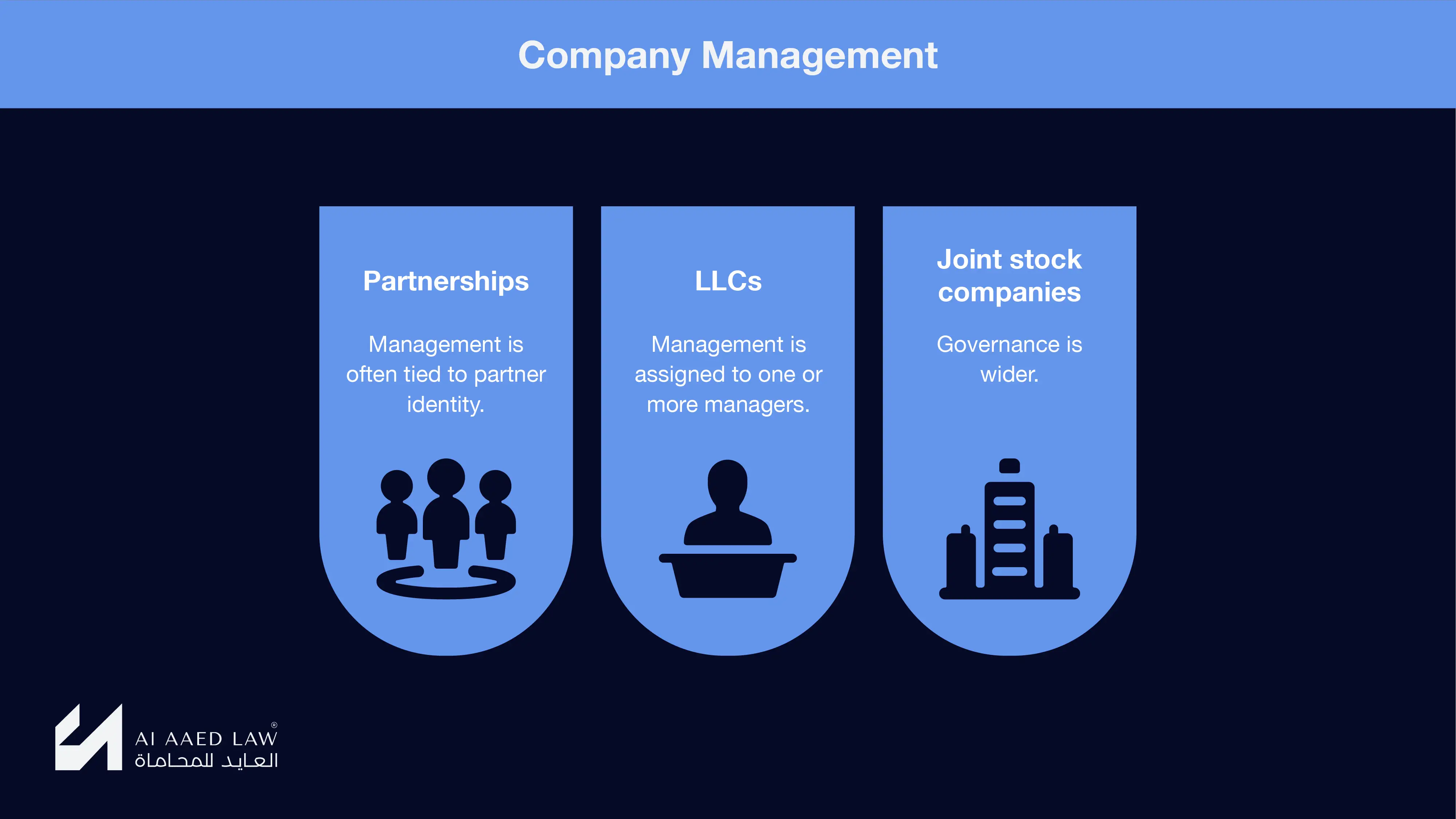
The legal form should reflect how management will actually operate:
- In a general partnership, personal identity is important, and the manager's powers and transactions requiring partner approval should be defined.
- In a limited partnership, general partners or authorized managers manage, while a limited partner does not represent the company externally.
- In an LLC, one or more managers act within the articles' limits on signing, borrowing, asset sales, security, and guarantees.
- In a joint-stock company, a board of directors manages under general-meeting oversight and wider governance rules.
The issue is not merely who is named manager. The documents should define the limits of authority, removal or replacement, quorum and majorities, conflicts of interest, bank-signing powers, and decisions reserved to the owners.
Transferring Interests, Admitting Investors, and Partner Exit
The ease of ownership transfer differs:
- Partnership interests are generally linked to partner consent and the rules in the agreement and the law.
- In an LLC, an interest transfer is subject to registration in the partners' register and legal rights and conditions, including partner pre-emption rights on a sale to a third party under the articles.
- Joint-stock shares are more transferable, subject to law, the articles, and market rules if listed.
- A sole establishment cannot admit a partner without reorganizing the activity as a company or using another legal arrangement.
The articles or shareholders' agreement should cover exit valuation, death or incapacity, priority rights, deadlock, minority protection, confidentiality, and non-compete obligations within legally permitted limits.
Registration, Publication, and Acquisition of Legal Personality
Article 3 of the Companies Law provides that a company does not acquire legal personality against third parties until publication. Publication is completed by registering the required agreements, articles, and data in the companies register, and amendments must also be published within the statutory periods. A joint venture company is exempt because it has no legal personality.
Depending on the form and activity, practical formation steps include name reservation, preparing the agreement or articles, defining the purpose, capital, and management, authenticating signatures, obtaining sector approvals, proving capital payment when required, registration, publication, and related tax and social-insurance registrations.
In July 2026, SANA reported the launch of an electronic company-formation service and the unification of procedures across company and commercial-register offices. The Companies Directorate's laws and regulations page should still be checked before filing because forms and document requirements may be updated.
Tax, Accounting, and Sector-Licensing Duties
The legal form does not by itself determine the tax burden. The result is affected by the activity, turnover, tax laws in force, exemptions or incentives, ownership, and any special investment regime.
Requirements for books, financial statements, appointment of an accountant or auditor, meetings, and recording resolutions also vary. An activity may require an additional license from a regulator even after the company is formed.
The decision should therefore integrate company, tax, labor, social-insurance, licensing, and contract law rather than focusing on liability alone.
How Do You Choose the Right Company Type?
Start with these questions:
- Is there one owner or are there several partners?
- What is the scale of debt, contract, product, and employee risk?
- Are the owners willing to accept unlimited personal liability?
- Is funding needed from investors who will not manage?
- Will the project eventually need a public offering or tradable shares?
- Who will manage, and which decisions need special approval?
- How will a new partner enter or an existing partner leave?
- Is the activity regulated or subject to prior approval?
- What is the cost of accounting and governance compliance?
- Is a later conversion, merger, or sale expected?
There is no single answer for every business. A sole establishment may be enough for a limited low-risk activity; a single-member LLC may be safer for a one-owner business; a general partnership may fit partners who accept personal liability; and a joint-stock company may better serve broad investment growth.
Common Mistakes When Choosing a Legal Structure
Common mistakes include:
- Listing only four types and omitting the joint venture company recognized by law.
- Treating a sole establishment as a company or confusing it with a single-member LLC.
- Forming a general partnership for a high-risk activity without understanding exposure of personal assets.
- Allowing a limited partner to manage third-party dealings in a way that may expand liability.
- Assuming LLC interests may be offered to the public.
- Using old capital or fee figures without checking current decisions.
- Relying on limited liability while signing broad personal guarantees.
- Failing to regulate exit, death, deadlock, and minority rights.
- Registering the company without completing sector, tax, or social-insurance requirements.
Can the Legal Form Be Changed After Formation?
Yes. The Companies Law permits certain forms to convert into others under conditions and procedures that depend on the company. The law may require a minimum period, a partner or general-meeting resolution, valuation of assets and liabilities, creditor notice, approval of the new articles, and completion of publication.
Article 217 provides that conversion does not change the company's legal personality. Its rights remain, and it continues to be responsible for earlier obligations under the liability rules that applied when each obligation arose. Conversion cannot therefore be used to erase debts or liabilities.
The Lawyer's Role in Selecting the Right Company Type
A corporate lawyer helps turn the business model into an enforceable legal structure by:
- Comparing liability, governance, and funding under each form.
- Reviewing activity restrictions, investor nationality, and required approvals.
- Preparing the formation agreement, articles, and shareholders' agreement.
- Regulating management, signing authority, reserved decisions, and conflicts of interest.
- Drafting rules on interest transfers, exit, death, and dispute resolution.
- Coordinating publication, licensing, tax, labor, and social-insurance steps.
- Reviewing guarantees, loans, investment, conversion, and merger consequences.
Early legal review generally costs less than a partner dispute or restructuring after the business has begun operating.
Why Work With AL AAED Law Firm in Syria?
AL AAED Law Firm can help select a structure aligned with your activity, risks, and funding plan; prepare formation documents and shareholder agreements; and follow registration, publication, licensing, and amendment procedures.
Before registration, a focused legal review can identify personal-liability exposure, ownership-transfer restrictions, management powers, and investor and regulatory requirements.
Contact AL AAED Law Firm for advice tailored to forming or restructuring your company in Syria.
Legal Notice
This article provides general information and is not legal or tax advice for a particular case. Procedures, fees, capital requirements, and licensing rules may change, and some activities are governed by special laws. The current legislation, decisions, and forms should be verified and professional advice obtained before action is taken.
Content last legally reviewed: July 2026.
This article is provided for general information only and does not constitute legal advice. For advice on a specific matter, contact AL AAED Law Firm.