A supplier’s general manager negotiates your contract, stamps the final page and asks for an advance payment that afternoon. The registration record names that manager, but it also contains a restriction: commitments above a stated amount require a second signature. An annex has just increased the price. You need to establish whether the final agreement satisfies the actual signing rules before releasing the money.
Company signing authority in Syria is a question about the particular company, person and transaction. A title, company stamp or familiar email address may help identify the person you are dealing with. None should replace checking the legal source and scope of that person’s authority.
This guide is for customers, suppliers, lenders and other counterparties verifying a signature. It concentrates on four questions: Who is the contracting company? Who can bind it? Does the authority cover the final deal? Who may receive the payment? Al AAED’s Corporate Governance guide addresses the broader task of setting a company’s internal approval and delegation rules.
What makes a signature binding on the company?
Article 106 of the Syrian Civil Code addresses a representative concluding a contract in the principal’s name and within the representative’s authority: the resulting rights and obligations attach to the principal. In company transactions, that analysis must be read with the rules governing the company’s legal form, registered representation and any relevant delegation. [1–2]
Do not collapse several issues into one signature check. A genuine signature can still raise a question about authority. A person may hold office but lack power to make a particular commitment alone. An approval may cover a transaction while leaving another person responsible for signing it. The documents need to explain both approval and representation.
Equally, do not declare an agreement automatically void because a document is missing from your file. The effect on the company and third parties can depend on statutory rules, registration and publication, knowledge, the actual mandate and subsequent events. Resolve gaps before committing where possible; seek a legal assessment where a dispute has already arisen.
Identify the exact legal entity before reviewing the signatory
Match the contract, registry and commercial documents
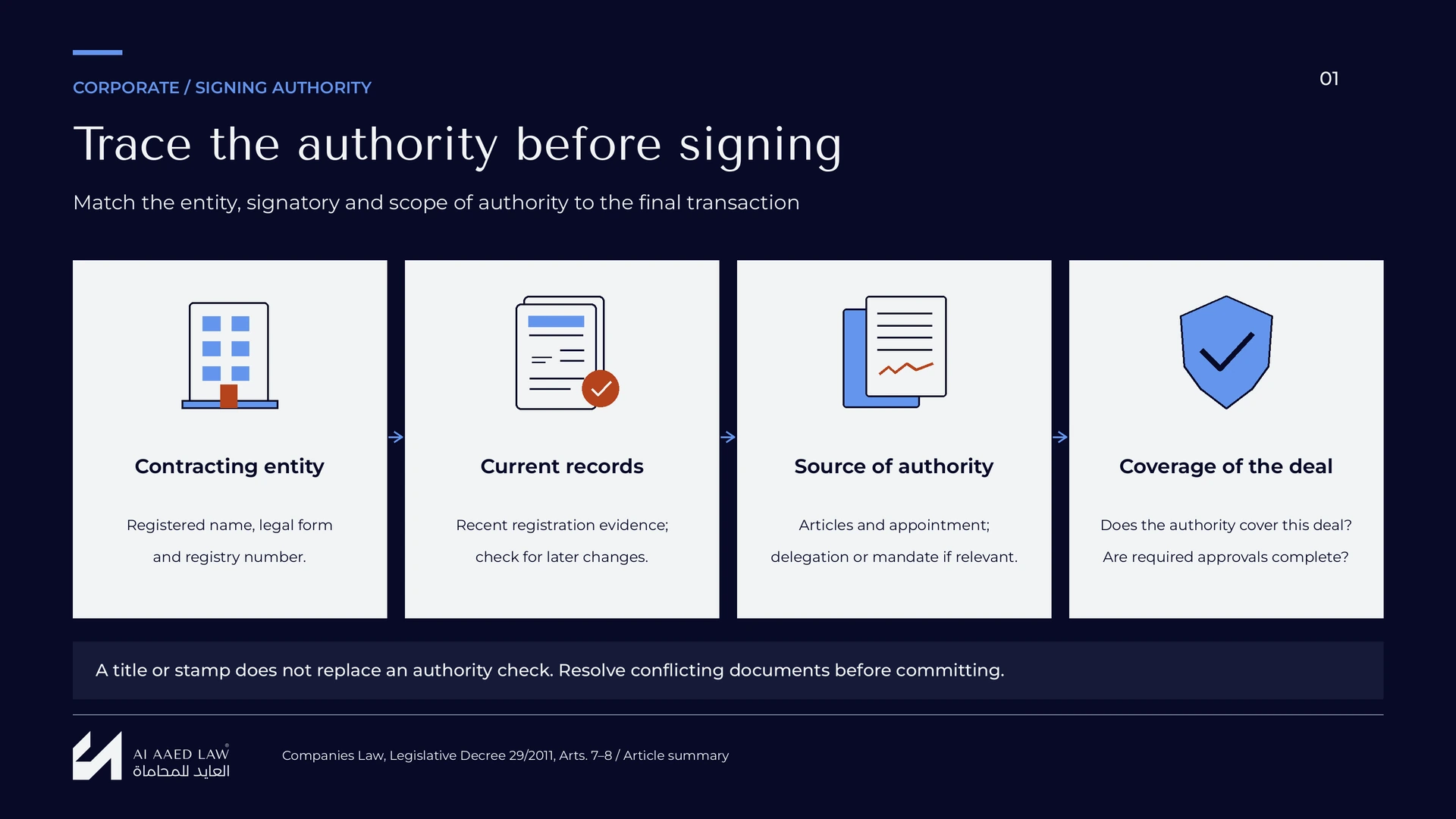
Record the full registered name, legal form and registry number. Compare them with the quotation, purchase order, agreement, invoice and proposed payment beneficiary. Similar trading names or shared branding do not prove that two group companies are the same debtor or seller.
Ask which entity will perform, invoice and receive payment if those functions appear divided. A parent company’s negotiation team does not automatically make the parent a party or guarantor. If an additional guarantee is intended, its parties, terms and signing authority need their own review.
Distinguish a branch from a separate company
Where the transaction is through a foreign company’s Syrian branch, identify the foreign entity and the registered branch. Do not treat a branch manager’s title as evidence that an unrelated Syrian subsidiary is bound. Conversely, do not assume that every locally used foreign brand operates through a registered branch.
The relevant records and representation rules differ. Companies Law No. 29 of 2011 governs Syrian company forms, while Law No. 34 of 2008 addresses foreign branches, offices and agencies. Establish the structure before applying a signing rule. [1, 3]
Assemble a current and coherent authority file
Articles 7–8 of the Companies Law address access to company register information and registration-certificate particulars, including management, authorised signatories, terms, powers and restrictions. Article 3 deals with registration and publication, including amendments and their effect toward third parties. Use these records as a starting point and resolve material inconsistencies. [1]
| Document or record | What it helps establish | What still needs checking |
|---|---|---|
| Recent official or properly certified registry evidence | Company identity and recorded management or signatory information | Later changes, relevant restrictions and supporting entries |
| Current articles of association and amendments | Governance, representation and approval rules | Whether the version supplied incorporates the amendments affecting this deal |
| Appointment or election document | The office held and the appointment basis | Effective date, term, replacement and required registration or publication |
| Transaction approval | Approval of a defined commitment by the relevant corporate body | Competence of that body, applicable decision requirements and final-contract coverage |
| Delegation or power of attorney | Authority conferred on a representative | Grantor’s power, scope, form, duration and any conditions on further delegation |
| Payment instruction | The authorised direction for transferring or collecting funds | Beneficiary identity, authenticity, authority and discharge of the payer’s obligation |
There is no universal “safe age” for a registry extract in this guide. A recently issued extract is useful, but a change may occur afterwards. Ask whether there have been later appointments, restrictions or revocations and refresh the review when circumstances warrant it.
Read the documents together. A certificate naming one manager and minutes naming another do not become consistent because both carry a stamp. Obtain an explanation supported by the current registry position and applicable rules. The Commercial Registry guide provides the wider registration context.
Apply the rules for the company’s legal form
Limited liability companies
For a Syrian LLC, review the manager’s appointment, term and the articles’ rules on individual or joint representation. Article 67 addresses management and its powers. Article 68(3) requires general assembly approval for an act outside the powers granted to the manager by the articles. Check the relevant approval rather than assuming a manager’s job title answers the question. [1]
Delegation also matters. Article 67(8) restricts a manager’s transfer to others of powers delegated by the general assembly without that assembly’s approval. If an employee signs under a manager’s authorisation, trace whether that authorisation could validly be given. A letter headed “full authority” does not establish the grantor’s own power. [1]
Joint-stock companies
Article 148 addresses representation by the chair and the effect of the chair’s signature, subject to the company’s articles. Article 147 allows executive managers to sign individually or jointly according to the board’s delegation. Read the actual board decision and articles; “chief executive,” “director” and “chair” should not be treated as interchangeable sources of authority. [1]
Where a transaction requires approval by a particular corporate body, confirm that approval separately from the person’s authority to execute the contract. Obtain the relevant decision and examine whether it covers the final terms, including material obligations added during negotiation.
Foreign branches and offices
Article 18 of Law No. 34 of 2008 gives the general manager statutory powers concerning receipt, payment, contracting, signing and representation relating to the foreign entity’s registered business. It also addresses the foreign entity’s responsibility for branch or office obligations. This requires an assessment of the applicable statutory role, not an assumption that every branch act depends solely on an ordinary employee mandate. [3]
Verify the foreign entity, registered activity and current appointment. If someone other than the general manager proposes to sign by delegation, Article 18(4) requires attention to the foreign entity’s permission and the statutory conditions on the delegate. Do not apply the rules for a Syrian LLC to a foreign branch without examining the distinction. [3]
For other legal forms or a company established under a special law, obtain advice on the relevant representation provisions. The examples above are not a complete catalogue of every Syrian business structure.
Understand registered restrictions and the registry-number rule
Articles 67(10) and 148(4) address the effect toward third parties of registered restrictions on relevant representation or signing powers where the company’s registry number is cited in the contract or act. A registry-number reference therefore deserves a substantive check of the registered restrictions, not merely a formatting check. [1]
This rule does not mean that omitting the number validates any signature or makes all restrictions irrelevant. Other rules and facts can affect the outcome. Do not deliberately remove identifying information as an attempted workaround; verify authority and address the actual restriction.
Also distinguish an internal instruction from a restriction whose effect toward a counterparty is being assessed. An internal approval failure and the external binding effect of an agreement are related questions, but they are not always answered identically. Seek advice before accepting either party’s assertion that an internal limit conclusively settles the dispute.
Test the final transaction against the scope of authority
Check the act, total commitment and duration
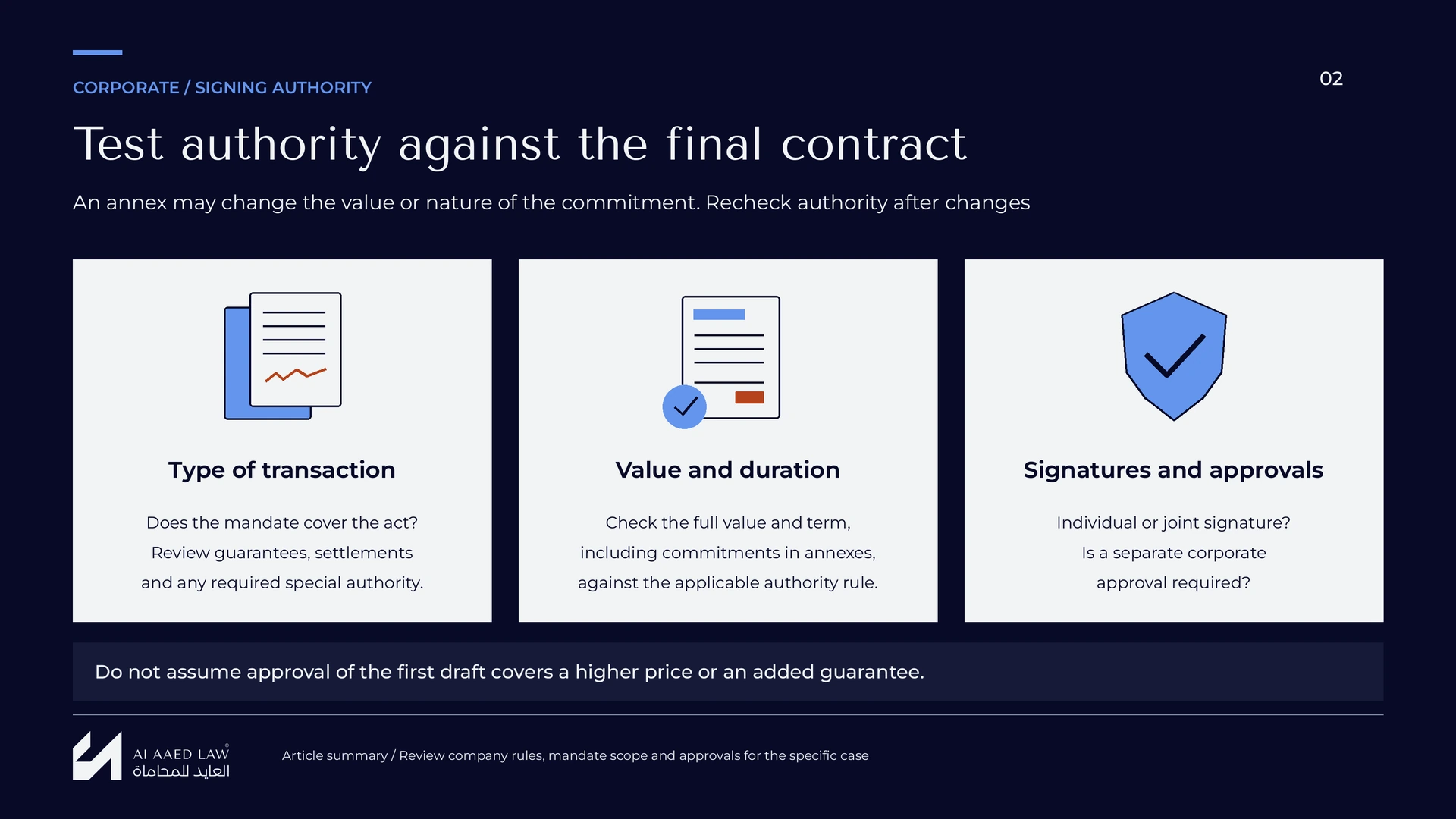
Read the mandate against the final contract, annexes and side letters. Does it cover this type of transaction and its full value? Does the rule count a single order, an aggregate commitment or another defined measure? Are tax, options, guarantees or later variations relevant under the actual wording? Do not invent a valuation method where the rule is unclear.
Illustrative example: a company’s documented rule allows one signature up to 100 units and requires two above that threshold. The initial draft is 80; an annex adds a committed 40. Determine how the rule measures the commitment and who must sign the complete package. The figures are hypothetical company limits, not statutory Syrian thresholds.
Duration can matter as much as price. A mandate for a short purchase may not resolve authority for a multi-year framework, automatic renewal or continuing guarantee. Identify the obligation actually being accepted, including termination payments or commitments that survive expiry.
Separate a second signature from an approval
A board or general assembly approval and a second contract signature can serve different purposes. If the applicable rule requires both, obtaining one should not be assumed to replace the other. Conversely, do not demand an unnecessary resolution as though every ordinary contract legally requires one.
Record the applicable rule, the evidence satisfying it and any unresolved point. Have the relevant signatories execute the same final version with its incorporated annexes. A signature on an earlier draft does not by itself explain agreement to a later material amendment.
Examine a power of attorney beyond its heading
Articles 667–668 of the Civil Code distinguish an agency expressed in general terms, covering administration, from special authority needed for acts beyond administration. The Code identifies acts including sale, mortgage, settlement, acknowledgment and arbitration, while Article 667 also describes acts falling within administration. The analysis is more precise than a blanket statement that every sale always requires the same document. [2]
Review the actual wording, transaction and grantor’s authority. Article 666 concerns the form required for the agency in relation to the underlying legal act. Where foreign documents are involved, establish the applicable authentication, translation and receiving-authority requirements for that file; there is no single checklist here that guarantees acceptance everywhere. [2]
Check expiry, conditions and evidence of revocation or replacement. If authority has been delegated again, examine the full chain and relevant corporate restrictions. A neatly translated power of attorney cannot confer more power than was validly granted.
For settlements, debt acknowledgments, guarantees, property dispositions or arbitration commitments, identify the specific act and any additional corporate approval. Do not infer authority to waive a claim from authority to discuss it. Article 109 also makes self-contracting a separate issue requiring attention to permission and applicable exceptions; a representative’s presence on both sides merits specific review. [2]
Verify payment instructions as a separate decision
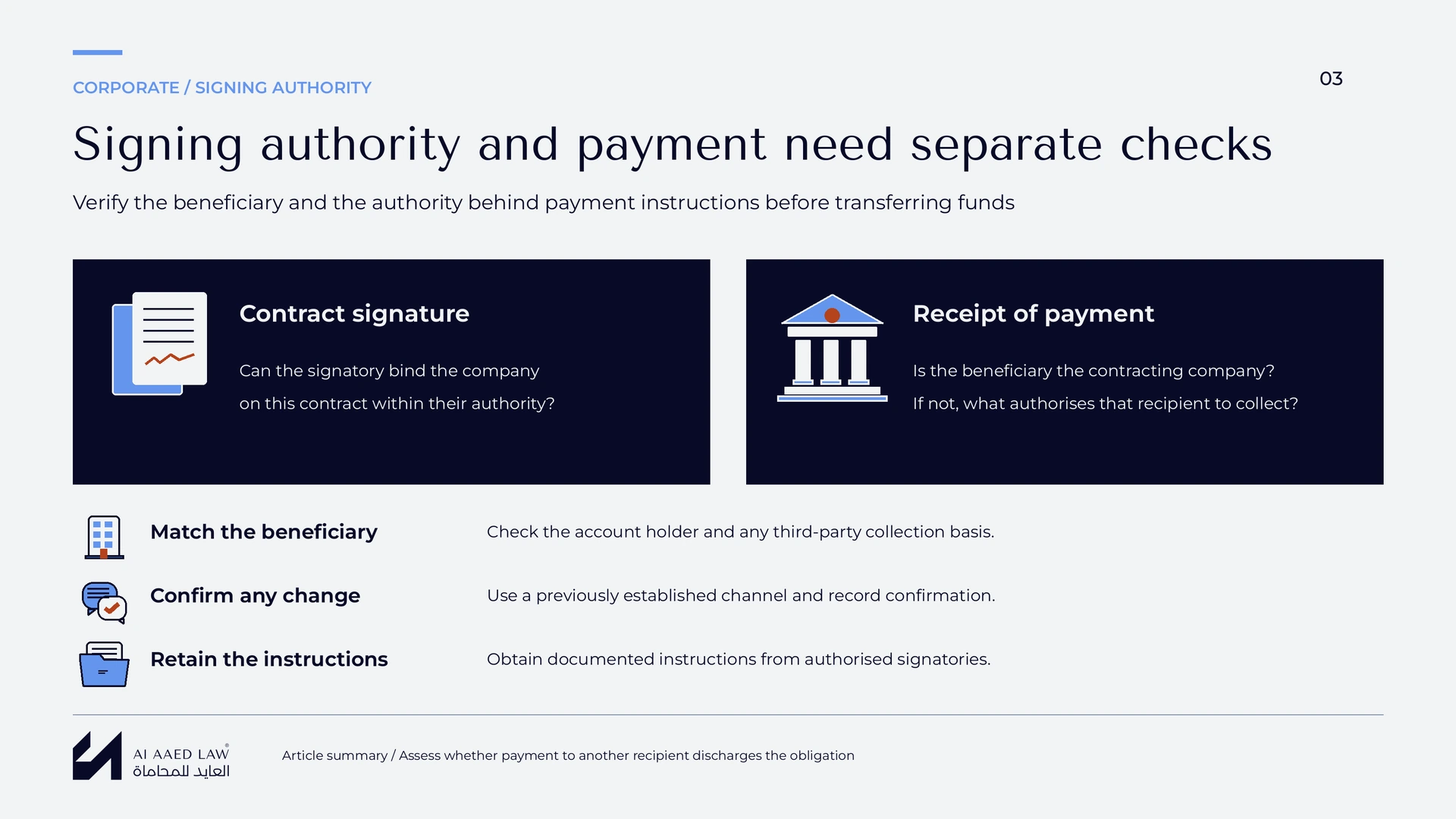
A person’s authority to sign a sales agreement does not alone establish that an unrelated recipient may collect the price. Match the account beneficiary with the contracting company, and investigate a request to pay a shareholder, another group entity, a distributor or an agent.
Obtain the explanation and authority for third-party collection in writing. Review whether payment in that manner will discharge the payer’s obligation and how the recipient will acknowledge receipt. Do not treat a bank transfer receipt as conclusive proof that the contractual creditor has been paid if the beneficiary differs.
For changed bank details, verify the instruction through a previously established contact channel. Record who confirmed it, their authority, the beneficiary and the final instruction. A plausible email address or a familiar signature image is not a reason to skip verification, particularly when funds are requested urgently.
These checks are operational controls. They do not replace transaction-specific advice on payment, banking restrictions, compliance or the validity of a third-party collection arrangement.
Recheck authority when the transaction changes
An amendment, extension, price increase, release or new guarantee may require another authority assessment. Keep a clear record of which version was approved and signed. Changes in management between negotiation and completion also deserve review; do not rely indefinitely on the person who handled the first meeting.
If an office or mandate has ended, the effect on an existing or new contract requires examination. Article 108 contains a particular rule where both the representative and counterparty were unaware at contracting that the representation had ended. It should not be turned into a general permission to disregard a known replacement or expired mandate. [2]
Preserve correspondence identifying when a change was communicated and what the parties knew. For broader internal delegation controls, see the Corporate Governance guide.
What if the agreement has already been signed?
Preserve the signed version, annexes, registry records, appointment and delegation documents, negotiations and evidence of payments or performance. Establish what the suspected defect actually is: wrong company, expired appointment, missing joint signature, exceeded mandate, absent approval or an authenticity concern.
Ask counsel to assess the agreement’s binding effect and whether an appropriate confirmation, fresh execution or other remedy is available. Any corrective step must come from the competent company body or representative and address the identified issue. Do not backdate documents or assume a later stamp cures every defect.
Before stopping performance, making another payment or asserting invalidity, review the contract and consequences. A signature dispute does not automatically answer rights to suspend, terminate or recover money. The Breach of Contract guide explains the wider remedies context.
Use a proportionate checklist before committing
| Check | Practical action |
|---|---|
| Entity | Match registered name, legal form and number across the deal documents. |
| Person | Verify identity, current office or mandate and the source of authority. |
| Scope | Check transaction type, value, duration and special commitments. |
| Approvals | Confirm required corporate decisions and individual or joint signatures. |
| Payment | Verify beneficiary, authority for collection and changed instructions. |
| Final file | Keep consistent records, final agreement, annexes and verification evidence. |
Scale the review to the transaction. An ordinary repeat order and a long-term secured commitment may require different supporting records. The objective is an explained, evidenced decision, not a large folder of documents nobody has read. Resolve material discrepancies before signing or paying whenever possible.
Verify authority before the commitment becomes difficult to reverse
Contact Al AAED with the draft or signed agreement, annexes, current registry evidence, articles and the signatory’s appointment, approval or mandate. Include payment instructions where funds are involved. A review of those documents can identify what is established, what remains unclear and which additional step is appropriate.