Your overseas business is preparing a Syrian maintenance contract. The customer wants the foreign company’s experience and warranty, but the work needs local staff, premises and payment arrangements. A branch appears to preserve the existing relationship. A Syrian subsidiary seems better suited to a continuing local business. Which structure actually fits the contract you are about to sign?
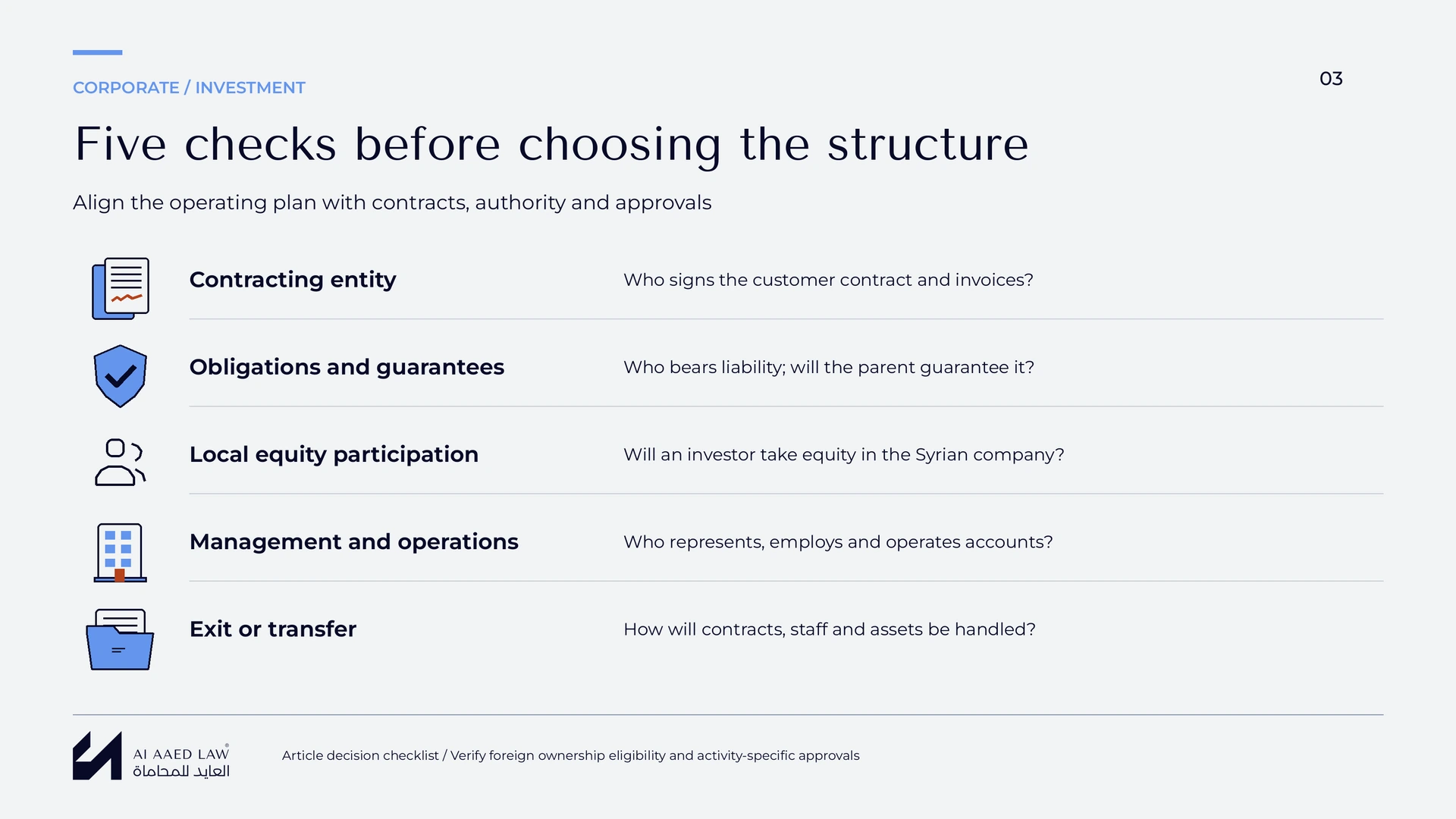
Start with the operating model rather than the filing timetable. Identify who will contract, perform, employ, invoice and bear the risk. Then check whether the proposed structure is permitted for the activity and can meet the customer’s and authorities’ requirements. A route that is easy to describe may still fail if the customer will not accept the contracting entity or the activity needs an additional approval.
This guide compares a foreign company’s registered branch with a separately incorporated Syrian subsidiary. Where an LLC is used as the subsidiary example, its rules should not be treated as the rules for every company form. The article complements Al AAED’s company formation guide, which addresses the wider incorporation process.
What is the difference between a branch and a subsidiary?
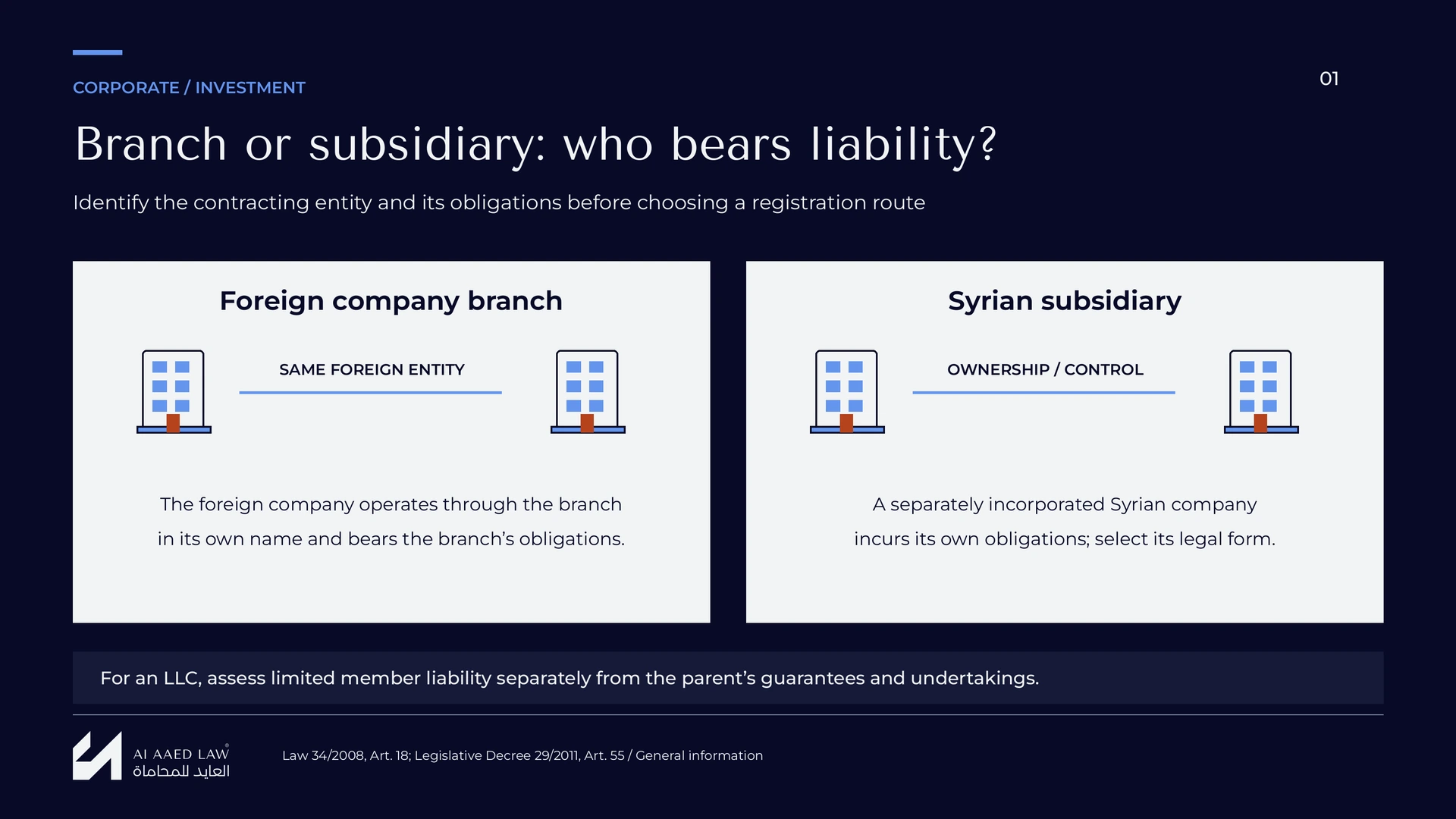
A branch is the foreign company operating in Syria through a registered local establishment under its own name. It is not a separately incorporated Syrian company with its own local shareholders. Law No. 34 of 2008 provides the framework for foreign branches and offices and makes the foreign legal entity responsible for the branch’s acts and obligations. [1]
A subsidiary is a separate company controlled by its parent. If incorporated under the ordinary Syrian company framework, it has its own legal form, constitutive documents and governing arrangements. “Subsidiary” describes the ownership or control relationship; it is not, by itself, a legal form to select on a registration application. An LLC is one possible form where suitable and permitted. [2]
A representative office, regional office or temporary office should not be casually used as another name for either structure. Law No. 34 treats these as distinct routes with their own purposes and restrictions. Choose between the legally available options for the actual activity, not simply between names used in an internal presentation. [1]
Compare the structures against the decisions the business must make
| Decision | Foreign company branch | Syrian subsidiary |
|---|---|---|
| Contracting identity | The foreign company acts through its branch and authorised representative. | The Syrian company contracts through its authorised representative; the parent’s separate role must be documented. |
| Liability | The foreign legal entity bears the branch’s obligations under Law No. 34. | The subsidiary incurs its own obligations; exposure of owners and managers depends on its form and their commitments. |
| Local equity | No separate Syrian branch capital interests exist for a local investor to acquire. | An investor can take an interest in the local company, subject to eligibility, approvals and transfer rules. |
| Governance | Particular attention is needed to the general manager’s statutory and documented powers. | Governance follows the chosen company form, articles and valid appointments and delegations. |
| Permissions | Registration and permitted activity must be checked alongside operating approvals. | Incorporation does not replace sector, location or project approvals. |
| Finance and records | Local accounting and reporting obligations still need an owner and budget. | The company needs its own financial records and documented arrangements with the parent. |
| Change or exit | Wind down the foreign company’s local operation and address continuing obligations. | An ownership sale, business transfer or liquidation involves different steps and possible consents. |
The table is a decision framework, not a statement that every foreign applicant or activity qualifies for both routes. [1-2]
Understand the liability before describing the structure as safer
A branch exposes the foreign entity to its obligations
Article 18 of Law No. 34 is central: the foreign entity is responsible for the branch’s acts and obligations. If the objective is to isolate the parent from local contractual exposure, a branch does not achieve that merely because the contract uses a Syrian office address or the group keeps a separate operating budget. [1]
Read the proposed warranties, indemnities, lease and employment commitments together. A short project can create obligations that continue after delivery, such as maintenance or defect-related commitments. The plan should identify who will manage those obligations if the branch later stops taking new work.
A subsidiary does not erase every parent commitment
Article 55 of the Companies Law addresses limited member liability in an LLC and permits a single-member LLC. The scope of an owner’s liability as a member is different from a guarantee, direct contract or other undertaking that the parent signs in its own name. [2]
For example, a local subsidiary might sign the service contract, while the parent separately guarantees performance. Assess both documents. Do not present the guarantee as a harmless attachment or assume a local company makes the parent’s express promise disappear. Also review the legal consequences of management conduct or other specific obligations where relevant; the company form alone does not decide every liability question.
Match the structure to the customer contract and tender
Resolve the contracting entity before the bid or signature
Ask whose experience, registrations and financial standing the customer is relying on. Does the tender accept the foreign company acting through a branch? Does it allow a newly incorporated subsidiary to rely on group experience? Are subcontracting or assignment permitted? Obtain the customer’s actual requirements instead of assuming group affiliation makes the entities interchangeable.
If the parent has already bid or signed, review the consequences before proposing a local substitute. A new subsidiary’s incorporation does not automatically change the successful bidder or transfer the parent’s contract. Consider the agreement’s consent requirements, approvals and the allocation of existing responsibilities.
Connect performance, invoicing and warranty roles
Prepare a short transaction map: contracting party, party performing each task, employer, importer where relevant, invoice issuer, payment beneficiary and warranty provider. Investigate every mismatch. An arrangement can involve several group companies, but the documents and permissions need to explain their roles.
Illustrative example: the parent supplies equipment, a Syrian company installs it, and a bank guarantee supports the contract. Identify which entity owes delivery, installation and warranty obligations and whether the customer accepts that split. Choosing a registration route is only one part of making the arrangement workable.
Consider ownership, funding and local participation
Decide where the investor is acquiring an interest
A branch has no separate Syrian company capital in which to admit an investor. If the group wants an investor to share ownership of the Syrian business, a local company may provide the relevant structure, subject to the applicable rules. An interest in the foreign parent would be a different transaction with wider consequences.
For a subsidiary, settle the proposed owners, voting rights, management, funding commitments and exit arrangements before promising equity. Article 55’s recognition of a single-member LLC does not establish that every proposed foreign ownership arrangement is acceptable for every sector. Check the activity and current instructions as well as the company form. [2]
Document how the operation will be financed
Prepare a realistic start-up and operating budget. Separate registered capital, working capital, loans, equipment and support from other group companies. Specify who provides each item and the legal and accounting basis. Avoid treating every transfer from headquarters as the same type of funding.
If the subsidiary will use the group’s software, brand, personnel or equipment, document the arrangement and review the relevant tax, licensing and payment implications. This does not mean every business needs the same suite of intercompany contracts; it means the paperwork should reflect what is actually supplied and paid for.
Separate registration, activity permission and investment licensing
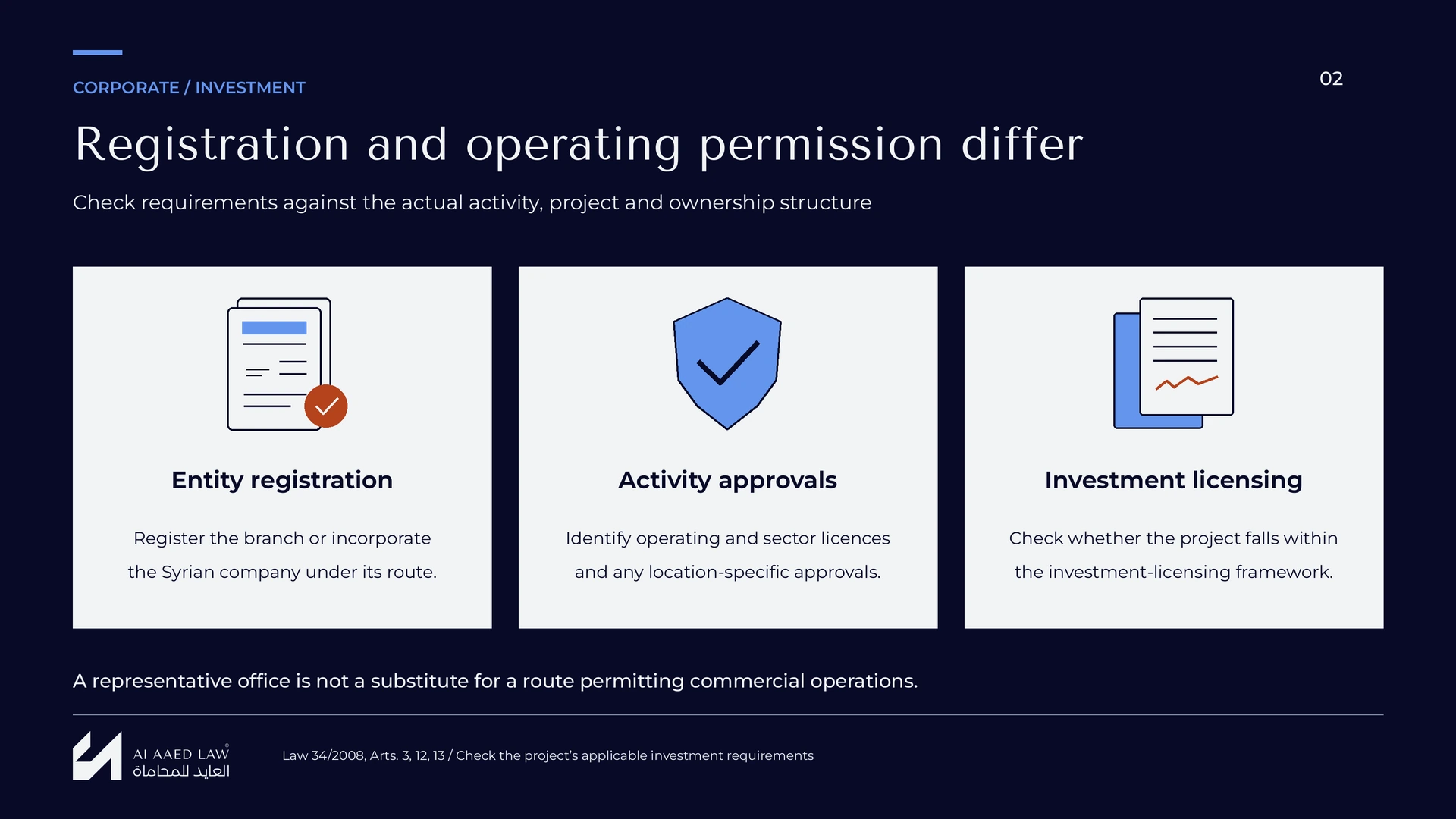
Registration identifies the entity and its registered scope
Article 3 of Law No. 34 distinguishes registration from permission to work under the applicable rules. The company framework similarly does not make incorporation a universal operating licence. Start with a precise activity description: sales, imports, installation, maintenance, advice and other functions should be considered on their actual facts. [1-2]
Current sector decisions matter. For example, SANA reported a 2026 Ministry decision on registering foreign-company agencies, branches and offices in the automotive, machinery and tyre fields. A decision about those activities should not be treated as permission for every sector or as making every registration type equivalent. Confirm the decision and its scope for the proposed file. [4]
An investment project can require its own assessment
Review separately whether the project falls within the investment-licensing framework and what that means for its approvals. Law No. 18 of 2021 was amended, including by Decree No. 114 of 2025, and implementing instructions were announced in 2025. The existence of this framework does not mean every branch or company must obtain the same project licence, or automatically receives investment incentives. [3]
Use Al AAED’s investment-law guide for the wider context, then check the current project-specific requirements. Neither an old checklist nor a general description of investment reform answers every ownership, activity or location question.
Treat the manager’s authority as an operational decision
For a branch, Articles 17-18 address the general manager and substantial powers associated with the registered activities. Review eligibility, the local address, the appointment and the authority document early. A proposed non-Syrian natural-person appointment needs the approval contemplated by Article 17. Verify the current acceptance and filing requirements before finalising foreign documents. [1]
Internal approval limits should be designed with the legal position in mind. Do not assume a headquarters spending policy, by itself, limits the effects of every act of the branch’s statutory representative towards outsiders. Have the interaction between the law, registered particulars and the proposed mandate reviewed.
A subsidiary needs a corresponding examination under its own form: who appoints management, who signs alone or jointly, what requires owner approval and how changes are recorded. Plan for absence or replacement of the key signatory. A business can be registered yet unable to process an urgent payment because no one arranged usable authority. For the broader controls, see Al AAED’s corporate governance guide.
Prepare the documents before ordering legalisation
For a branch, Article 5 identifies supporting documents involving the foreign entity’s constitution and registration, the decision to establish the local presence, the manager’s authority and financial or capital evidence as applicable. Confirm current requirements rather than copying a historical capital amount or assuming all foreign documents follow an identical authentication route. [1]
For a subsidiary, identify the shareholder and representative documents, corporate decisions, local constitutive documents, management appointments and relevant approvals. Check consistency of names and legal identities across languages and records. Resolve who can sign before documents are certified abroad.
A practical file schedule should record:
- The document and issuing body.
- The party responsible for obtaining it.
- Whether an original, certified copy or recent extract is needed.
- The accepted authentication and Arabic translation route.
- Any validity period, dependency or approval to be checked.
- The filing destination and evidence of completion to retain.
This is a preparation tool, not a substitute for the authority’s current requirements. Al AAED’s commercial registry guide explains the registration and amendment context. Verify that the current service channel handles the intended foreign branch or company transaction; a digital incorporation announcement does not prove all related services are available online.
Test whether the structure can operate after registration
Banking, accounting and ongoing costs
Discuss the proposed account holder, payment flows, currencies and counterparties with the relevant bank and advisers. Confirm what documentation and checks are required. Incorporation or branch registration does not guarantee a particular cross-border payment route, and the article does not assume the same banking access for every entity.
Article 25 of Law No. 34 addresses separate local accounts, audit and reporting for foreign branches. A branch therefore should not be selected on the assumption that headquarters accounting removes local obligations. A subsidiary also needs appropriate accounting and reporting under its own framework. [1-2]
Obtain a cost estimate covering formation or registration, foreign documents, translation, advice, premises, accounting, audit where applicable and ongoing compliance. Compare the expected period of operation and potential closure costs, not just the first filing fee. Tax treatment needs its own analysis; neither structure should be described as automatically cheaper or more tax-efficient without reviewing the actual activities and funding.
Staff, premises and operating permissions
Identify the employer and check employment, payroll, social-insurance and work-authorisation requirements relevant to the team. Assign responsibility for local records and renewals or updates. Article 27 of Law No. 34 addresses work authorisation for non-Syrian personnel of branches and offices; do not treat a manager appointment or business entry document as proof of every employment permission. [1]
The premises also need review: permitted use, lease party, activity approvals and any installation or operational requirements. If importing or storing goods is part of the model, assess those functions explicitly. A description of the business as “services” should not conceal equipment imports or regulated work.
Work through the first contract and the future exit together
| Business situation | Questions that influence the structure |
|---|---|
| One contract relying on the foreign company’s warranty | Will the customer accept the branch, and does the group accept the resulting foreign-entity exposure? Is a separate project-specific route relevant? |
| Continuing local services with a prospective investor | Can the intended ownership and activity be approved, and how will local equity, management and funding work? |
| Market exploration without commercial trading | Does a representative-office role genuinely fit, or will the proposed work exceed its permitted scope? |
| Moving an existing operation into a new local company | What happens to contracts, staff, permits, assets, claims and guarantees, and whose consent is needed? |
Article 12 allows defined promotional, information-gathering and technical-support functions for representative offices, while prohibiting commercial activity. That is not a blanket prohibition on every contact or support task, but it is not a sales licence either. Assess the actual work rather than relabelling commercial delivery as “support.” [1]
Illustrative example: a group registers a branch for maintenance and later wants a local investor. Incorporating a company does not automatically move the existing customer contract, lease, staff or permissions into it. Build a transition list for each item and check the transfer mechanism and approvals. If the parent remains a warranty provider, document that continuing role.
Closure requires similar discipline. For a branch, review outstanding local obligations and the applicable deregistration requirements; stopping new work is not the same as completing the wind-down. For a subsidiary, distinguish a sale of interests from a business transfer or liquidation. Do not promise that any of these routes automatically releases creditors’ rights or the parent’s separate guarantees.
Compare the routes before making commitments
Contact Al AAED with the proposed activity, customer or tender requirements, intended owners, staffing plan and expected payment flows. Reviewing those facts together helps identify an eligible structure and the documents, permissions and continuing obligations that need coordination.
General information only. Eligibility, ownership, permissions, contracts, tax, employment and banking consequences require review for the proposed structure and transaction. Practical examples and checklists are decision tools, not filing instructions or promised outcomes.