Your Syrian distributor wants to put your logo on its storefront, create product listings and add a local label to the packaging. You have agreed on prices and a territory. The remaining questions are more specific: which versions of the mark may it use, who approves changes, can its retailers use the same materials, and what happens to the shop signs and online accounts when the relationship ends?
A trademark licence should make those decisions before the distributor invests in them. It should connect the registered right with the actual business activities being authorised, provide a workable quality-control process and assign responsibility for recordal and later changes.
Under Syrian Law No. 8 of 2007, the proprietor may license one or more persons to use the mark for all or some registered goods or services. Articles 53–57 address the licence term, permissible restrictions, quality control, formalities, recordal, sublicensing and removal of the licence entry. This guide explains how those rules translate into a distributor’s agreement and operating file. [1]
Separate distribution rights from permission to use the mark
A distribution agreement organises the commercial relationship: supply, territory, sales channels, payment, stock and other commitments. A trademark licence defines the permission to use a particular registered mark. The permissions may be documented in the same agreement, but the wording must make the intended use and its limits clear.
Do not assume that authorising a distributor to resell genuine products answers every question about storefront branding, repackaging, local advertising or presenting itself as an authorised service centre. Equally, this article does not claim that every ordinary resale requires an identical licensing arrangement. Identify the activities proposed and obtain advice on the rights and documentation they require.
Keep related requirements separate. Trademark recordal does not itself establish compliance with any applicable commercial-agency, import, product, advertising or other regulatory requirements. Determine the legal character of the relationship and the products concerned rather than treating one filing as approval of the entire business model.
Verify the mark and the party granting the licence
Start with the current Syrian protection record
Check the registered proprietor, registration number, mark as registered, goods or services and protection term. Review renewals and changes affecting ownership or scope. A foreign registration or a group’s international brand presentation is not a substitute for identifying the right relied on in Syria.
List each mark separately where the arrangement covers a word mark, logo, Arabic version or several product brands. Do not assume a registration for one representation covers every translated name, redesigned logo or product line. Identify an application still pending as an application; assess separately what permission can be agreed and what is eligible for recordal at that stage.
The existing Trademark Registration in Syria guide explains the broader protection process. This article concerns managing permission to use a mark in a distribution relationship, rather than repeating the registration guide.
Confirm the grantor’s authority and the protection calendar
If the contracting licensor is an affiliate rather than the registered proprietor, establish its legal basis for granting the licence. Check any upstream authority and restrictions on sublicensing. Corporate signing authority and ownership of the trademark are different matters: a valid company signature does not by itself prove ownership of the licensed right.
Article 53 provides that the licence must not exceed the mark’s protection period. If renewal falls within the proposed commercial relationship, assign responsibility for renewal, evidence of completion and the consequences of non-renewal. Avoid wording suggesting that a long distribution term automatically extends trademark protection. [1]
Define permitted use in terms the business can apply
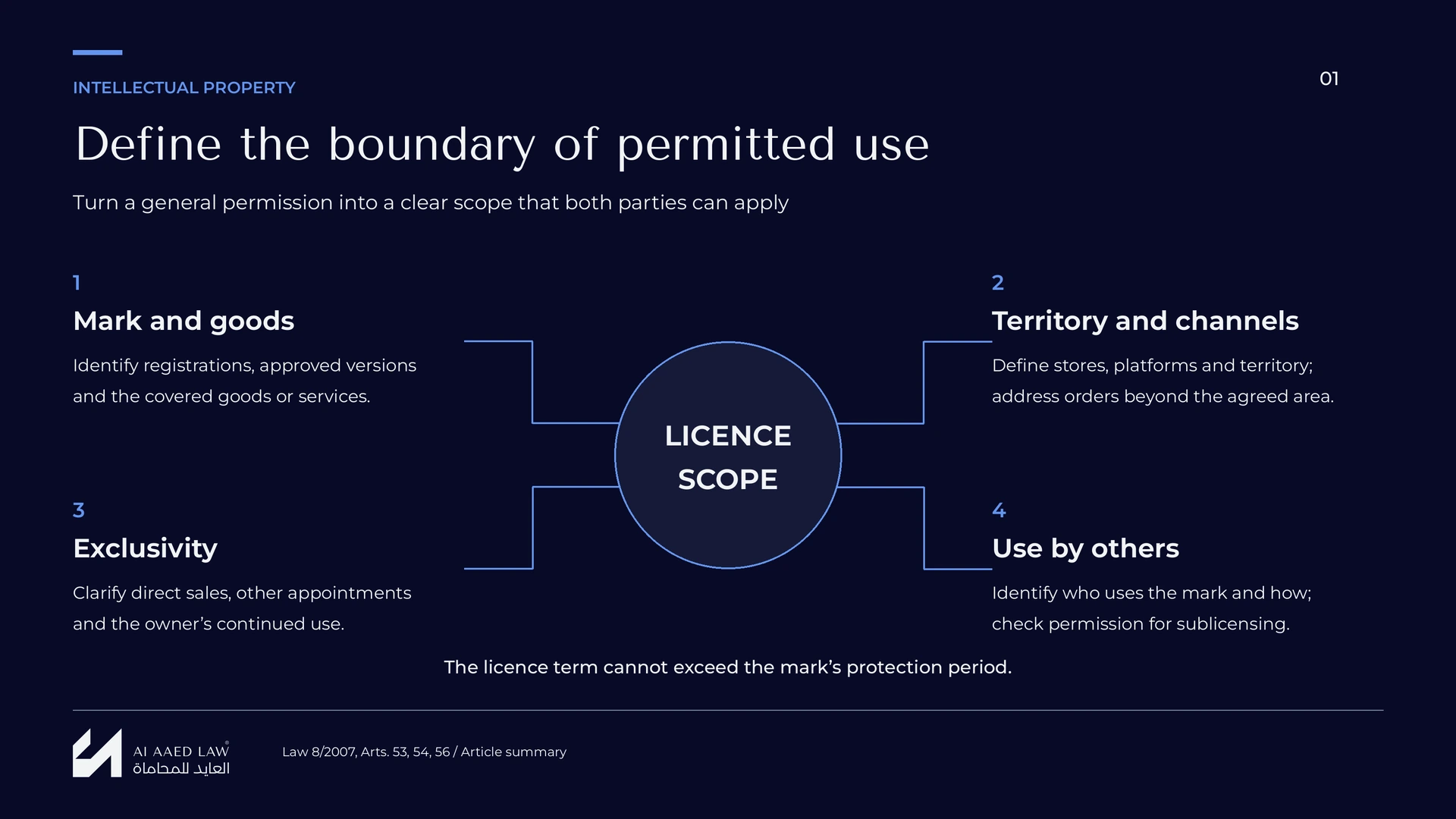
An operational licence identifies what people may actually do. “Use the brand for marketing” leaves unanswered questions about platforms, artwork, translations, packaging changes and activity by third parties.
| Decision | What the agreement should clarify |
|---|---|
| Marks and covered products | Registration details, approved representations and goods or services included in the licence. |
| Territory and channels | Authorised territory, stores, websites, marketplaces and treatment of orders or delivery beyond that scope. |
| Brand materials | Approved artwork, photographs, slogans, translations and the process for clearing separately protected assets. |
| Changes | Which packaging, labels, signage and campaigns require approval and how the approved version is identified. |
| Other participants | Retailers, marketing agencies, service centres and whether they act on the distributor’s behalf or receive independent rights. |
| Duration and transition | Start, expiry, renewal arrangements and any carefully defined permission during an agreed exit period. |
A schedule can contain the approved mark files and product list without overloading the main agreement. Give it a version date and a method for approving changes. Product teams should be able to identify which file is current without guessing from a conversation thread.
For digital channels, distinguish visibility from authorised sales activity. A website may be visible outside the agreed territory even where delivery is limited. Define the conduct the distributor must manage - such as targeting, fulfilment or marketplace listings - without promising that the internet can be confined to a geographical border.
Explain exactly what exclusivity means
Distinguish distribution exclusivity from trademark exclusivity
Article 53 allows the proprietor to continue using the mark unless otherwise agreed in writing. A promise that the distributor is “exclusive” should therefore explain which activities are restricted: appointing other distributors, the owner’s direct sales, use of the mark, particular channels or specified accounts. [1]
Identify reserved customers, existing relationships and any online channels the proprietor retains. An exclusive territory combined with unrestricted direct online sales may produce a commercial dispute even if each clause appears clear in isolation.
Define targets and consequences before measuring performance
If exclusivity depends on performance, state the measurement period, products, territory, treatment of returns and whether the target concerns purchases, paid invoices or sales to end customers. Specify the records used and how discrepancies are resolved.
Illustrative example: the parties agree a target of 1,000 units, but 150 units are later returned. The contract needs to say whether the target is gross orders, net delivered units or another agreed measure. These figures are a drafting illustration, not a statutory sales threshold.
Failure to meet a target might remove exclusivity, trigger a review or permit termination under agreed conditions. Those are different outcomes. State which is intended and assess whether the resulting change also requires amendment of the recorded licence. Avoid treating a lost sales privilege as automatically ending every permission to use the mark.
Review restrictions and sublicensing carefully
Article 54 prohibits unnecessary restrictions on the licensee for preserving rights arising from registration. It identifies permitted conditions concerning geographical marketing scope, licence duration and avoiding acts that degrade the value of the marked goods or services. Review the actual restrictions rather than assuming any clause labelled “brand protection” is acceptable. Other applicable legal rules may also need consideration. [1]
Article 56 prohibits assignment of the licence or granting sublicences unless the agreement provides otherwise. Distinguish a service provider handling approved materials on the distributor’s behalf from a retailer claiming an independent right to use the mark. If independent use is intended, review how it is authorised, controlled and documented. [1]
Consider practical limits for resellers and agencies: permitted files, no unauthorised alteration, approved claims, responsibility for corrections and action when the distribution relationship ends. Permission to sell through retailers should not leave everyone uncertain about who can create branded accounts, appoint further users or present a business as the proprietor’s official representative.
Make quality control an operating process
Set standards, samples and approval responsibilities
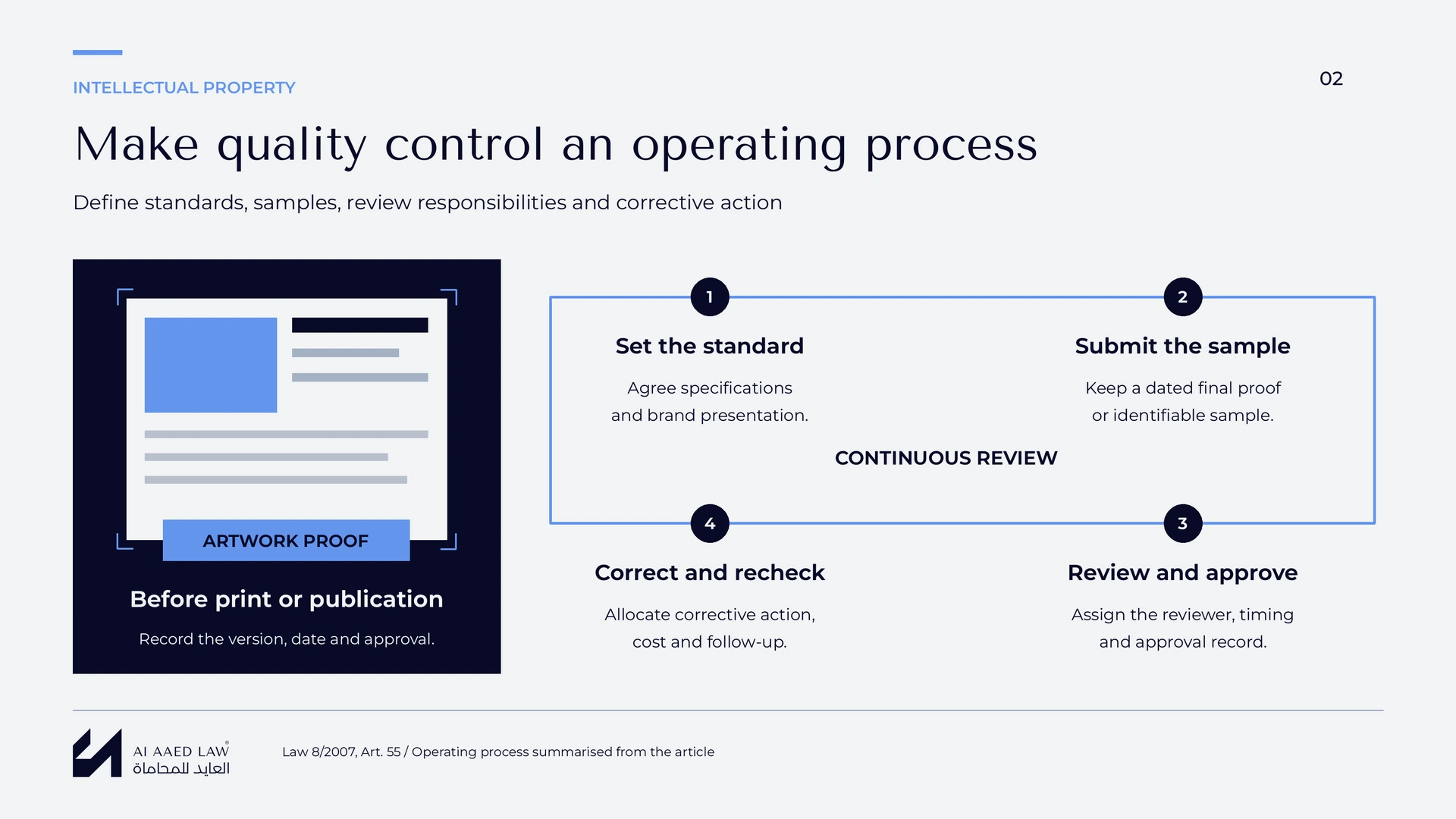
Article 55 requires licence terms enabling the proprietor to monitor the quality of the goods or services. A useful agreement explains the standards and the means of checking them, rather than stopping at a general promise to protect reputation. [1]
Identify which samples, final artwork, batch records or service records must be supplied and who reviews them. Define the approval method and how revisions are tracked. State when approval must be obtained and who can authorise exceptions; commercial urgency should not leave staff guessing whether a draft was cleared.
Plan correction, escalation and follow-up
Explain what happens after a failed check: identifying affected stock or listings, preserving evidence, notifying the responsible person, agreeing corrective action and checking completion. Allocate costs and responsibilities where appropriate. Any suspension, withdrawal or customer notice must be considered against the contract and applicable product rules, not improvised as an automatic statutory remedy.
Illustrative example: the distributor adds an Arabic label to imported packaging. Separate the review of legally required product information from approval of the brand presentation. Retain a dated final proof, identify the stock carrying it and decide who handles correction if an error is found after printing. Approval of the logo alone does not establish compliance of every statement on the label.
Quality monitoring should remain workable after launch. Assign contacts and reporting intervals proportionate to the goods or services. The proprietor needs visibility, while the distributor needs clear decisions that warehouse, sales and marketing teams can implement.
Address online accounts and other brand assets
A licence to use a trademark does not automatically resolve rights in product photography, packaging artwork, written content or software. Identify who owns those materials or can authorise their use, and whether editing or translation is permitted. The IP Protection guide provides the wider context.
For domains, marketplace accounts and social profiles, specify who may create them, in whose name they are held and who has administrative access. Address ownership, access and transfer separately: permission to display a mark does not necessarily make an account transferable under the platform’s rules.
Maintain a register of authorised accounts and current administrators. Plan what happens if an employee or agency leaves, how unauthorised listings are reported and how the owner’s name may be used in warranty or service claims. Treat account security and credentials as managed responsibilities, not something to negotiate for the first time at termination.
Sign the licence and verify recordal
Prepare the contract or an appropriate extract
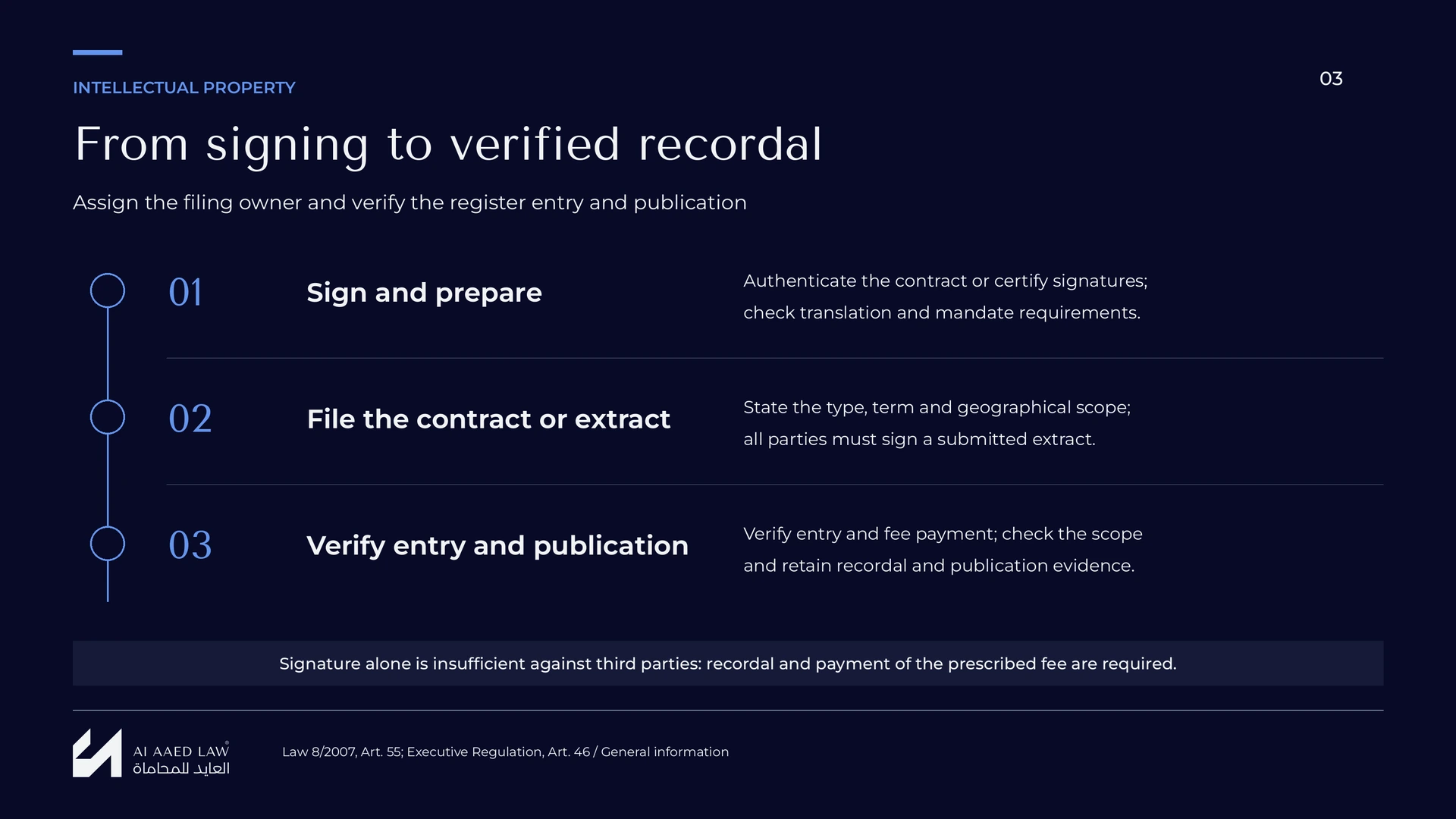
Article 55 requires the contract to be authenticated or its signatures certified by the competent authorities for recordal. Confirm the requirements applicable to the parties and documents, including any foreign execution, translation or representation requirements. A signature image on a marketing approval does not establish that the filing formalities have been met. [1]
Article 46 of the Executive Regulation applies relevant procedures from Articles 37–42 to licensing, with necessary adaptations. The contract or extract must identify the type, term and geographical area of the licence, and all parties must sign the extract. Assess which supporting documents the Directorate requires and whether an extract can protect unrelated confidential commercial terms while still meeting filing requirements. [2]
Do not assume that an extract may omit every substantive restriction. The filed description must accurately reflect the licence for the purpose of the recordal. Reconcile the main contract, schedules and proposed extract before signing and submission.
Assign the filing owner and track the result
Article 55 provides that the licence is not effective against third parties until entered in the trademarks register and the prescribed fee is paid. Signing, submitting an application and obtaining the entry are distinct stages; retain evidence of each relevant step. [1]
The same article provides for an additional fee if registration is delayed beyond 90 days from the licence contract. This is a late-fee provision, not a statement that the licence automatically expires on day 91. File promptly, and verify current fees and the available procedure rather than relying on historical amounts. [1]
Assign responsibility for obtaining signatures, lodging the documents, responding to queries, checking the entry and retaining publication evidence. Verify the recorded parties, mark and scope. A filing receipt alone does not establish that every requested entry has been made correctly. [1–2]
Decide how suspected infringement will be handled
Define who reports suspected counterfeits or misleading listings, how evidence is preserved and who authorises platform complaints or legal steps. Keep ordinary distribution disagreements separate from supported allegations of infringement.
Article 120 addresses civil infringement proceedings by the proprietor and, subject to its conditions and the licensing contract, action by an exclusive licensee where the proprietor does not act despite formal notice. It also addresses intervention by parties to the licence to seek compensation for their own harm. Do not treat every distributor, or every contract labelled exclusive, as having an unrestricted right to sue. Review licence status, the contract and procedural requirements before acting. [1]
Commercial arrangements should explain cooperation, costs and handling of communications, while recognising that a contract does not dispense with legal standing or procedural requirements. Avoid unverified complaints that could harm a legitimate seller or expose the complainant to a separate dispute.
Plan stock, accounts and responsibilities at exit
Define any limited sell-off permission
Identify the genuine inventory, cut-off date, permitted channels, reporting and end date of any agreed sell-off. Decide whether new purchases are excluded, what approved advertising remains necessary and how returns or warranty obligations are handled. A sell-off arrangement must fit the protection term and the contractual and recorded position.
Do not assume that ending the licence makes every genuine item in stock counterfeit, or that stock ownership grants unlimited future branding rights. The treatment of particular sales, products and ongoing use needs its own legal assessment. A clear transition agreement reduces uncertainty without inventing a universal rule.
Remove branding and update the register
Set responsibilities for storefront signs, packaging, promotional material, domains, listings and account access. Keep an evidence-based closure checklist: what was removed, what was transferred where possible and what remains for a limited agreed purpose. Customer-support responsibilities may continue after promotional rights end.
Article 57 allows the proprietor or licensee to seek removal of the licence entry after providing evidence of expiry or termination. It makes removal effective from the request date and provides for publication. Article 47 of the Executive Regulation addresses modification and cancellation procedures. Contract termination and removal of the register entry are related steps, not interchangeable evidence of completion. [1–2]
Illustrative example: the parties remove exclusivity but retain a limited non-exclusive licence. That is different from terminating the entire arrangement. Document the new scope and assess the necessary recorded amendment; do not request full cancellation while expecting staff to continue acting under the old permission.
Keep a file that can survive a change of personnel
| File item | Why it matters |
|---|---|
| Current trademark evidence | Identifies the right, proprietor, covered goods or services and protection calendar. |
| Signed agreement and approved schedules | Shows the scope, exclusivity, controls and current agreed version. |
| Filing and register evidence | Distinguishes submission from recordal, fee payment and publication. |
| Approval and monitoring records | Shows which artwork, samples or corrections were reviewed and implemented. |
| Authorised-channel and account list | Identifies who uses the mark and who controls access. |
| Amendments and closure records | Connects changes or exit obligations with the contractual and register position. |
These are practical file-management suggestions, not a statutory form. Give the commercial and legal teams clear responsibility for updates. A well-drafted licence becomes less useful if the approved artwork, current permissions or filing evidence cannot be found when needed.
Review the licence before branded activity begins
Review the trademark records, proposed distributor, territory, channels, exclusivity terms and examples of intended use. Include the draft agreement and any existing licence or recordal. These materials support a review of permissions, controls, filing and the eventual exit arrangements.
Operational examples and checklists explain drafting choices; they are not mandatory statutory forms.
General information only. Confirm the current law, protection status, parties’ authority, filing requirements and applicable commercial or product rules for the particular arrangement. A trademark licence does not guarantee recordal acceptance, regulatory compliance or a dispute outcome.