The types of commercial partnership agreements vary depending on the nature of the project, each partner’s contribution, how profits and losses will be allocated, management responsibilities, and whether the parties intend to establish a separate company or simply regulate a commercial relationship between them. There is therefore no single partnership agreement that suits every business arrangement.
Choosing the appropriate agreement begins with understanding the relationship between the parties before drafting the terms. Will each party contribute capital? Will one partner provide expertise or management? Who has authority to make decisions? How can the partnership be terminated or a partner exit? Addressing these issues helps the parties select an appropriate structure and draft an agreement that reflects how the partnership will actually operate.
Summary of key points
| Topic | Key point |
|---|
| What Are Commercial Partnership Agreements? | A commercial partnership agreement regulates cooperation between two or more parties for a commercial purpose or specific project. |
| Key takeaways | A commercial partnership agreement regulates cooperation between two or more parties for a commercial purpose or specific project. |
| Types of Partnerships Based on the Parties Involved | The identity of the parties can affect how the partnership agreement should be structured. |
| Contractual Partnerships and Company Formation | A commercial partnership does not necessarily require the establishment of a new company. |
| Key Clauses in a Partnership Agreement Between Two Parties | A partnership agreement between two parties should reflect the actual details of the project rather than simply stating the parties’ names and participation percentages. |
| Documenting Partnership Agreements and When It May Be Necessary | Proper documentation of partnership agreements helps establish what the parties agreed and provides clearer evidence of their respective rights and obligations. |
What Are Commercial Partnership Agreements?
A commercial partnership agreement regulates cooperation between two or more parties for a commercial purpose or specific project. It will typically address each party’s contribution, management responsibilities, allocation of profits and losses, decision-making procedures, and termination of the relationship.
A partnership may relate to a specific project or an ongoing commercial relationship. It may also exist between individuals, companies, or a company and an individual, making the identity and legal status of the parties important considerations when structuring the agreement.
Why Do Types of Partnership Agreements Vary by Business Activity?
Different
types of partnership agreements are required because a project based primarily on financial contributions will have different needs from one that depends on a partner’s expertise or management. A partnership created for a temporary project may also require different provisions from a long-term commercial venture.
The nature of the activity can affect licensing, liability, financing, and the assets required for the project. The agreement should therefore reflect how the business will actually operate rather than relying on a general template.
Types of Commercial Partnership Agreements Based on Contributions

Key takeaways
- A commercial partnership agreement regulates cooperation between two or more parties for a commercial purpose or specific project.
- Partnerships can be structured according to what each party contributes to the project.
- The identity of the parties can affect how the partnership agreement should be structured.
- A commercial partnership does not necessarily require the establishment of a new company.
- A partnership agreement between two parties should reflect the actual details of the project rather than simply stating the parties’ names and participation percentages.
Partnerships can be structured according to what each party contributes to the project. Partners may contribute capital, while another party may contribute expertise, management, or a combination of financial and non-financial resources.
Defining the type and value of each contribution from the beginning helps establish ownership interests, profit entitlements, and decision-making authority while reducing the risk of future disagreements over what each party has contributed.
Partnership Agreement Between Two Parties for a Commercial Project
This arrangement may be used when two parties agree to carry out a commercial project together. The agreement should define the project, each party’s contribution, who will manage the business, how decisions will be made, and how profits and losses will be allocated.
It should also establish the duration of the partnership and what happens if either party wishes to withdraw, transfer their interest, or terminate the project.
Capital-Based Partnership Agreement
In a
capital-based partnership , the partners primarily contribute funds to finance the project. The agreement should identify the amount contributed by each partner, when it must be provided, the resulting participation percentage, and how additional financing requirements will be handled.
Financial contribution percentages should not be assumed to determine every other aspect of the relationship automatically. Management rights, voting arrangements, and the allocation of profits and losses should also be expressly addressed.
Partnership Based on Expertise or Management
A partner may contribute expertise, time, or management services rather than making a direct financial contribution. In this situation, the agreement should clearly describe the partner’s role and the responsibilities they are expected to perform.
The agreement should also establish what that partner receives in return, whether through a share of profits or another arrangement, and what happens if the agreed expertise or management services are no longer provided.
Types of Partnerships Based on the Parties Involved
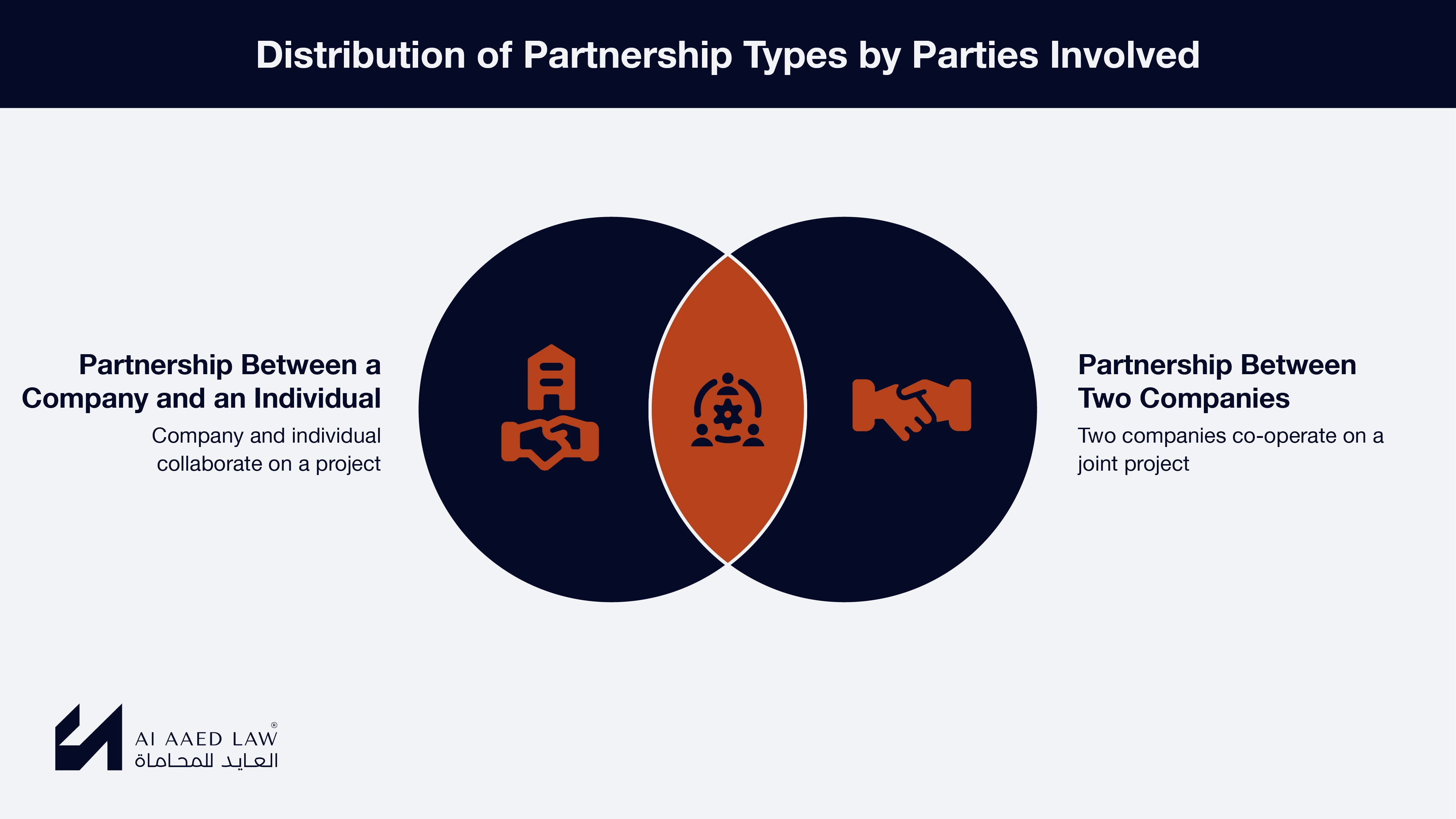
The identity of the parties can affect how the partnership agreement should be structured. A partnership between two individuals may require different arrangements from an agreement between two existing companies with separate management structures and contractual obligations.
The legal status of each party and the authority of the individuals signing the agreement should therefore be confirmed before the partnership is established.
Partnership Between a Company and an Individual
A company may enter into a partnership with an individual to undertake a project or develop a particular business activity. The agreement should clarify whether the individual will become an owner in a legal entity or whether the relationship will remain purely contractual.
It should also define the obligations of both parties, ownership of project assets, management authority, distribution of returns, and the process for ending the relationship.
Partnership Between Two Companies
Two companies may cooperate on a joint project while each retains its separate legal identity. The partnership agreement should define the scope of the project, each company’s contribution, management responsibilities, financing arrangements,
intellectual property rights , allocation of returns, and liabilities.
The parties should also verify that the individuals signing the agreement have sufficient authority to bind the companies they represent.
Contractual Partnerships and Company Formation
A commercial partnership does not necessarily require the establishment of a new company. Parties may regulate their cooperation through a contractual arrangement, while other projects may be better suited to a separate legal entity that conducts the business, owns assets, and enters into contracts in its own name.
The choice between these approaches can affect liability, management, ownership, taxation, and legal procedures. The appropriate structure should therefore be selected according to the project rather than simply based on which option is easiest to establish.
Profit-Sharing Partnership Without Establishing a Company
Two or more parties may agree to cooperate on a project and share its returns without creating a new company. In such cases, the agreement becomes particularly important for defining the nature of the relationship, each party’s contribution, and how profits and expenses will be calculated.
The legal effect of this arrangement should be considered carefully. Simply describing an agreement as a "partnership" does not by itself determine its legal nature or the parties’ liability towards third parties.
Company Formation as a Form of Business Partnership
Where the parties decide to establish a company for the project, the incorporation documents become an important part of regulating their relationship. These documents can define capital, ownership, management authority, and decision-making procedures according to the chosen corporate structure.
The partners may also need to regulate matters beyond the basic incorporation requirements, particularly partner exits, additional financing, major decisions, and procedures for resolving disagreements.
Key Clauses in a Partnership Agreement Between Two Parties
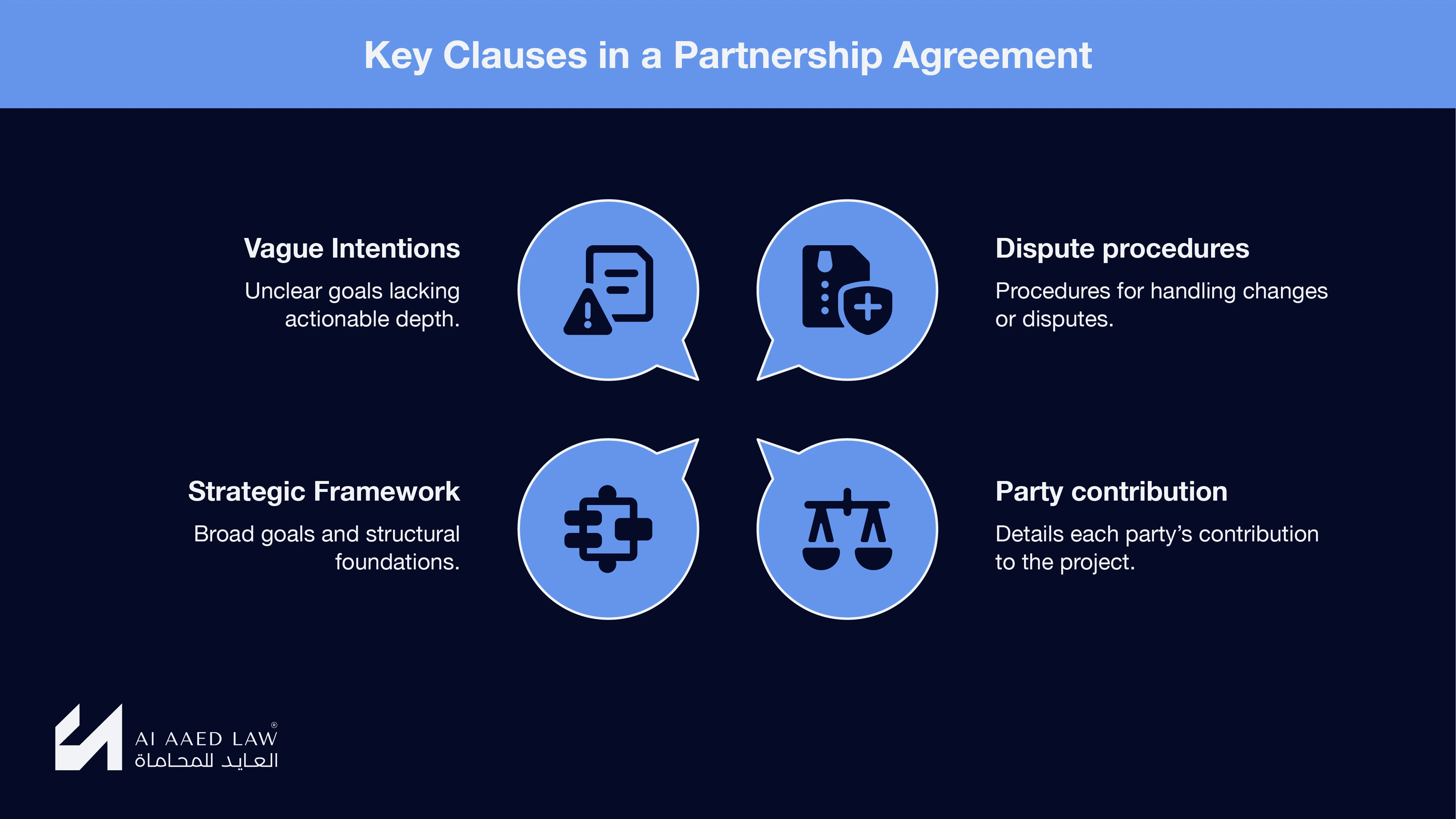
A partnership agreement between two parties should reflect the actual details of the project rather than simply stating the parties’ names and participation percentages. A clear agreement defines the purpose and duration of the partnership, each party’s contribution, management arrangements, financial rights, and procedures for handling changes or disputes.
The provisions should also work together consistently. Stating that a party holds a particular percentage is not enough without clarifying whether that percentage applies to ownership, profits, voting rights, or all of these matters.
Defining Ownership Interests, Profits, and Losses
The agreement should identify each party’s contribution and how it has been valued, whether it consists of money, assets, expertise, or services. Where ownership interests are allocated, the basis for calculating those interests should also be clear.
The agreement should explain how distributable profits are calculated, when distributions will take place, how expenses and reserves are treated, and how losses will be allocated under the agreement and applicable law.
Management and Decision-Making Authority
The agreement should establish who will manage the project, which decisions can be taken independently, and which matters require approval from the other partners. Financial limits may also be imposed on individual authority, with significant commitments requiring joint approval.
These provisions become particularly important where ownership percentages are similar or where one party provides capital while another manages the project’s daily operations.
Documenting Partnership Agreements and When It May Be Necessary
Proper documentation of partnership agreements helps establish what the parties agreed and provides clearer evidence of their respective rights and obligations. However, formal documentation or registration requirements may differ depending on the nature of the agreement, project, assets involved, and legal structure.
The parties should therefore determine whether specific formal procedures apply rather than assuming that signatures alone are sufficient in every situation. Final signed agreements and any subsequent amendments or schedules should also be retained.
Risks of Relying on an Oral Partnership Agreement
An oral agreement may leave important matters without clear evidence, including the value of each partner’s contribution, profit percentages, decision-making authority, and exit arrangements.
If a disagreement occurs, each party may have a different understanding of what was originally agreed. A written partnership agreement reduces this uncertainty by providing a clearer reference for the commercial relationship.
Common Mistakes in Commercial Partnership Agreements
Common mistakes include using a generic template without adapting it to the project, defining profit percentages without explaining how profits will be calculated, failing to regulate management authority, and overlooking what happens if the project requires additional financing.
Problems can also arise when the agreement does not address death, withdrawal, transfer of an interest, or disputes between partners. A partnership agreement should therefore consider events that may change the relationship in the future rather than focusing only on how the project begins.
Managing a Partner’s Exit or the End of the Partnership
The agreement should ideally establish in advance how a partner can exit, how their interest will be valued, when payment will be made, and how existing obligations and contracts will be handled.
It should also define the circumstances in which the partnership can be terminated and establish procedures for settling accounts, assets, and outstanding debts. Agreeing on these mechanisms before a dispute occurs can make the end of the relationship easier to manage.
The Role of a Lawyer in Choosing and Drafting a Partnership Agreement
A lawyer can help determine the legal structure that best reflects the proposed relationship and whether the project requires a partnership agreement, company formation, or additional legal arrangements.
Legal review can also identify provisions that require greater clarity, including management authority, financing, profit and loss allocation, intellectual property, exit arrangements, and
dispute resolution procedures.
What Should Be Reviewed Before Signing a Partnership Agreement?
Before signing, the parties should confirm their details, contributions, participation percentages, management authority, and decision-making procedures. Profit and loss calculations, transfer restrictions, and exit arrangements should also be reviewed.
The parties should also consider termination and dispute resolution mechanisms and determine whether any formal documentation or registration requirements apply before beginning the project.
This article is provided for general information only and does not constitute legal advice. For advice on a specific matter, contact AL AAED Law Firm.
Official source: Syrian Ministry of Justice