This article explains employment contracts in Syria. An employment contract is more than a record of salary and job title. Under Syrian law, it sits inside a wider framework of mandatory rules governing how the relationship begins, how performance and discipline are managed, and how the contract may end.
For private-sector employers, investors and employees, the practical risk usually does not come from failing to use sophisticated language. It comes from leaving fundamental points undocumented, using the wrong contract type, treating probation as unlimited, ending employment without the required notice or evidence, or assuming that a general release automatically removes statutory rights.
The principal framework addressed in this guide is Syrian Labour Law No. 17 of 2010. In the official and government-linked materials reviewed through 6 September 2026, Syrian authorities continued to refer to Law No. 17 of 2010 while describing proposed amendments as being under development. This article therefore explains the rules in the current published text. Draft proposals should not be treated as enacted law. Because the applicable rules can change according to the sector, the legal status of the employer, the worker's nationality, collective arrangements and later decisions, each employment situation should be reviewed on its own facts.
Why employment contracts are a priority in Syria in 2026
The need for clear employment documentation has become more immediate as businesses reopen, restructure, recruit and formalize their workforces. In January 2026, the Ministry of Social Affairs and Labour publicly reminded non-governmental organizations that workers should be registered with social security and employed under written contracts recording their wages and rights. Although that announcement concerned NGOs, it reflects a broader compliance principle already found in Labour Law No. 17 of 2010: employers should document the relationship and register workers as required.
At the same time, announced reform work has focused on new forms of work, fair wages, contract regulation, social-insurance coverage, inspection and voluntary compliance. Until final amendments are formally issued and effective, employers should build their policies around the current law while monitoring developments.
Which employment relationships does Labour Law No. 17 of 2010 cover?
Article 4 applies the Law to labour relations in the private sector, Arab and foreign union companies, the cooperative sector and the mixed sector where the Civil Servants Basic Law does not apply. Article 5 identifies exclusions and special categories. Other legislation may govern public-sector staff, agricultural relations and particular forms of work.
This means that the first legal question is not simply whether a person performs services. The relationship must be classified correctly. The following points may affect the answer:
- Whether the worker acts under the employer's direction and supervision in return for wages.
- Whether the employer belongs to the private, cooperative, mixed, public, agricultural, charitable or another regulated sector.
- Whether a special statute, decree, collective agreement or staff regulation applies.
- Whether the worker is Syrian or a non-national who requires a work permit.
- Whether the arrangement is genuine employment or an independent commercial service relationship.
The label chosen by the parties is not always decisive. A document called a consultancy agreement may still create employment risks if the actual relationship has the characteristics of supervised wage-earning work.
What is an employment contract under Syrian law?
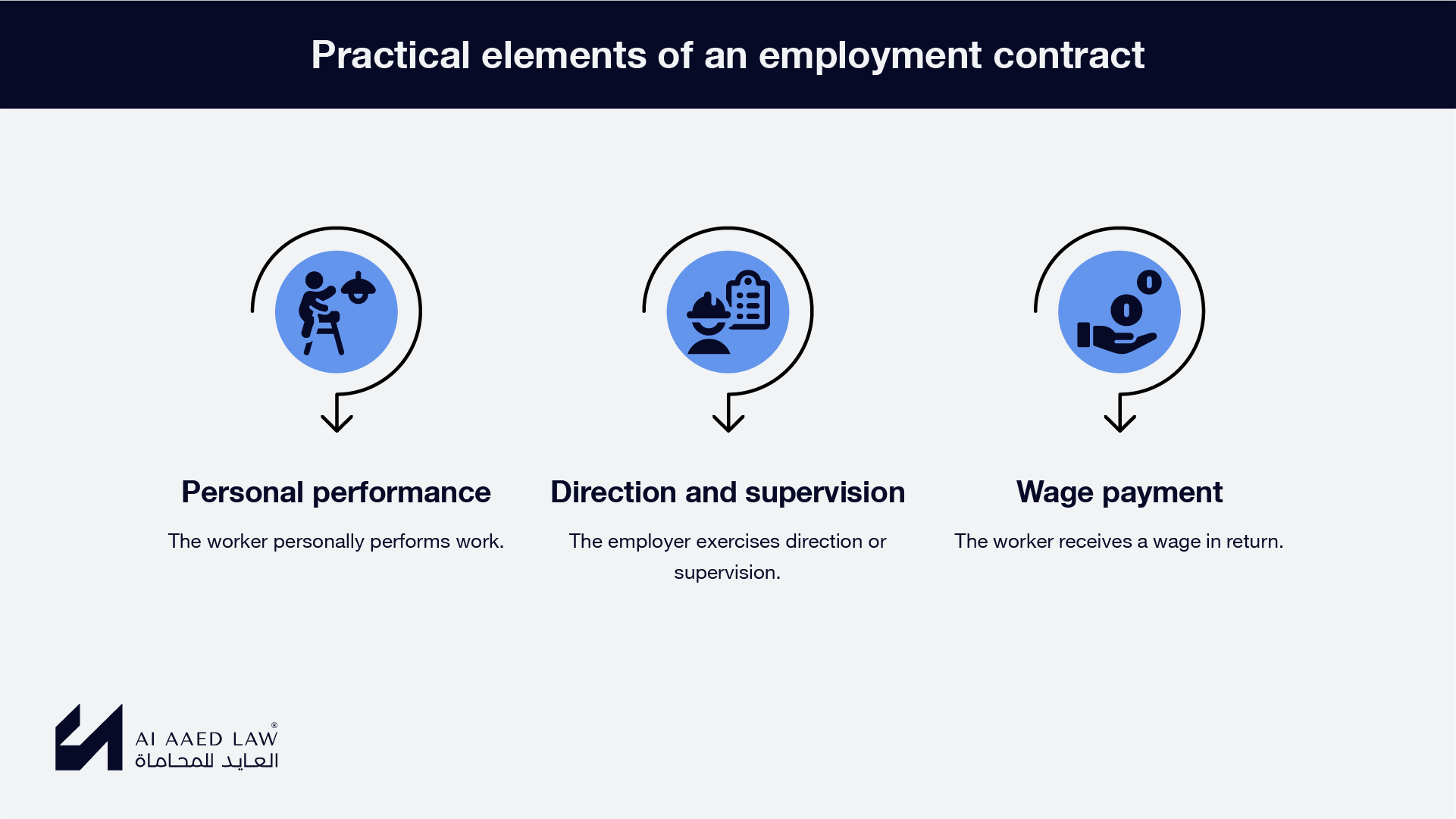
Article 46 defines an individual employment contract as an agreement under which the worker undertakes to work for an employer, under the employer's direction and supervision, in return for wages. This definition highlights three practical elements:
- The worker personally performs work.
- The employer exercises direction or supervision.
- The worker receives a wage in return.
The contract should therefore describe the real arrangement, not an artificial version designed only to obtain a preferred label. The job description, reporting line, workplace, working time and payment terms should correspond to how the parties will actually operate.
Must an employment contract in Syria be written?
Yes. Article 47 requires the employer to prepare a written employment contract in three Arabic copies. Each party keeps one copy, and the employer files the third with the competent social-security directorate within three months from the contract's effective date. For a non-Arab worker, the law also refers to an additional copy in a foreign language.
A missing written contract does not automatically mean that no employment relationship exists. Article 47 allows a worker to establish entitlements through all methods of proof, while the employer may prove the contrary. In practice, this makes undocumented relationships more uncertain rather than less regulated.
The employer should also give the worker a receipt for original assets, documents or qualifications deposited with it. Original personal documents should not be retained informally without clear records and a lawful reason.
What information should the contract contain?
Article 48 requires the contract to state, in particular:
- The name, nationality and detailed address of each party.
- The workplace.
- The nature and type of the agreed work.
- The duration and type of contract.
- The agreed wage, how and when it will be paid, and agreed cash or in-kind benefits.
- Working hours.
- Any additional entitlements or benefits not already provided by the Law.
These are minimum content requirements, not a complete drafting checklist. Depending on the role, a sound contract may also address reporting lines, duties, confidentiality, intellectual property, permitted outside activities, equipment, expenses, performance expectations, disciplinary rules, leave administration, data handling, return of property, notice mechanics and dispute procedures. Every additional clause must remain consistent with mandatory law. Article 6 invalidates terms that reduce statutory worker rights and preserves terms that are more favourable to the worker.
The three principal contract types
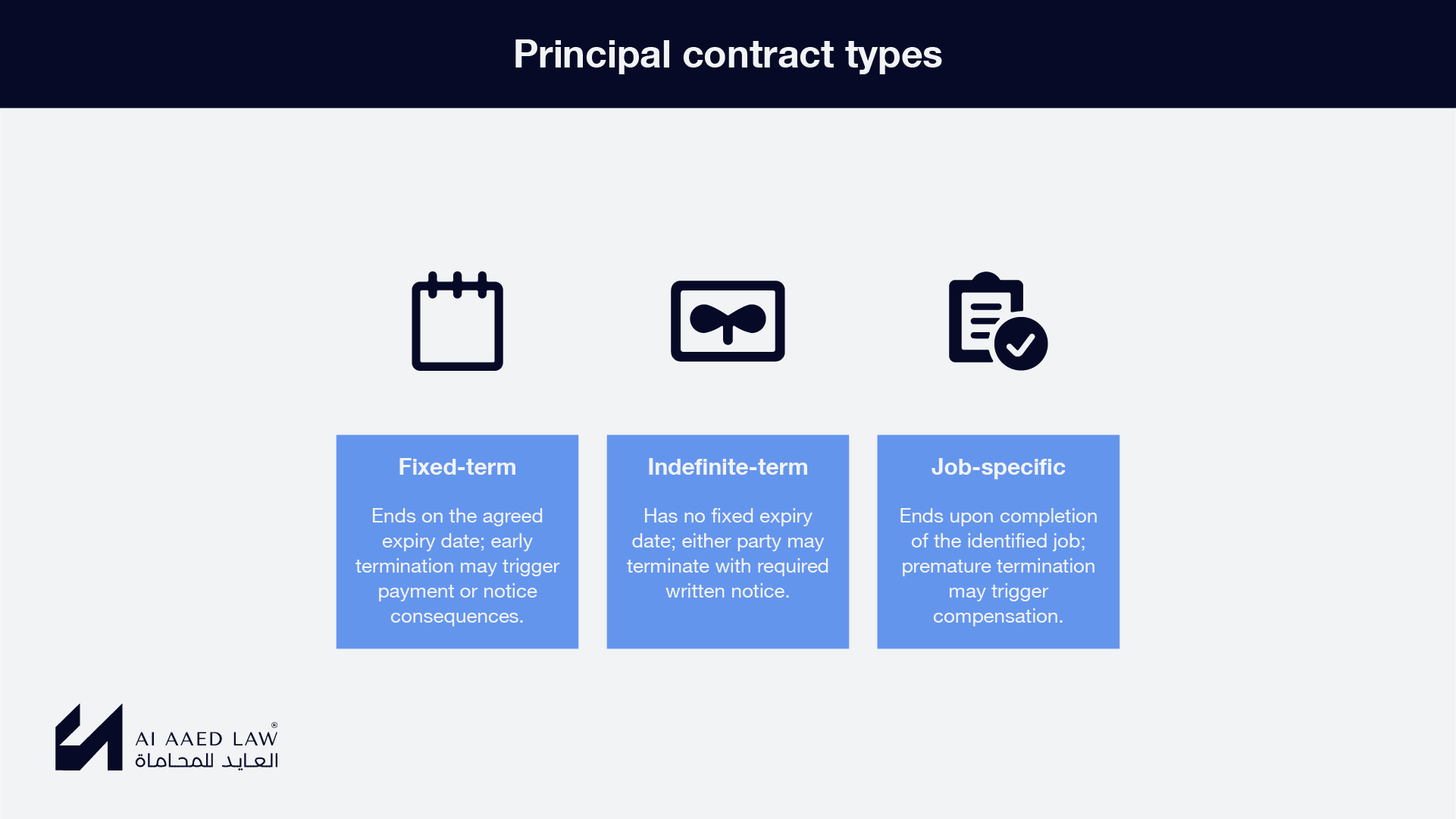
Article 50 recognizes fixed-term, indefinite-term and job-specific contracts. The official English translation uses “unspecified-term” for the second category; “indefinite-term” is the more familiar English expression.
| Contract type | Normal end point | Important legal consequence |
|---|---|---|
| Fixed-term | The agreed expiry date | Early termination can trigger payment or notice consequences; continued performance after expiry may convert the relationship into an indefinite-term contract. |
| Indefinite-term | No fixed expiry date | Either party may terminate with the written notice required by Article 56, subject to lawful grounds and unfair-dismissal rules. |
| Job-specific | Completion of the identified job | The contract ends when the agreed job is completed; premature termination by the employer may trigger compensation. |
Fixed-term contracts
A fixed-term contract normally expires automatically on its stated end date. It may be extended expressly for one or more further fixed terms. Under Article 54, if the original and extended periods exceed five years, subject to the statutory rule on interruptions, the relationship becomes indefinite-term. It may also become indefinite-term when the parties continue performance after expiry without a new fixed arrangement.
Article 53 deals with early termination. An employer that ends a fixed-term contract during its term must pay the worker the wages for the remaining period. A worker may end it early by giving two months' written notice; otherwise, the worker may owe compensation equal to the notice period or its unserved remainder. These rules should be read together with the Law's provisions on lawful immediate dismissal, employee departure for employer breach and other statutory termination events.
Indefinite-term contracts
An indefinite-term contract has no agreed expiry date. Article 56 allows either party to end it by written notice served two months before termination. The notice begins on receipt and cannot be made conditional. The parties may agree to extend the period, but the employer may not unilaterally shorten or dispense with the statutory notice obligation.
Ending an indefinite-term contract with notice does not by itself prove that the dismissal is lawful. The reason, evidence, timing and procedure still matter, particularly where the employee challenges the termination as unfair or discriminatory.
Job-specific contracts
A job-specific contract ends when the agreed job is completed. If the work is recurrent and the parties continue after completion, Article 55 may treat the contract as tacitly extended for the time needed to perform the same work again. If the employer ends the contract before the agreed job is complete, the worker may be entitled to unfair-dismissal compensation, subject to the statutory exceptions.
How long may probation last?
Probation must be expressly stated in the employment contract. Article 49 limits it to a maximum of three months and prevents the same worker from being placed on probation more than once by the same employer.
During a valid probation period, either party may terminate without prior notice or compensation. If the relationship continues after probation, the probationary period counts as part of the worker's actual service.
Probation should not be used as a recurring reset after promotion, internal transfer or contract renewal. Employers should document the start and end dates clearly and complete any performance assessment before the period expires.
Statutory rights cannot simply be contracted away
The rights established by Labour Law No. 17 of 2010 are minimum rights. Article 4 describes them as inalienable, while Article 6 provides that a term reducing those rights is void. More favourable contractual, collective or workplace benefits remain effective.
The same principle affects settlements and releases. A broad sentence saying that the employee waives “all present and future rights” may not be effective if it diminishes mandatory rights, particularly during employment or within the statutory period addressed by Article 6. A termination settlement should identify each amount and legal basis separately and be reviewed for enforceability rather than relying on a general waiver.
Core obligations during employment
Employer obligations
Article 93 requires employers to provide lawful and safe working conditions, keep employment records, inform workers of working conditions, issue service and release certificates where applicable, and register workers for social security. Article 91 also requires a personal file recording matters such as the worker's wage, changes, penalties, leave, termination date and reason, and requires the file to be kept for at least one year after termination.
Registration for social security should not be treated as optional or replaced by a private promise to pay the worker later. The legal consequences of coverage also affect how some end-of-service entitlements are assessed.
Worker obligations
Articles 95 and 96 require workers to perform their duties carefully, follow lawful instructions, respect working time, safeguard equipment and documents, maintain professional conduct, preserve work secrets, provide accurate personal information and comply with legitimate safety measures. The Law also restricts competing activity and certain work for third parties without employer consent.
Clear contracts and internal policies help translate these general duties into role-specific expectations. They do not, however, authorize sanctions that are inconsistent with the Law.
Internal regulations and disciplinary procedure
An employer with fifteen or more workers must prepare internal regulations and a list of penalties under Article 90, submit them through the prescribed approval process and display them at the workplace.
Discipline should be evidence-based and proportionate. Articles 97 to 104 establish important safeguards, including:
- The alleged violation must be work-related and included in the approved penalty list.
- The worker must be informed of the allegation and allowed to defend themselves.
- The investigation and the worker's response should be documented.
- The Law limits wage deductions and generally prevents multiple penalties for the same violation.
- More serious penalties require the process and decision-making body specified by the Law.
These safeguards matter before dismissal. An employer should not assume that a serious accusation automatically eliminates the need to prove the facts or preserve procedural records.
How may an employment contract be terminated?
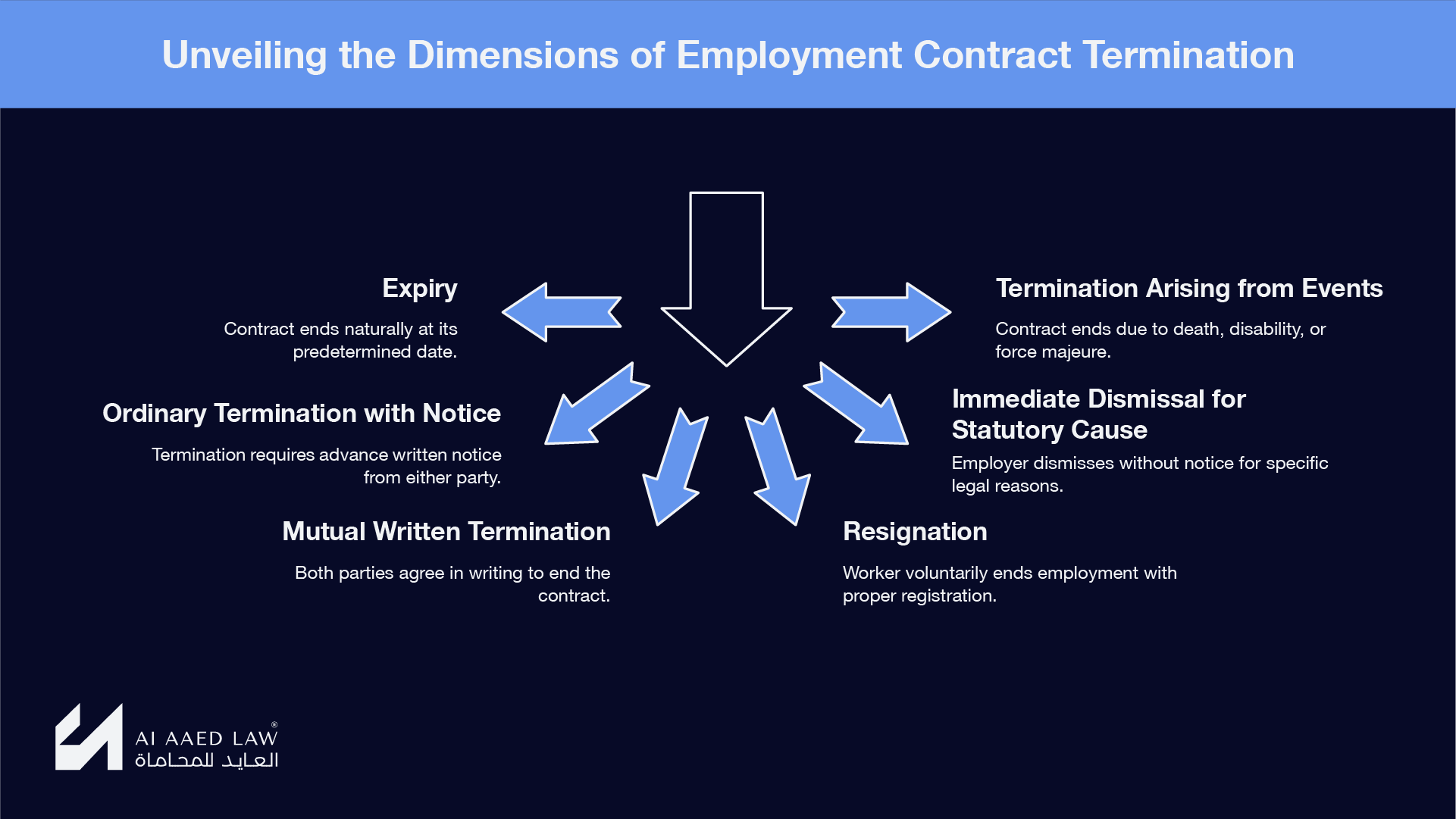
The correct process depends on the contract type, the reason for termination and the party initiating it. At minimum, a termination review should distinguish among expiry, ordinary termination with notice, mutual written termination, resignation, immediate dismissal for statutory cause and termination arising from events such as death, disability or force majeure.
Notice for indefinite-term contracts
Article 56 requires two months' written notice. A party that gives no notice, or ends the relationship before the notice period expires, must generally pay compensation equal to the wage for the whole or unserved part of the notice period.
The employment relationship continues during notice. When the employer initiates termination, Article 59 gives the worker paid time to look for another job: one full day or eight hours per week during the notice period, with advance notice to the employer. The employer may release the worker from duties during notice, but Article 60 keeps the service continuous and the wage payable through the period.
Notice timing is restricted during certain leave. Article 57 states that notice should not be served on a worker during leave or on a female worker during maternity leave, and sick leave may interrupt a notice period already running.
Resignation
Article 61 states that a worker's resignation is valid only when registered by the worker with the competent directorate. It also permits the worker to withdraw the resignation in writing once, within one week of being informed that the employer accepted it.
Employers should not treat an oral statement, unsigned message or disputed absence as a completed resignation without checking the statutory formalities and the surrounding evidence.
Immediate dismissal for statutory cause
Article 64 permits an employer to dismiss without notice, severance or compensation in specified cases. They include proven identity or qualification fraud, a fault causing substantial material loss that is reported within the statutory time, repeated disregard of written safety instructions, absence beyond the stated thresholds after the required warnings, failure to perform material contractual duties, disclosure of professional secrets, specified criminal conviction, intoxication at work and serious assault connected with work.
The list should be applied carefully. Some grounds contain their own evidence, warning, timing or reporting requirements. Article 64 places the burden of proof on the employer. A policy should not expand the statutory list and then assume that every policy breach justifies immediate dismissal.
When the worker may leave because of employer conduct
Article 66 allows a worker to leave before the contract expires without notice in specified circumstances, including material misrepresentation about working conditions, failure by the employer to perform material legal obligations, immoral conduct or assault, and a serious known health or safety hazard that the employer fails to address.
The worker may bring an unfair-dismissal claim, but bears the burden of proving the relied-upon ground. This is why written complaints, payroll records, correspondence, medical or safety evidence and witness information can be decisive.
Prohibited dismissal reasons
Article 67 prohibits dismissal for reasons including protected trade-union activity, certain electoral activity, a complaint or participation in proceedings against the employer, and discrimination based on the characteristics listed in that article. The statutory remedy may include reinstatement and full wages for the interruption period. Where reinstatement is considered impossible or inappropriate in the circumstances described by the Law, compensation rules apply.
What compensation may follow an unlawful termination?
Article 65 provides that where the employer cannot prove a lawful Article 64 ground, the dismissal is treated as unfair. The worker may receive compensation equal to two months' wage for each year of service, calculated proportionately for part of a year and capped at 150 times the minimum wage. This is calculated using the worker's last monthly wage and does not remove other statutory or contractual entitlements. Notice requirements also remain relevant.
For the protected grounds addressed by Article 67, reinstatement is the primary statutory remedy. Where the court considers reinstatement impossible, impractical or inappropriate in the circumstances stated in the Law, the compensation may be two months' wage for each year of service, capped at 200 times the minimum wage, in addition to the other applicable consequences.
The correct calculation must separate different legal heads. Remaining fixed-term wages, notice compensation, unfair-dismissal compensation, unpaid salary, accrued contractual benefits and any applicable severance are not interchangeable labels.
Are end-of-service benefits automatic in Syria?
Not in the same form for every worker. Article 63 provides a severance payment of one month's wage for each year of service, calculated using the last monthly wage, for workers who are not covered by the Social Security Law when their contracts end in the circumstances listed in Article 62. Fractions of a year are calculated proportionately.
This statutory severance is different from:
- Wages for the unexpired portion of a fixed-term contract under Article 53.
- Compensation for missing notice under Article 56.
- Unfair-dismissal compensation under Articles 65 or 67.
- Salary, benefits or other amounts already accrued under the contract.
Before quoting a final settlement figure, the employer should confirm the worker's social-security status, the reason for termination, contract type, service period, last wage, notice position and any more favourable contractual or collective terms.
How are dismissal disputes handled?
Articles 203 to 209 establish the route for individual labour disputes. A competent primary civil court is formed in each governorate to hear disputes arising from the Law and the individual employment contract.
For a dispute concerning dismissal or notice of dismissal, Article 208 permits the worker, or the trade union at the worker's request, to seek mediation by the competent directorate within ten days of notification. The directorate should attempt settlement within no more than one month. If mediation fails, the worker may proceed to court.
The deadlines are short enough that both sides should preserve documents and obtain advice promptly. Employers should retain the contract, personnel file, attendance records, payroll, warnings, investigation materials, the termination decision and proof of service. Workers should preserve the contract, pay evidence, correspondence, complaints, medical or safety records and the termination notice.
Practical checklist before signing an employment contract
- Confirm which employment law and sector-specific rules apply.
- Select the contract type based on the genuine business need.
- Prepare the required Arabic copies and any additional foreign-language copy.
- State the parties, workplace, role, duration, wage, payment terms, benefits and working hours clearly.
- Define probation expressly and keep it within the three-month limit.
- Align confidentiality, intellectual-property and outside-work clauses with the role and the Law.
- Refer accurately to approved internal regulations and disciplinary rules.
- Complete social-security and other required registrations on time.
- Give each party its copy and retain proof of filing and receipt.
- Review the contract when the role, workplace, salary or structure materially changes.
Practical checklist before terminating employment
- Identify the contract type and proposed termination date.
- Identify the exact legal ground; do not rely only on a general policy label.
- Check whether warning, investigation, reporting or approval requirements apply.
- Preserve evidence and give the worker a proper opportunity to respond where discipline is involved.
- Check notice, leave and protected-ground restrictions.
- Calculate every payment category separately.
- Prepare a clear written decision and retain proof that it was served.
- Complete required directorate and social-security steps.
- Issue the statutory service and release documents where applicable.
- Anticipate mediation or litigation deadlines before closing the file.
Further Reading
- Business Insolvency in Syria: A 2026 Guide to Preventive Composition, Bankruptcy and Restructuring
- Restructuring in Syria: A Legal Guide for Businesses and Creditors
- Drafting Commercial Agreements
- LLC Formation in Syria: Key Clauses and Legal Requirements
- Investment Law in Syria: What Investors and Companies Need to Know
For tailored advice, contact our team or explore all practice areas.
This article is provided for general information only and does not constitute legal advice. For advice on a specific matter, contact AL AAED Law Firm.
Official source: Syrian People's Assembly