This article explains business insolvency in Syria. Financial distress does not always mean that a business is insolvent, and insolvency does not automatically mean that a company has been declared bankrupt. These stages carry different commercial and legal consequences. Acting early may preserve a viable business, while delayed or selective action can reduce the available options and expose transactions, managers and counterparties to greater risk.
The principal Syrian framework addressed in this guide is Commercial Law No. 33 of 2007, particularly Book Four on preventive composition and bankruptcy, Articles 413 to 610. The Law provides a formal preventive-composition procedure before bankruptcy and a collective court-supervised bankruptcy process after the legal conditions are met.
The expression “restructuring” is also widely used in business practice. However, Syria's current Commercial Law does not establish a separate modern court-supervised restructuring procedure equivalent to the rescue or reorganization regimes found in some other jurisdictions. A 2026 Damascus University study specifically recommended that the Syrian legislature adopt such a framework. In current practice, restructuring normally refers to consensual debt negotiations, operational changes and corporate transactions carried out within the existing laws, or to the formal preventive-composition mechanism where its strict conditions can be satisfied.
This article focuses on traders and commercial entities. Civil insolvency, regulated financial institutions, public bodies, special sectors and cross-border cases may involve additional rules. Every distressed-business situation should therefore be assessed on its own facts.
Why insolvency and restructuring require early attention
The most valuable restructuring work often takes place before missed payments become a public crisis. At that stage, management may still have enough information, liquidity and stakeholder confidence to negotiate a workable solution.
Once a trader stops paying commercial debts as they fall due, critical statutory periods may begin. Preventive composition must generally be requested before cessation of payment or within the ten days following it. A later bankruptcy judgment may also identify an earlier cessation date, creating a suspect period in which certain transactions can be challenged.
Early action can help a business:
- Separate a temporary cash-flow shortage from a structurally unviable model.
- Preserve working capital and essential suppliers.
- Avoid inconsistent promises to different creditors.
- Protect accounting records and evidence.
- Assess whether new finance or asset sales are lawful and commercially realistic.
- Compare a negotiated workout with preventive composition or formal bankruptcy.
- Reduce the risk of transactions later being treated as prejudicial to creditors.
For creditors, early analysis is equally important. A rushed enforcement step may not be recovery strategy if coordinated restructuring preserves more value, but delay without safeguards may allow assets or evidence to disappear.
The legal framework governing business distress in Syria
Commercial Law No. 33 of 2007 is the central statute for preventive composition and bankruptcy. Book Four covers the preventive procedure, declaration and effects of bankruptcy, administration of the estate, composition after bankruptcy, union of creditors, negligent or fraudulent bankruptcy, rehabilitation and special rules for companies.
Other laws may also become relevant, including:
- Companies legislation governing managers, shareholders, capital changes, mergers, dissolution and liquidation.
- The Civil Code and contract law governing guarantees, security, set-off, assignment and negotiated amendments.
- Civil procedure and enforcement rules.
- Criminal rules where concealment, falsification, preferential conduct or fraud is alleged.
- Labour, social-security and tax rules affecting employees and public claims.
- Banking, foreign-exchange, licensing and sector-specific regulation.
The correct strategy therefore cannot be based on the Commercial Law alone. A restructuring plan must be legally implementable across the debtor's complete obligations.
What do insolvency, cessation of payment and bankruptcy mean?
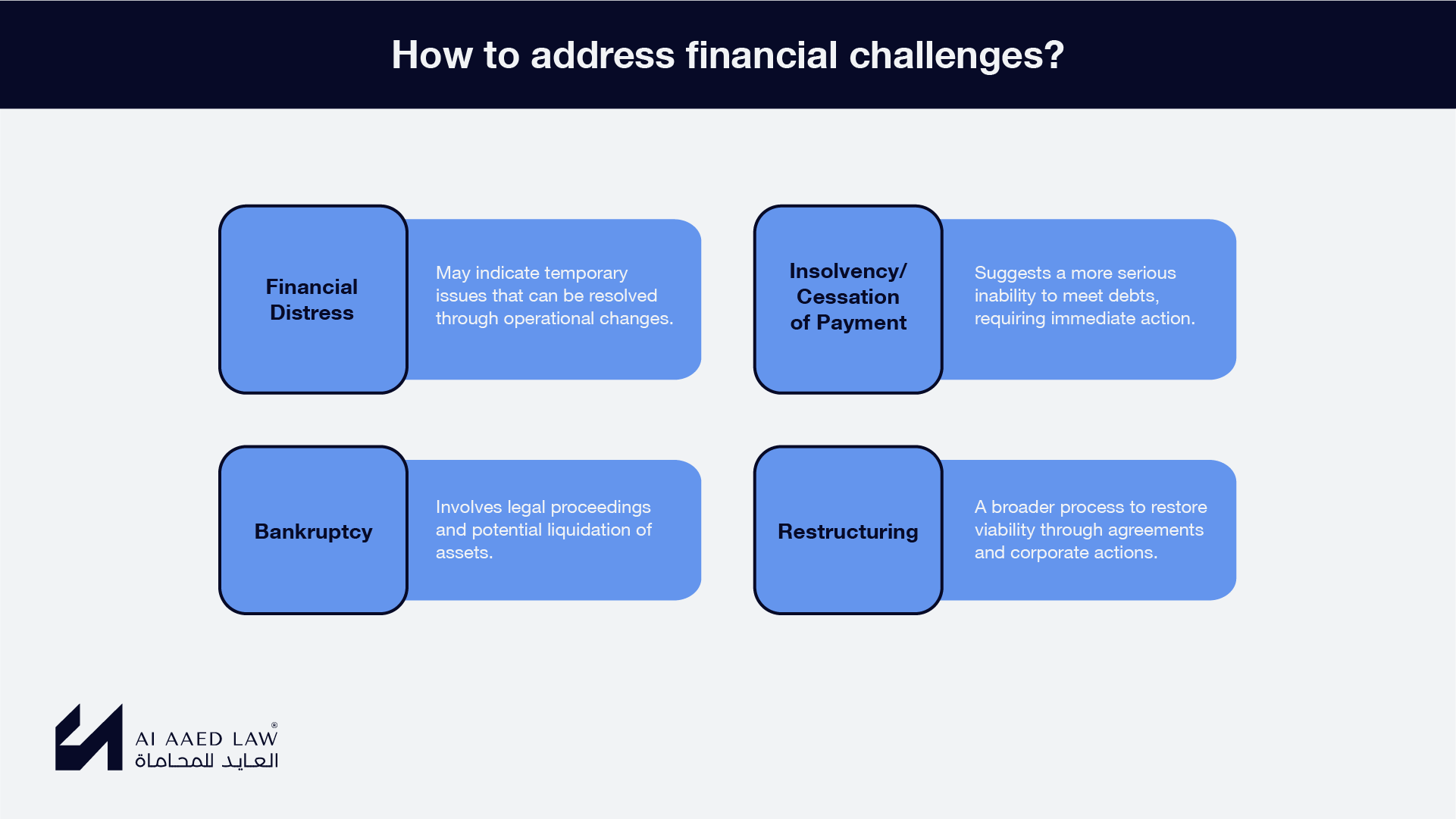
These terms are related but should not be used interchangeably.
Financial distress
Financial distress is a commercial description, not a single statutory test. It may include falling revenue, covenant breaches, overdue payables, loss of credit lines or insufficient cash to fund operations. A distressed business may still be solvent and capable of recovery.
Insolvency and cessation of payment
In ordinary usage, insolvency may describe inability to meet obligations or an excess of liabilities over assets. Syrian bankruptcy law focuses more specifically on the commercial trader's cessation of payment. This is a practical breakdown in the ability to pay commercial debts at maturity and is not identical to a balance-sheet deficit.
A trader may own assets worth more than its liabilities yet still cease payment because those assets cannot generate cash in time. Conversely, a company with balance-sheet weakness may continue paying due debts and may not yet satisfy the bankruptcy test.
Bankruptcy
Bankruptcy is a legal status created by a court judgment. Article 443 addresses a trader who stops paying commercial debts or sustains financial confidence through plainly unlawful means, while Article 444 requires a judgment from the competent civil court of first instance. A missed invoice alone does not automatically create bankruptcy.
Restructuring
Restructuring is the broader process of changing debts, operations, ownership, assets or governance to restore viability or improve creditor recovery. Under the current Syrian framework, it is not a standalone statutory court procedure. It normally occurs through negotiated agreements, corporate actions and, when available, preventive composition.
Who may be subject to commercial bankruptcy?
The bankruptcy framework principally applies to traders. Article 9 includes persons who professionally conduct commercial activity and companies whose objects are commercial. It also subjects civil-purpose companies formed as joint-stock or limited-liability companies to the relevant trader obligations and to preventive-composition and bankruptcy rules.
The classification matters because ordinary civil inability to pay does not automatically follow the same commercial bankruptcy regime. The analysis should confirm:
- The debtor's legal form and registered activities.
- Whether the debtor has trader status.
- The nature and maturity of the relevant debts.
- The location of the principal place of business.
- Whether a sector-specific insolvency or supervisory regime applies.
- Whether partners or guarantors have separate personal liability.
Foreign ownership does not by itself remove a Syrian entity from local insolvency rules. Cross-border assets, creditors or guarantees, however, can create jurisdiction, recognition, sanctions, payment and enforcement issues requiring separate advice.
The three principal response paths
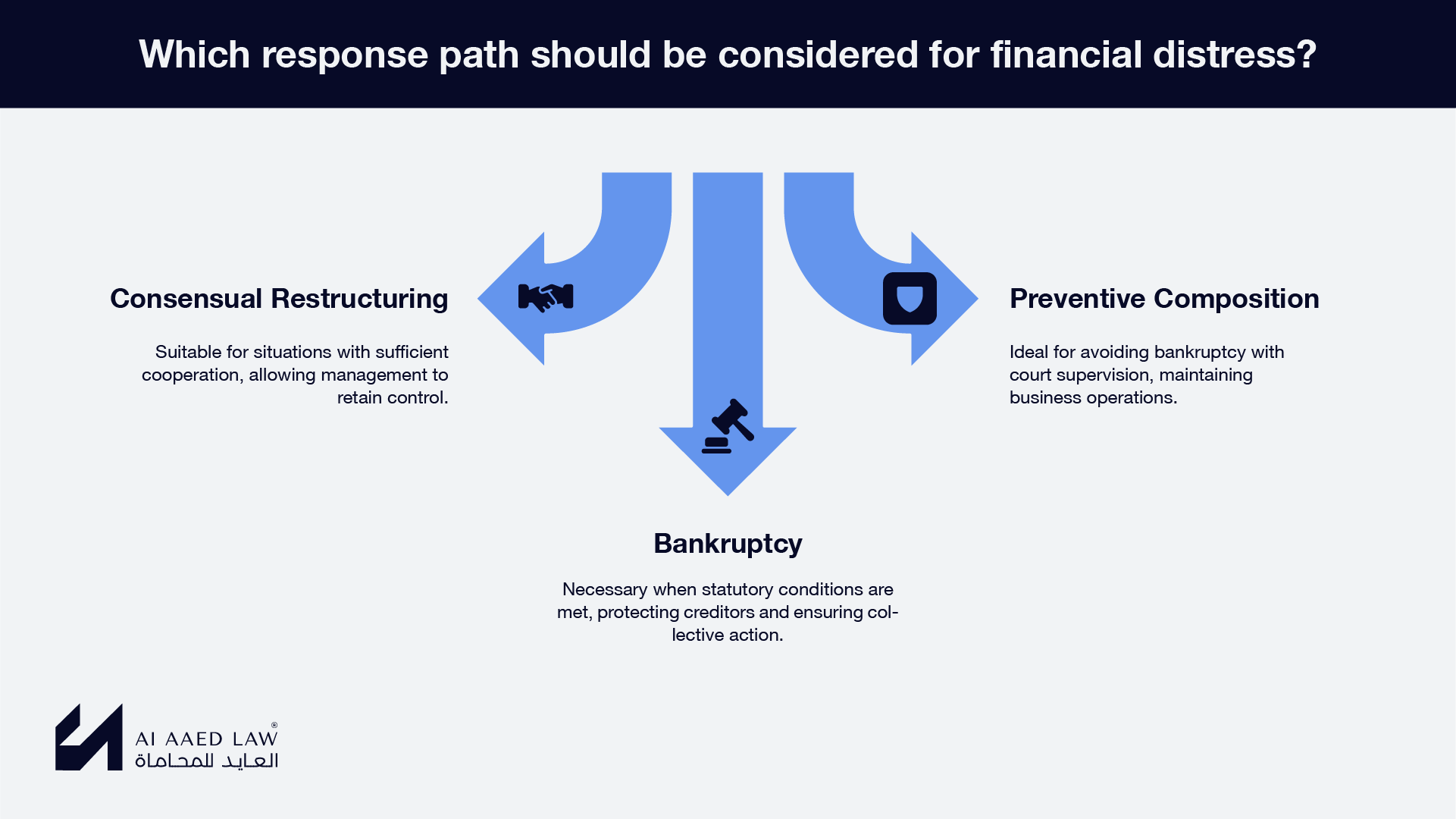
| Path | When it may be considered | Main objective and control |
|---|---|---|
| Consensual restructuring | Before or during distress, while sufficient cooperation remains | The parties negotiate contractually. Management retains control, but there is no automatic statutory stay or power to bind non-consenting creditors. |
| Preventive composition | Before cessation of payment or within the short statutory period after it | A court-supervised compromise seeks to avoid bankruptcy. The debtor continues ordinary business under supervision, subject to creditor approval and court confirmation. |
| Bankruptcy | When the statutory conditions are established and the court declares it | A collective process protects the creditor body. The debtor loses control of estate assets and a bankruptcy trustee administers the process. |
These paths are not interchangeable. Preventive composition has strict timing, documentation and voting requirements. Informal restructuring depends on consent. Bankruptcy creates collective statutory effects that private agreements cannot reproduce.
Early-warning signs that should trigger a legal review
No single indicator proves insolvency. A combination of the following signs should prompt immediate financial and legal assessment:
- Repeated inability to pay wages, taxes, rent, loans or key suppliers on time.
- Use of short-term borrowing to meet ordinary operating expenses.
- Returned cheques, cancelled facilities or demands for cash in advance.
- Enforcement notices, attachments, lawsuits or accelerated loan demands.
- Large receivables that are disputed, overdue or difficult to collect.
- Loss of a major customer, licence, supply source or distribution channel.
- Related-party transfers, unusual asset sales or new security for old debt.
- Incomplete books, unreconciled creditor balances or missing contracts.
- Management disagreement about liquidity or continued trading.
- A business plan that depends on unsupported future funding.
The response should not begin with a generic promise to “pay everyone soon.” Management needs a verified cash position, a creditor map and a legally realistic decision timetable.
Consensual business restructuring before formal proceedings
An out-of-court workout can be faster and less disruptive than formal proceedings, but it succeeds only when the debtor presents reliable information and the principal stakeholders see more value in cooperation than immediate enforcement.
Build a reliable financial and legal diagnosis
The business should prepare a short-term cash-flow forecast, aged receivables and payables, secured-debt schedule, litigation list, asset register, employee liabilities, public dues and a map of guarantees. Figures should reconcile to the accounting records and contracts.
The legal review should identify which creditors hold security, retention-of-title rights, guarantees, set-off rights or enforceable judgments. It should also identify change-of-control, cross-default, termination and acceleration clauses that could be triggered by the restructuring itself.
Select restructuring measures that address the real problem
A viable plan may combine:
- Temporary standstill or agreed suspension of enforcement.
- Extension of maturities or revised instalments.
- Reduction or capitalization of interest, where lawful and agreed.
- New working-capital finance with properly approved security.
- Shareholder funding, debt-to-equity arrangements or capital measures.
- Sale of non-core assets at supportable value.
- Collection, assignment or financing of receivables.
- Operational cost reductions and contract renegotiation.
- Merger, acquisition, investor entry or transfer of a viable business line.
The plan should contain conditions, approvals, milestones, reporting duties, default consequences and a clear closing mechanism. A non-binding term sheet may organize negotiations, but final rights should be recorded in enforceable agreements.
Understand the limits of an informal workout
Private negotiations do not automatically stop lawsuits, attachments or security enforcement. They do not bind an absent or dissenting creditor. A standstill is effective only against the parties that validly agree to it.
New payments, asset transfers and security arrangements must be assessed carefully. If bankruptcy later follows, transactions during the court-determined cessation period may face challenge. The company should avoid hidden preferences, undervalue transfers, unsupported related-party dealings and security granted merely to protect selected insiders.
All corporate approvals and registrations must also be completed. A commercially attractive restructuring can fail if the board, shareholders, lender, regulator or registry approval required for implementation was never obtained.
Preventive composition under Commercial Law No. 33 of 2007
Preventive composition is Syria's principal formal rescue mechanism before bankruptcy. It allows an eligible trader facing payment difficulty to propose a court-supervised compromise to creditors.
Eligibility and the ten-day filing window
Article 413 permits a trader to apply before cessation of payment or within the ten days following it. The application goes to the civil court of first instance in the area of the trader's principal place of business.
This deadline is critical. A business considering preventive composition should not wait until its records, liquidity and creditor relations have collapsed. Whether cessation has legally occurred is fact-sensitive and requires prompt analysis.
Documents and proposal required from the debtor
Article 414 requires substantial disclosure. The filing should include, among other items:
- Evidence of registration in the commercial register.
- Mandatory commercial books kept according to law for at least three years, or since trading began if the period is shorter.
- A detailed statement and valuation of the business.
- A complete list of creditors, amounts and addresses.
- For a company, documents proving its proper establishment.
- The reasons for seeking preventive composition.
- The proposed distribution or an explanation of why it cannot yet be stated.
- The personal or real security offered to creditors.
The statutory minimum proposal depends on the payment period. The published text provides a minimum of 30% of ordinary debts for payment within one year, 50% for eighteen months and 75% for three years. The proposal, classification of claims and security package should be checked directly against the operative text and case facts before filing.
Court review and creditor meeting
The court may reject an incomplete or disqualified application. Article 415 also addresses prior fraudulent conduct, specified convictions, failure under an earlier composition, inadequate security, flight or concealment and dissipation of assets. If the trader has ceased payment, rejection in the statutory circumstances may lead the court to declare bankruptcy.
If the application proceeds, a delegated judge organizes the creditor process and may set the meeting within a maximum of thirty days. A commissioner who is not a creditor monitors the business, verifies assets and liabilities, examines the debtor's conduct and reports to creditors.
Management control during the procedure
Under Article 419, the debtor generally remains in management and continues ordinary business under the commissioner's supervision and the delegated judge's oversight. This is a major difference from bankruptcy, where management of estate assets passes to the trustee.
Continued control is not unrestricted. Extraordinary transactions, dispositions outside the ordinary course and acts that prejudice creditors may be prohibited, require authorization or produce adverse legal consequences. The debtor should establish a controlled approval and reporting process immediately after filing.
Creditor voting and court confirmation
The composition requires approval by a majority of participating creditors representing at least three quarters of the unsecured, non-privileged debt participating in the calculation. Secured and privileged creditors may enter the voting calculation only on the basis and to the extent that they validly surrender security or priority; a partial surrender is subject to the statutory threshold.
After the vote, the court examines the process, objections, legality, required majority, minimum distribution and reliability of performance. Court confirmation gives the arrangement binding legal effect. Ordinary creditors are generally bound by the confirmed composition, while secured rights require separate analysis where they were not waived.
Performance, rescission and annulment
Confirmation does not end compliance risk. Until the debtor performs the agreed obligations, restrictions can apply to sales, mortgages and other dispositions outside ordinary business unless the composition or a court-approved decision permits them.
A creditor may seek rescission if the debtor fails to perform the confirmed obligations. Under Article 440, a creditor may seek annulment and declaration of bankruptcy within three years from publication of the confirmation judgment where the debtor fraudulently overstated debts or concealed a material portion of assets. Transparent disclosure is therefore essential from the first filing.
When may a Syrian court declare bankruptcy?
The substantive test
Article 443 focuses on a trader's cessation of payment of commercial debts and on maintaining financial confidence through plainly unlawful means. Cessation of payment is a broader factual condition than a single late debt. The court assesses whether the debtor's financial position and payment conduct show a genuine breakdown in commercial credit.
A disputed debt, temporary administrative delay or isolated missed payment should not automatically be treated as conclusive. Equally, continued selective payments do not necessarily disprove cessation if the business is sustaining itself through improper or unsustainable means.
Court judgment and jurisdiction
Bankruptcy exists only through a court judgment. Article 444 assigns jurisdiction to the civil court of first instance where the debtor's principal place of business is located. That court also has jurisdiction over disputes arising from the bankruptcy rules.
The judgment identifies the cessation-of-payment date. Under Article 449, the court may not generally move that date back more than eighteen months before the bankruptcy judgment. This date matters because it helps define the period during which prior transactions may be scrutinized.
Evidence and immediate preparation
A debtor or creditor assessing bankruptcy should preserve:
- Contracts, invoices, account statements and payment demands.
- Commercial-register and company documents.
- Audited and management accounts, ledgers and mandatory books.
- Cash-flow forecasts and bank communications.
- Security, guarantee and asset-ownership documents.
- Litigation, execution and attachment records.
- Board and shareholder minutes concerning the crisis.
- Evidence of asset transfers and payments to related parties.
Incomplete records can obstruct restructuring, weaken claims and increase exposure for those responsible for management or accounting.
What are the immediate effects of a bankruptcy judgment?
Loss of control over estate assets
From the judgment, the bankrupt debtor is generally divested of managing and disposing of estate assets. The bankruptcy trustee replaces the debtor in the administration of those assets and in litigation concerning the creditor body. Certain personal rights and legally non-attachable assets remain outside the divestment rules.
This is not simply an internal management change. Transactions attempted by the debtor after divestment may be ineffective against the estate, and counterparties should verify the trustee's authority before dealing with estate property.
Collective treatment of creditors
Article 456 generally stops ordinary creditors and creditors holding a general privilege from pursuing individual actions and enforcement. The trustee represents the collective estate, reducing the risk that the fastest creditor captures value at the expense of others.
Article 457 stops the running of interest on unsecured debts as against the creditor body, subject to the distinctions in the Law for secured claims and the debtor's continuing personal liability. Article 458 accelerates debts owed by the bankrupt debtor, while not automatically accelerating obligations of co-debtors or guarantors.
Security, ownership reservations, set-off and priority claims require individual review. A creditor should not assume either that its security disappears or that it can enforce without regard to the collective process.
Review of suspect-period transactions
Articles 460 to 464 protect the creditor body from certain pre-bankruptcy transactions. Acts after the court-determined cessation date, and in specified cases during the preceding twenty days, may be automatically ineffective or may be challenged.
The categories include gratuitous or prejudicial transfers, payment of debts before maturity, specified non-cash payment methods and new security granted for an existing debt. Other paid transactions and payments after cessation may be challenged where the legal conditions are met. The Law also establishes a short limitation period for particular avoidance actions.
Businesses should not respond to distress by transferring assets to affiliates, repaying insiders first or granting last-minute security without a documented lawful basis and independent review.
How is the bankruptcy estate administered and concluded?
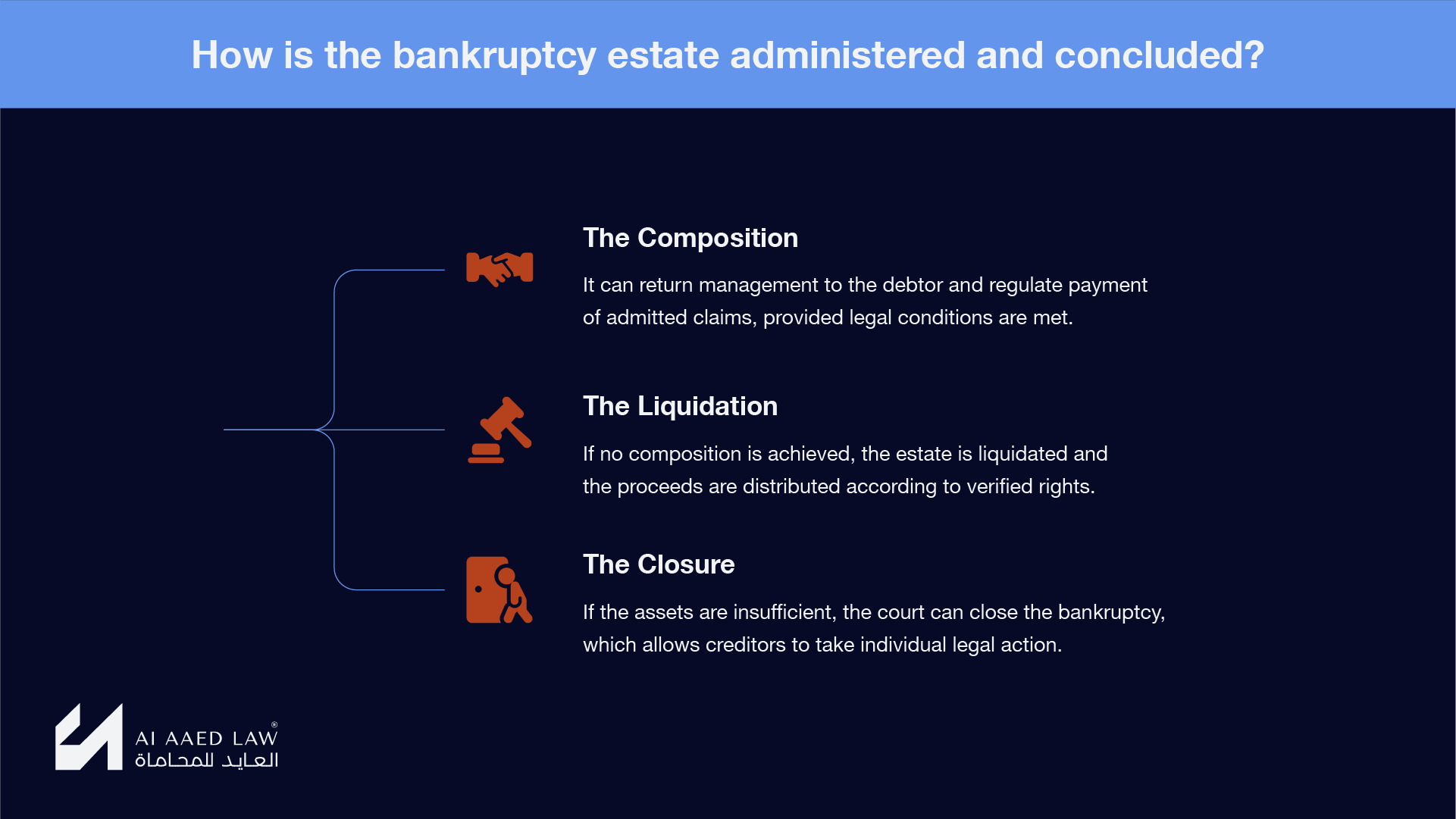
Trustee, verification and supervision
The court appoints one or more bankruptcy trustees and a delegated judge supervises the proceedings. The trustee secures and administers assets, examines records, represents the creditor body and supports verification of claims.
Creditors must present and substantiate their claims through the applicable procedure. A creditor should reconcile principal, interest, security and supporting documents rather than submit an unsupported account balance.
Composition after bankruptcy
Bankruptcy does not always end in immediate liquidation. A simple composition may be agreed between the bankrupt debtor and the creditor body, subject to the statutory majority, the absence of disqualifying fraudulent bankruptcy and court confirmation. Once confirmed, it may return management to the debtor and regulate payment of admitted claims.
The Law also permits a composition involving total or partial surrender of assets. Secured and privileged creditors who have not surrendered their rights require separate treatment.
Union of creditors, sale and insufficient assets
If no composition is achieved, creditors enter a state of union and the estate is liquidated through the statutory process. Assets are sold and proceeds distributed according to verified rights and priorities.
Article 553 permits the court to close the bankruptcy before composition or union where the estate lacks sufficient assets to continue. Such closure can restore creditors' individual right of action, but it does not create assets or guarantee recovery.
The likely outcome should be modelled early. A restructuring proposal is credible only when creditors can compare it with a realistic bankruptcy recovery and timeline.
Special issues for companies, partners and managers
Companies, partners and guarantees
The debtor entity, its partners and its guarantors should not be treated as one legal person. Liability depends on the company form, constitutional documents, guarantees, security and applicable legislation.
In partnerships, partners with unlimited personal liability may face direct exposure. Article 538 addresses compositions involving a partnership and one or more partners. A composition does not automatically erase claims against guarantors or co-debtors; the wording and statutory effect must be reviewed for each party.
Group companies also require separate analysis. Cash pooling, intercompany loans, shared assets and cross-guarantees can create conflicts between different creditor groups. A “group restructuring” should not move value between entities without authority, consideration and creditor-impact analysis.
Conduct and potential manager exposure
Bankruptcy is not itself a crime. However, negligent or fraudulent acts connected with bankruptcy may create civil or criminal exposure. Risk areas include concealment of assets or books, falsified accounts, excessive or sham speculation, prejudicial payment after cessation, failure to maintain required records and conduct designed to delay bankruptcy through damaging transactions.
Managers should respond to distress through documented decisions, accurate records and professional advice. Board minutes should record the financial information considered, conflicts disclosed, alternatives evaluated and reasons why a transaction was believed to protect the company and creditors.
Practical checklist for a financially distressed business
- Prepare a daily thirteen-week cash-flow forecast and update it against actual results.
- Reconcile every material creditor, security, guarantee, judgment and enforcement step.
- Preserve mandatory books, contracts, bank statements, invoices and corporate minutes.
- Identify the first possible cessation-of-payment date and obtain legal advice immediately.
- Stop undocumented related-party transfers, insider repayments and new security arrangements.
- Separate essential operating payments from historic debt and document the rationale.
- Test business viability under realistic revenue, cost and funding assumptions.
- Compare consensual restructuring, preventive composition and bankruptcy outcomes.
- Obtain all board, shareholder, lender, regulatory and registry approvals required for the chosen plan.
- Communicate consistently with employees, creditors and key counterparties without making unsupported promises.
Practical checklist for a creditor
- Confirm the debtor's exact legal identity, trader status and principal place of business.
- Reconcile the debt, maturity, default events, interest and supporting documents.
- Verify security, guarantees, registrations, retention-of-title and set-off rights.
- Check whether enforcement, preventive composition or bankruptcy proceedings already exist.
- Preserve payment demands, acknowledgments, correspondence and evidence of asset transfers.
- Assess whether a coordinated workout offers better recovery than immediate enforcement.
- Require reliable financial disclosure, milestones and reporting before granting time.
- Document any standstill, waiver, amendment or new security with proper authority.
- Monitor suspect transactions and avoid receiving a preference that may later be challenged.
- File and substantiate claims promptly if formal proceedings begin.
A practical decision guide
| Business position | First legal question | Likely focus |
|---|---|---|
| Temporary liquidity gap; core business viable | Can key creditors agree before payment failure deepens? | Consensual standstill, rescheduling, fresh funding and operational measures. |
| Payment failure imminent or very recent | Can Article 413 timing and Article 414 disclosure requirements be satisfied? | Urgent assessment of preventive composition and filing readiness. |
| Commercial debts are no longer being paid and collective risk is increasing | Are the statutory bankruptcy conditions met, and what transactions fall within the potential suspect period? | Court strategy, asset preservation, creditor claims and trustee process. |
| Business is not viable even after debt relief | Can an orderly sale, negotiated exit or formal liquidation preserve more value? | Controlled realization, employee and regulatory obligations, and priority analysis. |
The correct route can change quickly. A business that is suitable for an informal workout today may lose that option after an enforcement event, loss of records or expiry of the preventive-composition filing window.
How can Al AAED Law assist?
Al AAED Law advises distressed businesses, shareholders, investors, lenders, suppliers and other creditors on Syrian insolvency and restructuring matters. Our work may include:
- Assessing cessation-of-payment and bankruptcy exposure.
- Preparing legal and creditor maps for restructuring decisions.
- Negotiating standstills, rescheduling, settlements and security packages.
- Advising on preventive-composition eligibility, filings and creditor approval.
- Representing debtors or creditors in bankruptcy-related proceedings and disputes.
- Reviewing guarantees, security, priorities and suspect transactions.
- Advising boards and managers on governance, records and risk.
- Coordinating corporate, employment, tax, regulatory and asset-transfer workstreams.
Early advice is especially important before a material payment, asset disposal, new security, related-party transaction or decision to stop trading.
Legal notice
This article provides general information on the Syrian legal framework as reviewed on 6 September 2026. It is not legal advice and does not cover every company form, sector, security right, public claim, cross-border issue or factual situation. Laws, procedures and administrative or judicial practice may change. Obtain advice on the current law, the debtor's status and the proposed transaction before acting.
Further Reading
- Restructuring in Syria: A Legal Guide for Businesses and Creditors
- Drafting Commercial Agreements
- Partnership Agreement in Syria
- LLC Formation in Syria: Key Clauses and Legal Requirements
- Anti Money Laundering in Syria: AML Requirements for Businesses
For tailored advice, contact our team or explore all practice areas.
Official source: Central Bank of Syria