Anti money laundering compliance is an important legal consideration for businesses handling financial transactions, investments, real estate, customer funds, and other activities that may create exposure to illicit financial flows.
In Syria, the legal framework addresses both money laundering and terrorist financing and applies to financial institutions as well as certain non-financial businesses and professionals. Companies operating or investing in Syria should understand whether these requirements apply to their activities and what measures they need to implement.
This guide explains Syria's anti money laundering framework, the businesses it covers, key compliance obligations, and practical steps companies can take to reduce regulatory risk.
Summary of key points
| Topic | Key point |
|---|---|
| What Is Anti Money Laundering Under Syrian Law? | Anti money laundering, commonly known as AML, refers to legal and regulatory measures designed to prevent illegally obtained funds from being concealed, transferred, converted, or presented as legitimate assets. |
| Which Businesses Are Subject to AML Requirements in Syria? | AML requirements are particularly important for financial institutions, but the Syrian framework extends beyond banks. |
| What Are the Main Anti Money Laundering Requirements? | AML compliance requires more than responding to transactions that are clearly illegal. |
| What Does Customer Due Diligence Involve? | Customer due diligence is a fundamental part of an effective anti money laundering system because it helps businesses understand who they are dealing with and why transactions are taking place. |
| What Are Common AML Risk Areas for Businesses? | AML exposure varies according to the company's industry, customers, transactions, and business model. |
| How Can Businesses Build an AML Compliance Program? | An effective AML framework should reflect the size, activities, transaction profile, and legal obligations of the business. |
What Is Anti Money Laundering Under Syrian Law?
Anti money laundering, commonly known as AML, refers to legal and regulatory measures designed to prevent illegally obtained funds from being concealed, transferred, converted, or presented as legitimate assets.
Syria's AML framework is principally established under Legislative Decree No. 33 of 2005 concerning the combating of money laundering and terrorist financing, as subsequently amended.
How Syrian Law Addresses Money Laundering
The legislation addresses conduct intended to conceal or alter the identity or origin of funds connected with unlawful activities so that they appear to result from legitimate activities.
This includes conduct involving the concealment, transfer, exchange, acquisition, possession, management, investment, or use of illicit funds in circumstances covered by the legislation.
For businesses, AML controls should form part of wider regulatory compliance in Syria, particularly where significant financial transactions or third-party funds are involved.
Money Laundering and Terrorist Financing
The Syrian framework addresses money laundering together with terrorist financing.
Businesses subject to the rules should therefore consider both the origin of funds and whether transactions or business relationships could potentially involve terrorist financing.
Which Businesses Are Subject to AML Requirements in Syria?
AML requirements are particularly important for financial institutions, but the Syrian framework extends beyond banks.
Companies should assess their activities carefully rather than assuming AML obligations apply only to the traditional financial sector.
Banks and Financial Institutions
Banking and financial institutions registered with the Central Bank of Syria are subject to monitoring requirements designed to prevent their involvement in transactions that could conceal money laundering or terrorist financing. AML compliance is therefore a key consideration within banking and finance law in Syria, particularly when onboarding customers and monitoring financial transactions.
Non-Financial Businesses
The framework also covers specified non-financial businesses and institutions. Depending on their activities, these can include:
- Money exchange and transfer businesses
- Financial intermediaries and investment funds
- Financial leasing businesses
- Insurance companies
- Real estate businesses and brokers
- Dealers in high-value goods
- Certain professional service providers
Businesses entering relevant sectors should consider AML requirements during company formation in Syria and when establishing their ongoing compliance procedures.
What Are the Main Anti Money Laundering Requirements?
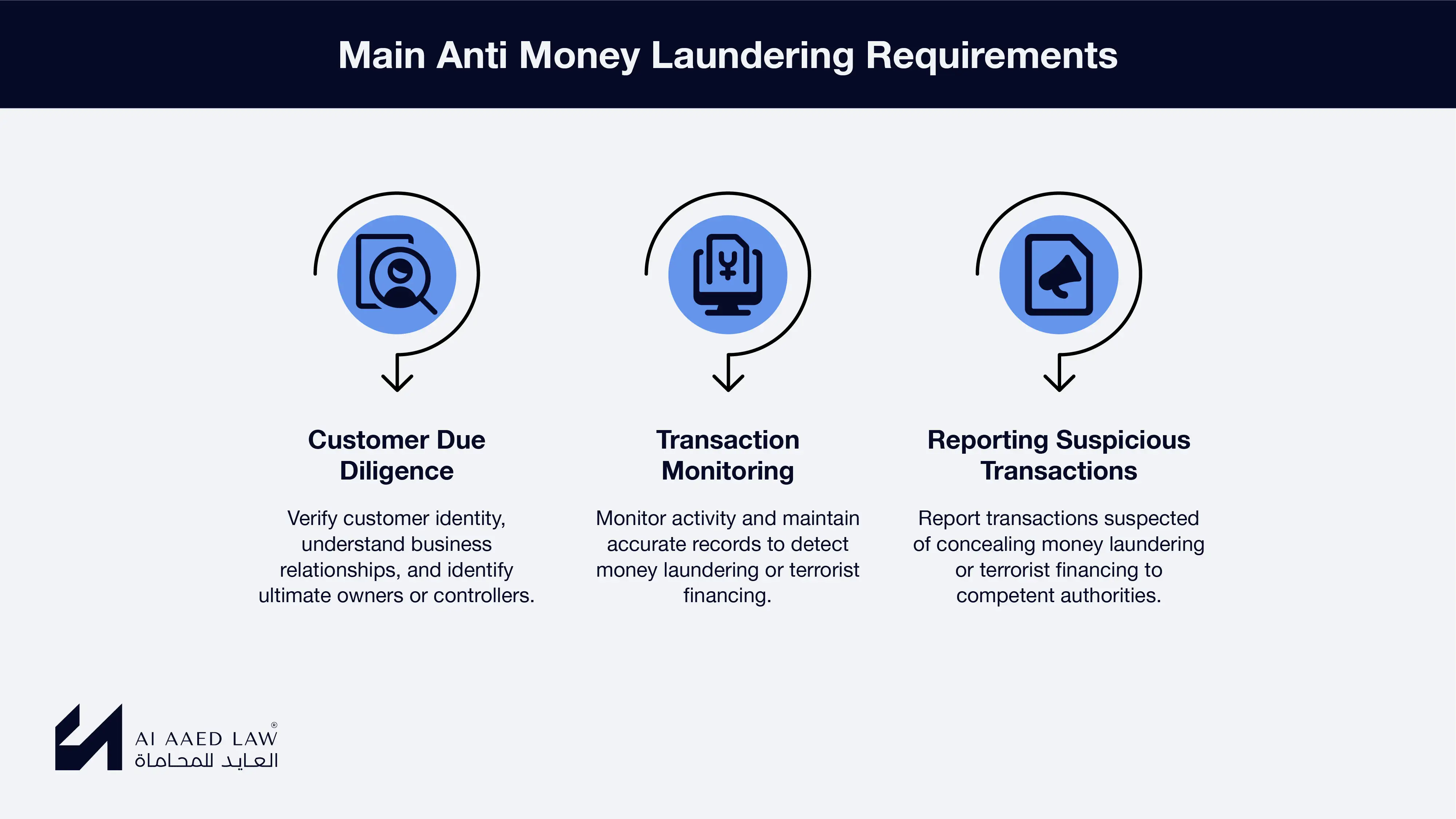
AML compliance requires more than responding to transactions that are clearly illegal. Covered institutions need systems that help them understand customers, monitor transactions, maintain records, and identify suspicious activity.
The precise requirements depend on the institution and its activities.
Customer Identification and Due Diligence
Covered businesses need sufficient information to identify customers and understand relevant business relationships.
Customer due diligence may involve verifying a customer's identity, understanding the purpose of the relationship, and identifying the person who ly owns or controls a legal entity where applicable.
This is particularly relevant during foreign investment in Syria, corporate transactions, real estate deals, and arrangements involving complex ownership structures.
Transaction Monitoring and Record Keeping
Covered institutions may need to maintain transaction records and monitor activity for indications of money laundering or terrorist financing.
Businesses should therefore implement procedures that allow relevant transactions to be reviewed and documented. Accurate records can also help demonstrate compliance if a transaction is later examined by a competent authority.
Reporting Suspicious Transactions
Certain institutions and professionals must report transactions they suspect may conceal money laundering or terrorist financing.
Suspicion does not necessarily require proof that a crime has occurred. Unusual circumstances concerning the source, structure, parties, or purpose of a transaction may justify further review and, where legally required, reporting.
What Does Customer Due Diligence Involve?
Customer due diligence is a fundamental part of an effective anti money laundering system because it helps businesses understand who they are dealing with and why transactions are taking place.
The appropriate level of review depends on the legal requirements and risks associated with the relationship.
Identifying Customers and Ownership
Businesses should obtain and verify the information necessary to establish a customer's identity.
Where the customer is a company or another legal entity, understanding who owns or controls that entity may also be necessary. This can be particularly important during corporate due diligence where ownership is structured through several entities or jurisdictions.
Understanding the Business Relationship
Customer identification should be supported by an understanding of the purpose and expected nature of the relationship.
Unexpected transaction patterns, unusual payment arrangements, unexplained ownership changes, or transactions inconsistent with a customer's known business may require closer review.
What Are Common AML Risk Areas for Businesses?
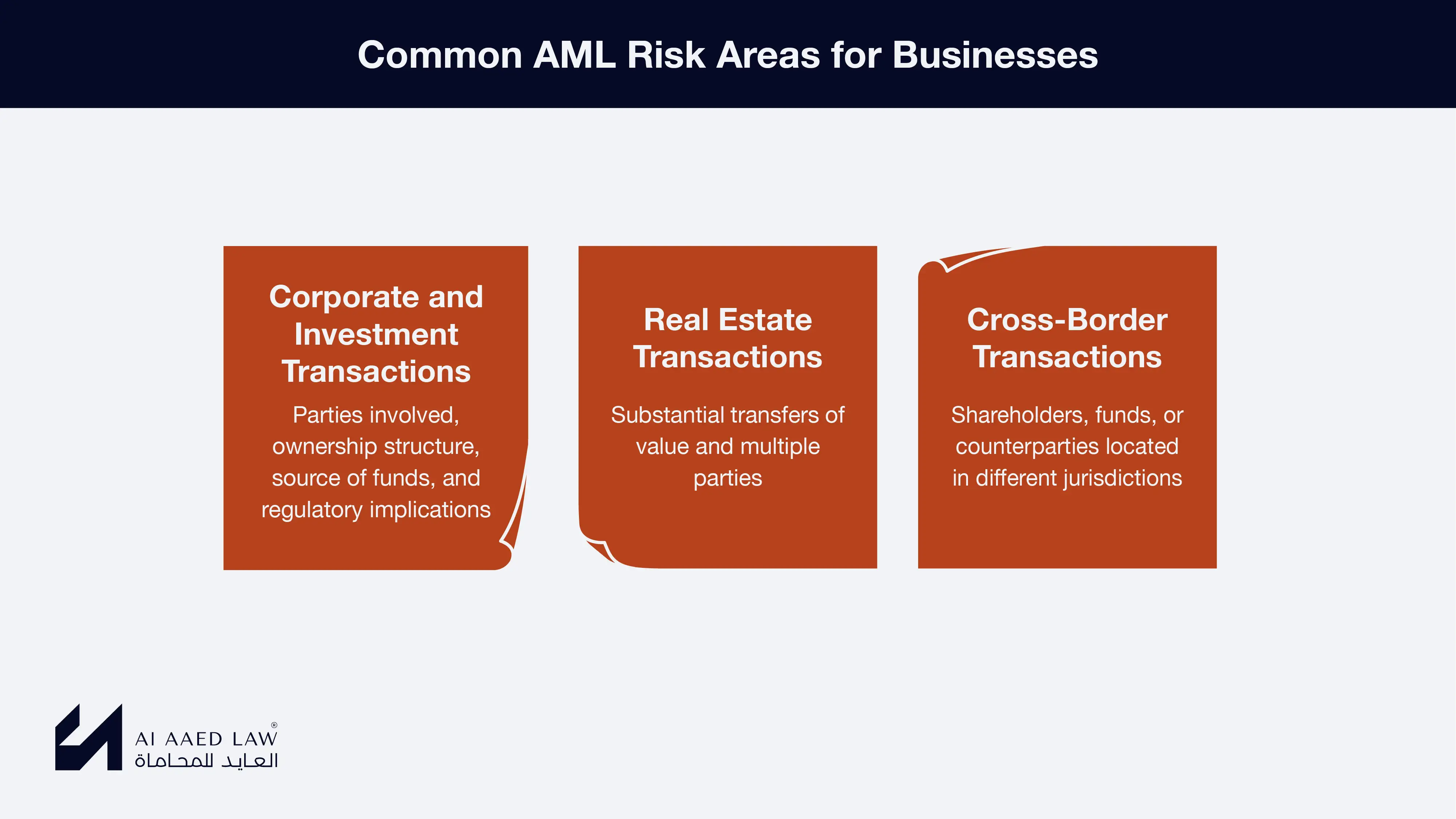
AML exposure varies according to the company's industry, customers, transactions, and business model. Certain circumstances can create greater compliance concerns and justify additional scrutiny.
Companies should identify these risks before entering significant transactions.
Corporate and Investment Transactions
Investments can involve multiple companies, shareholders, intermediaries, and sources of funding.
Effective legal due diligence in Syria should therefore consider the parties involved, ownership structure, source of funds where relevant, and regulatory implications of the transaction.
Complex corporate structures or unexplained third-party payments may require additional review, particularly where several types of companies are used within one ownership chain.
Real Estate and Cross-Border Transactions
Real estate transactions can involve substantial transfers of value and multiple parties. Syrian AML legislation specifically covers certain real estate businesses and brokers.
Cross-border transactions may create additional concerns where shareholders, funds, or counterparties are located in different jurisdictions. Companies involved in foreign investment in Syria should consider AML compliance alongside corporate, banking, and investment requirements.
How Can Businesses Build an AML Compliance Program?
An effective AML framework should reflect the size, activities, transaction profile, and legal obligations of the business.
Companies should establish practical procedures rather than relying solely on general compliance policies.
Establish Clear Internal Procedures
Depending on the applicable obligations, an AML compliance framework may address:
- Customer identification and verification.
- Beneficial ownership information.
- Transaction monitoring.
- Record keeping.
- Identification and escalation of suspicious activity.
- Reporting procedures where required.
- Employee responsibilities and oversight.
These measures can form part of the company's broader corporate governance and compliance framework, alongside well-drafted commercial agreements.
Review Higher-Risk Transactions
Transactions with unusual characteristics may justify additional review. Examples can include unexplained third-party payments, unnecessarily complex ownership structures, transactions inconsistent with the customer's business, or unclear sources or destinations of funds.
Businesses should document how significant compliance concerns are assessed and resolved.
Train Relevant Employees
Employees working in finance, compliance, customer onboarding, legal, sales, or transaction management may encounter AML risks directly.
Relevant employees should understand company procedures, recognize warning signs, and know when a transaction or customer relationship should be escalated for further review.
What Are the Consequences of AML Non-Compliance?
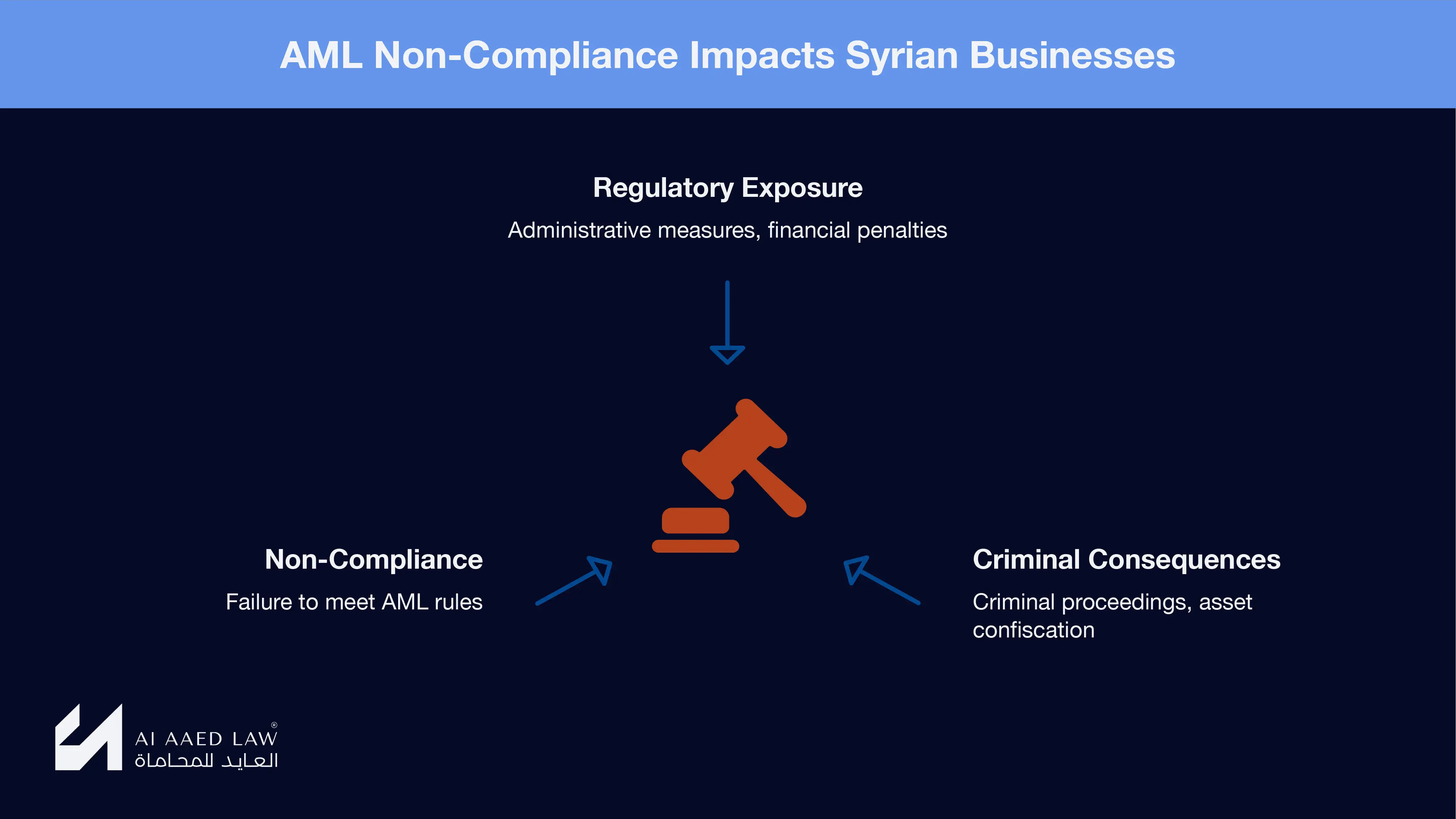
Failure to comply with applicable anti money laundering requirements can expose businesses and individuals to serious legal and regulatory consequences.
The Syrian framework provides for criminal consequences relating to money laundering and terrorist financing as well as administrative measures for violations of compliance obligations.
Regulatory and Financial Exposure
Competent authorities have powers relating to AML supervision and enforcement. Violations can lead to administrative measures, corrective action, and financial penalties where provided by applicable legislation. Businesses should therefore treat AML controls as an ongoing part of regulatory compliance in Syria, rather than a one-time exercise completed when the company begins operating.
Criminal and Asset-Related Consequences
Money laundering offenses can result in criminal proceedings and measures affecting illicit assets.
The legislation provides for confiscation in connection with funds resulting from money laundering and terrorist financing offenses, including certain situations where illicit funds have been converted or mixed with legitimate assets.
Building Anti Money Laundering Compliance Into Business Operations
Anti money laundering compliance should be integrated into how businesses assess customers, structure transactions, maintain records, and manage regulatory risk in Syria.
Banks and financial institutions face particularly significant AML responsibilities, but relevant requirements also extend to businesses in areas such as real estate, insurance, investment, money transfer, and high-value goods.
Companies should identify the rules applicable to their activities and periodically review their compliance procedures as operations develop. Professional legal advice can also help businesses integrate AML requirements into company formation in Syria, transactions, investment structures, and wider regulatory compliance.
Further Reading
- Restructuring in Syria: A Legal Guide for Businesses and Creditors
- LLC Formation in Syria: Key Clauses and Legal Requirements
- Partnership Agreement in Syria: Protecting Partners and Business Relationships
- Investment Law in Syria: What Investors and Companies Need to Know
For tailored advice, contact our team or explore all practice areas.
This article is provided for general information only and does not constitute legal advice. For advice on a specific matter, contact AL AAED Law Firm.
Official source: Syrian Ministry of Justice